


America at Two Hundred and Fifty
Self rule was not a new idea at the formation of the United States, but this experimental form of government had not been attempted successfully previously. It has, and should remain a work in progress. Balance is critical in order to fulfill the rights of all our citizens and residents.
Years ago, I shared a story I ran across researching the influence of the druids in early celtic life. The druids were an essential part of early communities throughout Ireland and Western Europe. Their wisdom and insight were called upon to settle disputes, make alliances, heal the sick and maintain harmony in these pre-Christian communities.
Druids
Leadership was not a birthright, leaders were chosen and followed as long as the good of all was considered. Most scholars agree that the druids were advisors to the leaders rather than leaders themselves.
The history or information of the druids comes from Roman and Greek manuscripts that were translated by early Christian monks in Ireland. That leaves interpretation of those manuscripts biased.
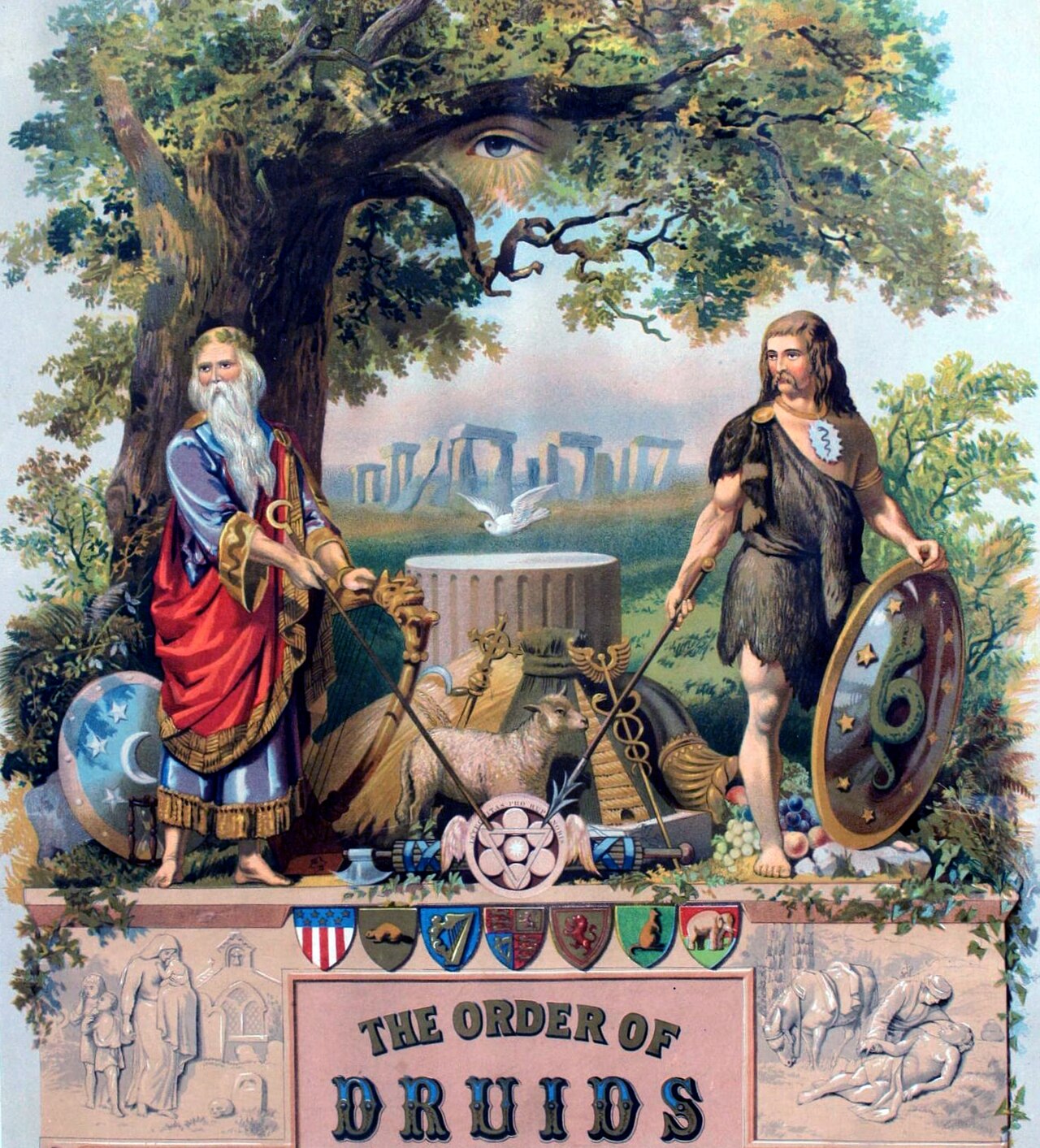
The truth is we know very little of the beliefs or practices of the druids. The druids and Christians did share a space in time until Christianity displaced druid teachings.
A story from the sixth century about a monk named Guénole, later to become a saint, shows that by that time, the druids had all but disappeared. The story concerns the king of Kernev in southwest Brittany. The king, Gradlon is dying and sends for Guénolé.
When the monk arrives, he finds a druid priest there. The king asks the monk not to be harsh with him. He tells Guénolé, the druid knows his suffering, “The ills I have endured are as nothing to the agonies through which he has passed … he has lost his gods! Once he was a druid, now he mourns a dead religion.”
Gradlon dies and both the Christian monk and the druid say their psalms and dirges. In the morning, they wash and prepare the body, washing it in a nearby spring. The druid then asks Guénolé, “to raise a church to the Sorrowful Mother of your God” on the spot, so the sick might find health and “the heavy laden, peace.”
Guénolé felt sympathy for the druid, despite theological disagreements, when the monk offered to teach him “the word of life” and the druid rejected him. His compassion for the druid however, led him to offer him refuge in the Abbey at Landévennec. The druid declined, saying he prefers the woodland paths, “for do not all paths lead to the same great centre.”
George Washington
“Let me now take a more comprehensive view, and warn you in the most solemn manner against the baneful effects of the Spirit of Party, generally.”
“This Spirit, unfortunately, is inseparable from our nature, having its root in the strongest passions of the human mind. It exists under different shapes in all Governments, more or less stifled, controlled, or repressed; but in those of the popular form, it is seen in its greatest rankness, and is truly their worst enemy,”
“The alternate domination of one faction over another, sharpened by the spirit of revenge, natural to party dissension, which in different ages and countries has perpetrated the most horrid enormities, is itself a frightful depotism. The disorders and miseries, which result, gradually incline the minds of men to seek security and repose in the absolute power of an individual; and sooner or later the chief of some prevailing faction, more able or more fortunate than his competitors, turns this disposition to the puposes of his own elevation, on the ruins of Public Liberty.”
“There is an opinion, that parties in free countries are useful checks upon the Adminstration of the Government, and serve to keep alive the spirit of Liberty. This within certain limits is probably true, and in Governments of a Monarchical cast, Patriotism may look with indulgence, if not with favor, upon the spirit of party. But in those of the popular character, in Governments purely elective, it is a spirit not to be encouraged. From their natural tendency, it is certain there will always be enough of that spirit for every salutary purpose, and there being constant danger of excess, the effort ought to be, by force of public opinion, to mitigate and assuage it. A fire not to be quenched; it demands a uniform vigilance to prevent its bursting into a flame, lest, instead of warming, it should consume.”
– Excerpted from George Washington’s Farewell Address, Sept. 19, 1796
Washington warned us, there were many of his supporters that felt he should rule as a king. He led America in its fight against that type of rule, he knew the danger! Stepping down after two terms allowed diversity in policies.
I was very optimistic at America’s bicentennial; maybe I was naive, I was fifty years younger. Our elected officials were building bridges with our allies. The problem of pollution was being attacked head on. Corruption was being fought,
America still had problems, we always will, but most politicians were working for us. Today I no longer feel that those elected to represent us do so. Party over positve accomplishments seems to be the norm.
Lincoln was elected president at one of the worst times in the history of our nation. He knew without the support of his political adversaries, the Union would fall. To that end, he appointed his political critics and opponents as members of his cabinet. Now if one party supports something, the other party is compelled to reject it.
After Lincoln’s death, political rivalry picked up again. Mark Twain commented; “When the doctrine of allegiance to party can utterly up-end a man’s moral constitution and make a temporary fool of him besides, what excuse are you going to offer for preaching it, teaching it, extending it, perpetuating it? Shall you say, the best good of the country demands allegiance to party? Shall you also say it demands that a man kick his truth and conscience into the gutter, and become a mouthing lunatic, besides.”
The druid and the monk, despite their differences, came together for a common goal. Are our differences so great we can’t come together for the greater good of our nation, our children, our planet?
One last thought, from one of my favorite authors, Bram Stoker; “But we are strong, each in our own purpose, and we are all more strong together.”
Happy Fourth!