







When Irish people at the turn of the last century read dispatches from the Ottoman Empire, they did not require a pundit to explain what they were seeing. The confiscation of Armenian lands, the forced marches, the destruction of a people’s claim to their own soil — these were not foreign horrors. They were a grammar that Irish men and women had been made to learn through their own history.
The Cromwellian “transplantation” to Connacht, the coffin ships of the Famine, the evictions and burnings and the long silence of a government in London that chose, deliberately, not to intervene — these were a muted but unmistakable cousin of what was being done to Armenians under the Sultan and Young Turks.
And the calendar, as if to confirm what history had already written, dealt in precise symmetry: April 24 and the year 1918 carry a double weight in the story of nations that refused to disappear. On the night of April 24, 1915, Ottoman authorities arrested and deported hundreds of Armenian intellectuals, clergy, and community leaders from Constantinople — a deliberate act of decapitation designed to leave a people leaderless before the slaughter that followed.
The Easter Rising of April 24, 1916, was Ireland’s answer, written in blood on the streets of Dublin, that some peoples cannot be unmade. Then 1918 brought two things at once: the birth of the First Armenian Republic and the landslide victory of Sinn Féin, the moment when Ireland told Westminster it would not settle for less than independence.
It is little known today, but Armenia appears by name in one of the founding documents of Irish diplomacy. The Official Memorandum presented by Seán T. O’Ceallaigh and George Gavan Duffy to the Paris Peace Conference in 1919 — Ireland’s demand to be recognized as a sovereign nation — invoked Armenian witness to British disgrace, noting that England’s shame was “not less evident to the remote Armenian than to her nearest continental neighbors.” Ireland’s founders saw Armenians watching. A century later, Ireland has earned the standing to do what witness alone never could — to speak, to recognize, and to act.
There is a more ancient bond than shared political tragedy, one carved in stone. Many have heard of the intriguing resemblance between Irish high crosses and the Armenian khachkar — the distinctive cross-stone that has marked Armenian sacred sites for nearly seventeen centuries. What fewer know is that in the ruins of Tigranakert in Artsakh, the ancient Armenian city that Azerbaijan has now swallowed, there exists an early Christian cave sanctuary whose walls are carved with ringed crosses strikingly similar to those that watch over the Emerald Isle.
Both the Armenian Apostolic Church and the Irish Catholic Church have functioned, across centuries of occupation and suppression, as something far greater than religious institutions — they were the vessels in which national identity survived when everything else was stripped away. Under Ottoman rule and Russian domination, it was the Armenian Church that stood between a people and oblivion.
In Ireland, the Catholic Church provided not only consolation but organization: Daniel O’Connell’s Catholic Association was among the first mass Christian Democratic movements in modern Europe. In both cases, forced conversion was weaponized against the people, and in both cases, to no avail.
But if history explains the connection, it is the present that gives it urgency. In the twenty-first century, power is no longer exercised solely through states. It increasingly flows through networks — communities that span continents, shape public opinion, influence policy, and sustain cultural continuity across generations. Few nations understand this better than the Irish and the Armenians.
The Irish diaspora has long been a decisive force in global affairs. Its influence in the United States, in particular, helped shape political outcomes and contributed to the international support that underpinned the Good Friday Agreement. The Armenian diaspora, similarly, has built influential communities across Europe, the Middle East, and the Americas — networks capable of mobilizing resources, shaping narratives, and sustaining national identity across borders.
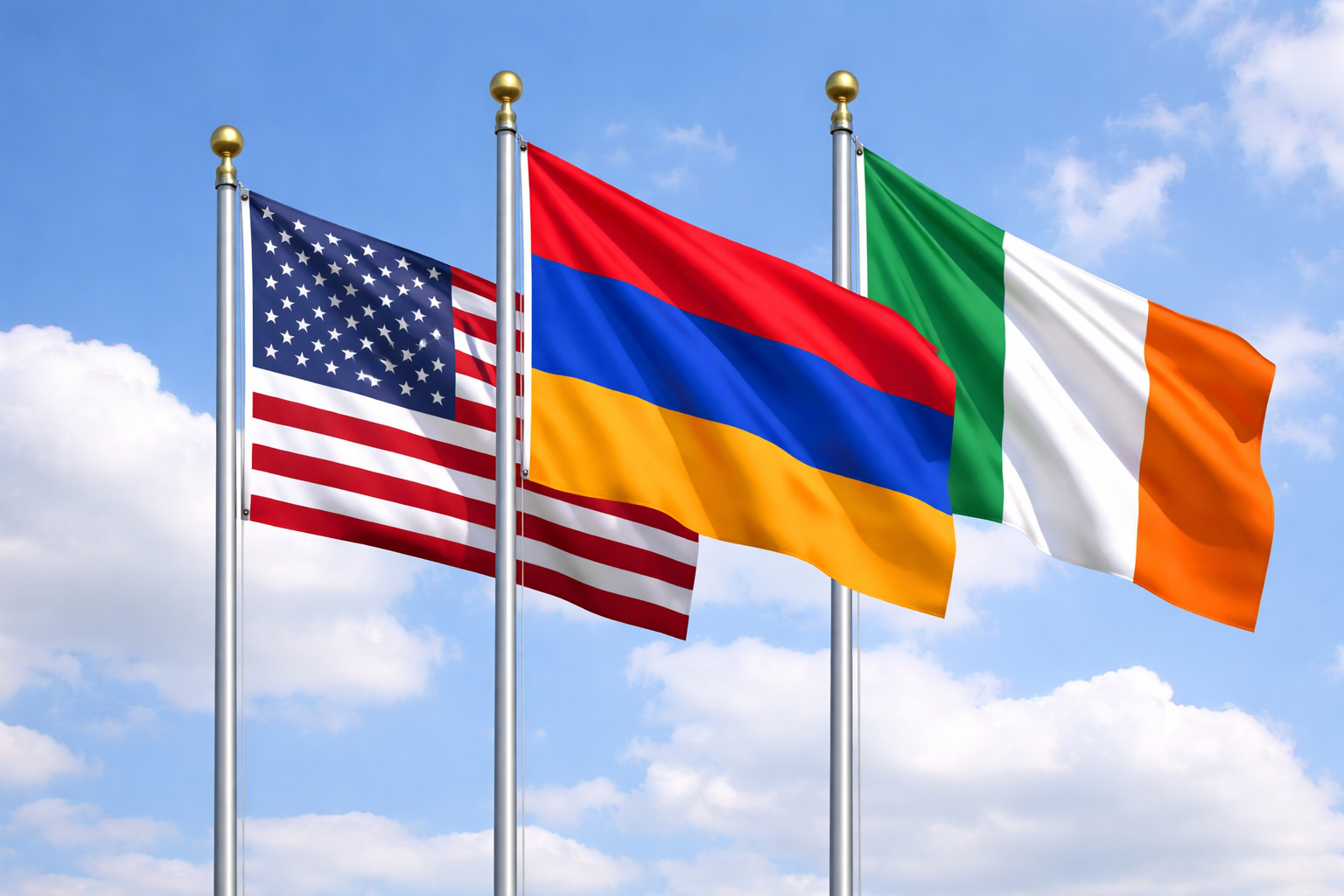
Yet despite these striking parallels, cooperation between these two transnational nations has remained largely undeveloped. This is a missed opportunity.
In different countries, Irish and Armenian communities already exist within the same civic and cultural space. They attend the same universities, participate in the same political debates, and contribute to the same economic and cultural life of their host societies. These overlapping networks operate at the center of influence — in media, academic circles, business, and public policy.
Closer cooperation between these communities would not require the creation of new structures so much as the recognition of an existing reality. It would mean aligning advocacy efforts on issues such as minority protection, historical justice, and international accountability. It would mean recognizing that influence, when exercised collectively across multiple countries, becomes significantly more effective.
There is also a moral dimension that resonates strongly with Irish public consciousness. Ireland’s own historical experience has shaped a foreign policy identity grounded in the defense of human dignity and international law. Irish people have been among the most vocal European nations in condemning the Israeli atrocities in Gaza that followed the ethnic cleansing of Nagorno-Karabakh by Azerbaijan by only weeks.
This perspective carries particular weight precisely because it comes from a nation that understands the consequences of indifference. Nor is Armenia a stranger to this solidarity. In the 1970s, Armenians fighting for Genocide recognition trained and organized alongside Palestinian liberation networks, united by a shared cause: survival against erasure.
At the Camp David Summit in 2000, Yasser Arafat refused to concede the ancient Armenian Quarter of Jerusalem to Israeli administration. Today, the Palestinian Minister of State for Foreign Affairs and Expatriates is Varsen Aghabekian — an Armenian woman, a tireless advocate for Christian and women’s rights in the Middle East.
Armenians, whose history bears the imprint of genocide and displacement, share a similar relationship with memory. For both Irish and Armenians, history is a guide to action.
In an era where traditional alliances often struggle to adapt to shifting realities, transnational nations offer a different model of influence. They are flexible, resilient, and capable of operating simultaneously across multiple political and cultural environments. When such nations find common ground, their cooperation is not limited by geography.
The Irish and the Armenians have spent generations recognizing each other’s suffering. The next step is to recognize each other’s strength.
In the emerging global landscape, where identity, influence, and community increasingly transcend borders, few partnerships make more sense than that between these two peoples. What history began as a shared experience of endurance could yet become something more enduring still — a collaboration between two transnational nations that have learned not only how to survive, but how to shape the world far beyond the lands where their stories began.
Ciara Walsh
Christian activist. Project coordinator at Open Doors International


Really enjoyed this article. I’ve never really seen articles exploring the connections between the Irish and Armenians before. This was a fresh and engaging read. Thanks for posting.