



The Docs
The leaf you reach for after that most annoying Irish country complaint, a nettle sting, is called a dock leaf. It takes the sting out. I know the Saw Doctors’ nickname has nothing to do with those leaves, but the image fits: their enduring gift is turning ordinary rural Irish life into mostly light-hearted anthems that take the sting out of the everyday humdrum.
Ambling Away?
That gift was on my mind when I saw the young and surprisingly popular band Amble, in Cleveland at the end of July. The large bar was packed, standing room only, beers sloshing liberally.
But when their most popular song, “Mary’s Pub,” began, the crowd became one, singing right over the band. Amble seemed genuinely surprised to have their lyrics sung back to them in a city they had never visited. These scenes are direct parallels to a Saw Doctors concert.
Then someone shouted for “The Green and Red of Mayo.” Lead singer Robbie Cunningham politely declined, saying, “Yeah, it’s a good song.”
That moment of interruption and polite decline made me miss my Saw Doctors. It left me wondering if there was a generational shift happening and the Docs were on their slow slide to the musical dust heap. Was a handoff of the torch of Irish cultural troubadours in the making?
Don’t Count The Saw Doctors Out Just Yet
That handoff matters, because the Saw Doctors have spent most of their career being underestimated, the punch line of “what’s playin’ in the tractor?” The music business once suggested they would never be more than local legends. Forty years later, they are still playing to crowds who know every word of their deep catalogue.
So when I scanned the pre-festival hype for the annual outdoor Irish music festival, I looked for them on the list with nerves and my old loyalty. Amble were a headline act, and the Saw Doctors were on the bill too.
I am emotionally attached to the Docs, and I felt a bit of trepidation on their behalf: yes, they are doing limited touring and were last in Cleveland in 2025, but it felt possible that they might be dated or had overextended their shelf life.
But don’t count them out. The band that made the papers after Electric Picnic was the Saw Doctors. They played the instruments for “The Green and Red of Mayo” while the champion Mayo footballers mounted the stage and sang along with the audience. If any of the Saw Doctors were singing, you couldn’t hear them.
Irish Springsteens
How do they still manage to cause so much enthusiasm and loyalty when bands that were once their contemporaries are now relegated to singing their one-hit wonders before shuffling off the stage? The Saw Doctors songs speak to the Irish soul in a Patrick Kavanagh, Bruce Springsteen kind of way. They are the pedestrian poets of everyday, rural, small-town life, and that is why their music keeps finding those rooms full of people ready to sing along.
Their poetry is local and specific. Listen to “Red Cortina.” There is certainly some Springsteen in the wistful depiction of unrequited first love: a girl, emerging from a car with no thought but going to school, totally unaware of how she affected a boy. The towns in “Never Mind the Strangers” and “Sugar Town” may have passed a mythical prime, but the days they describe are so real you can taste the tea.
The songs also move into rural work, sports and the little rituals of small-town Irish life. “Hay Wrap” is a a punny rap on the excitement of hay making as a kid. That song generated one of my all-time favorite T-shirt lines: “get that wasp off my sandwich.”
“The F.C.A.” explains why the average Irish lad might join the Irish Army, nicknamed the “Free Clothes Association”. Other songs capture the epic importance of local sports, especially football in the West. “ Broke My Heart” is all about the frustration of knowing you could save the day if only somebody would pass you the damn ball. The wistful “To Win Just Once” is relatable to every Cleveland resident, and it is soo much more.
Irish Anthems
Their best-known songs turn those specific, idiosyncratic details into relatable anthems. “N17” was the first, capturing all the angst of late-1980s emigration. It begins with the drive to Shannon from the West and ends with the fear that you can never go home again.
In concert, the band is drowned out by the audience singing that song back to them. It is the same with “Green and Red of Mayo,” a triptych of Mayo that takes in everything from Clew Bay to the last Sunday in July, when pilgrims climb the Reek. “Joyce Country Céili Band” manages to parody a country band while getting the audience out of their seats with the same country music.
The Genuine Article
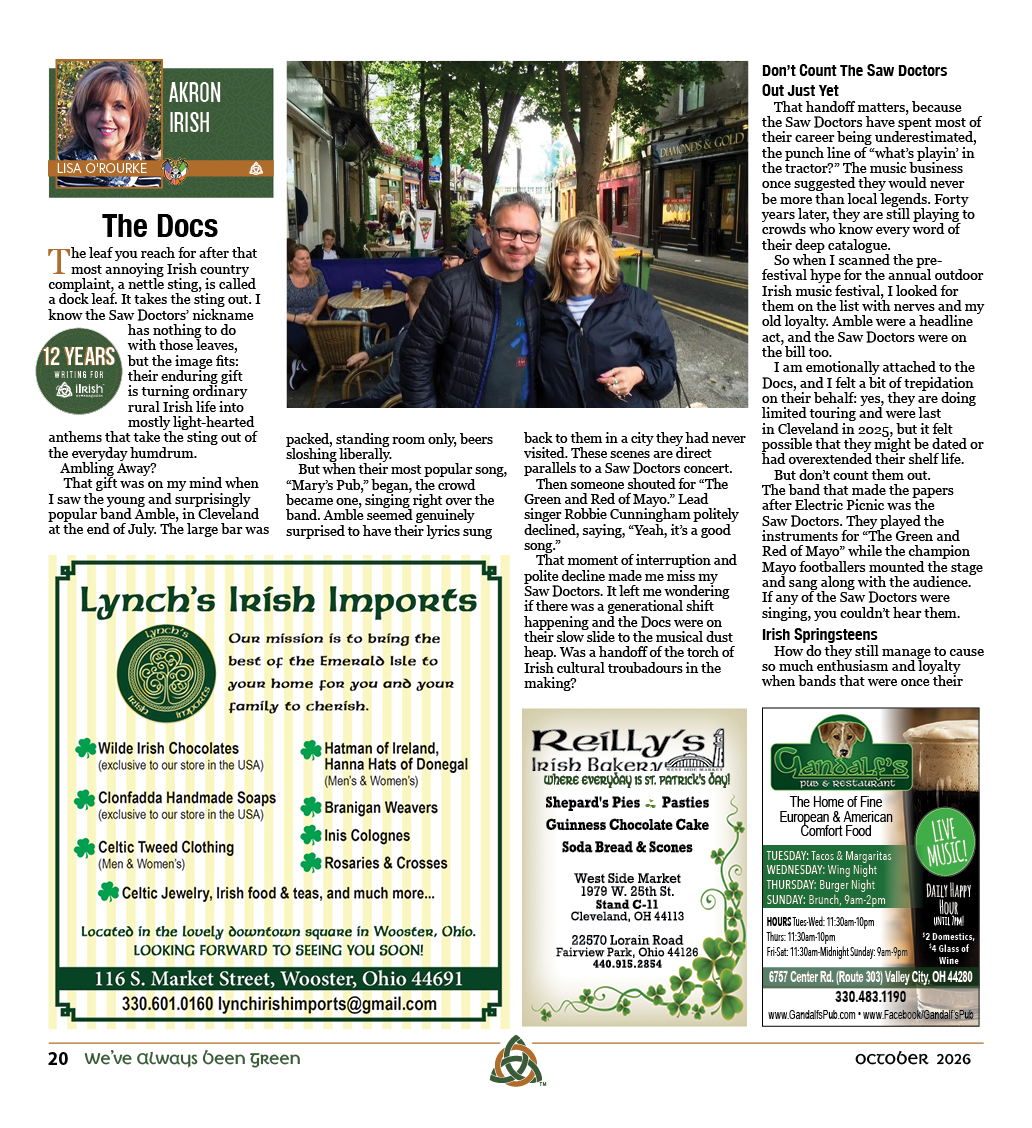
We have met them casually a few times, and they are exactly who you think they are. Davy is a great man to meet out, quick with stories, smokes, and rounds. Leo is a little more unpredictable, a warm curmudgeon. He has been “small-town sweet” talking about a mutual acquaintance’s Granny.
Another time, in Neachtain’s, he was clearly looking to have a quiet pint when we said hello, but his curiosity got the better of him, and we ended up in a long chat about the state of the Irish language. We had to fight our way out of the conversation to get to the door.
The following summer, I saw him at Neachtain’s again. I said hello and reminded him that we had talked there previously. His reply was, “Oh, I suppose you think I’m sitting in here drinking all the time.”
Then he posed for a photo with me. I can’t think about it and not laugh.
That warmth is what really makes them special. Their songs radiate friendship: a universal kindness, a “look, here we all are” kind of vibe. You walk out of their concerts smiling, looking at those around you with the camaraderie that comes from all having been at a small-town gig with the local lads. And it’s a party.
That is why the dock leaf image fits after all. The Saw Doctors take the sting out not by going away from ordinary life but by highlighting how worthwhile that life is. Their songs are all about friendship, place, and belonging.
You leave a Saw Doctors concert smiling at strangers because for a few hours, no one is a stranger. And, of course, there’s the party.