


Knowing Ourselves
I have two friends named Sheila, one my dearest friend of many years, Sheila Haney Drain, and the other a new friend, the erudite Sheila Ives. Both are reading Fintan O’Toole’s We Don’t Know Ourselves and recommended it to me.
Turns out I have two hardback copies. I had given one to my mother to read.
I had the good fortune of meeting Fintan O’Toole briefly after he interviewed Gerry Hynes, director of the Druid Theater Company, during the Galway Theater Festival (he and Gerry were more impressed that I was related to Amelia Colleran, known for upscale food in Galway).
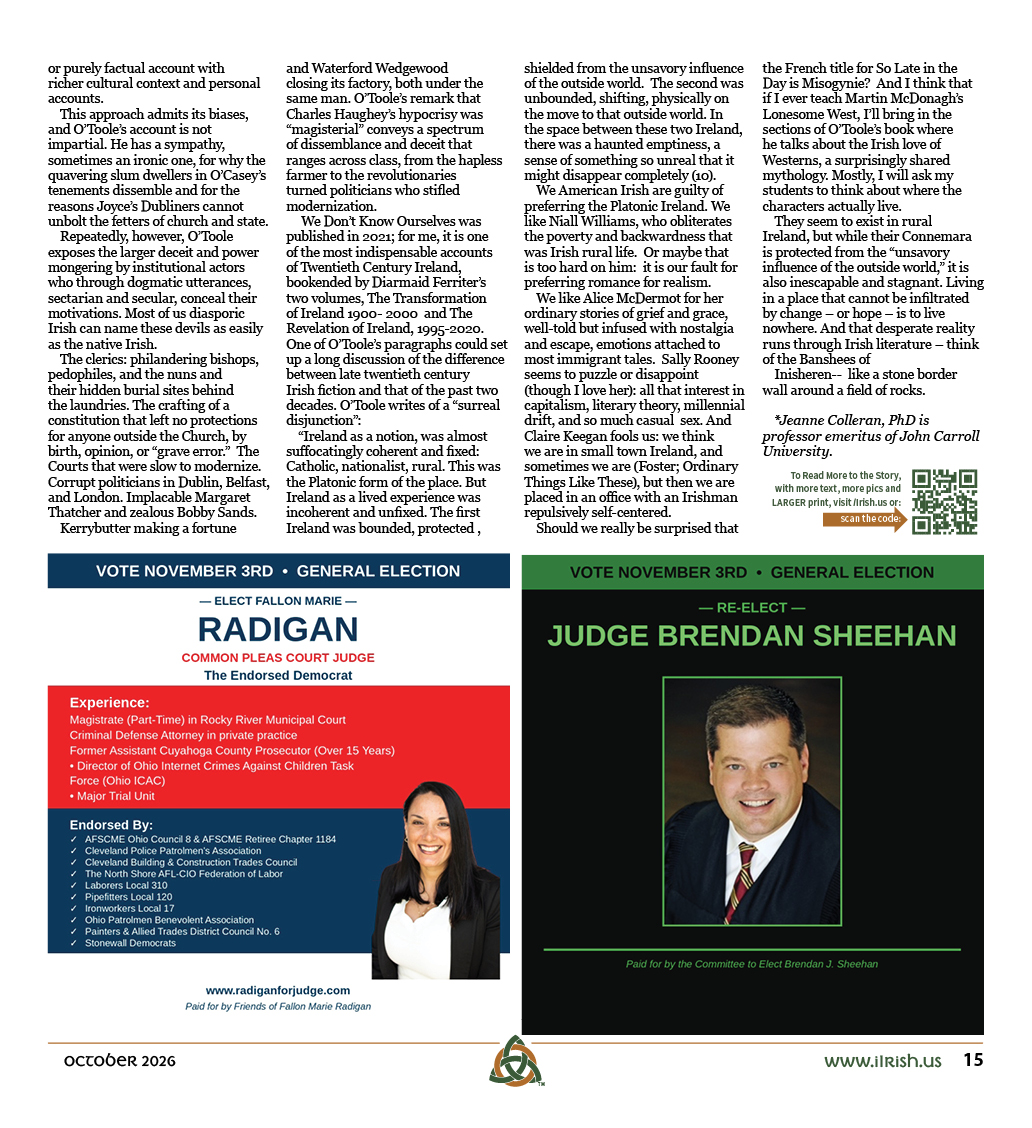
Like so many others, I try to read an article by Fintan O’Toole whenever one appears. But who can keep up? I discovered him when he wrote mostly about drama; now he writes as a public intellectual – one of the top 300 in Britian according to the Observer—and he has acknowledged that he has “very few unpublished thoughts.”
O’Toole is a great exploder of Irish secrets. He reads the history and culture of Ireland as one of concealment, avoidance, and indirection. While the Irish are heralded for their charm in speaking, the origin of this national characteristic is likely rooted in secretiveness as a survival tactic.
Colonial pressure, clerical imposition, legal conservatism, social disapproval: all of these factors shaped the great ‘northern reticence,” as Seamus Heaney termed it, and its Republican counterpart. O’Toole writes to unburden his homeland of its secrets, whether it wants to or not.

Fintan O’Toole, who was born in 1958 in Crumlin, a working-class area near Dublin, saw that he could chart the emergence of modern Ireland from the inside, continuous with his own life. He happened upon a narrative strategy that weaves personal memory with historical account and social commentary. Each chapter hooks onto a distinct moment or event, and with journalistic doggedness, O’Toole contextualizes that history as first colonial and then global.
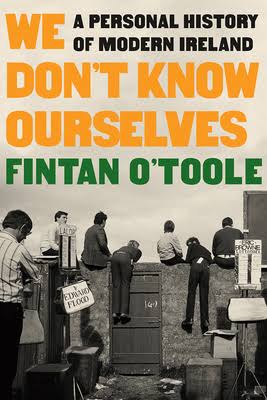
I found myself dipping back into chapters I had already read to understand events I thought I had known well. Many had particular resonance for one of my own family’s memories as it will for anyone whose family emigrated from 1925 on.
The description of the bombing of Nelson’s Pillar drove me to find an old picture of my grandfather, James Colleran, taken just a few years before at the bottom of the pillar. I gave We Don’t Know Ourselves to my mother because her life, like those of my grandparents, intersected with the events O’Toole examines – or more accurately—exhumes.
Just as much as literary critical essays assist students’ approach to Irish literature (I recommend the Field Day’s Nationalism, Colonialism and Literature), We Don’t Know Ourselves contextualizes Irish history while animating it. O’Toole offers what the cultural anthropologist Clifford Geertz called a “thick history,” an account that supplements a “thin” or purely factual account with richer cultural context and personal accounts.
This approach admits its biases, and O’Toole’s account is not impartial. He has a sympathy, sometimes an ironic one, for why the quavering slum dwellers in O’Casey’s tenements dissemble and for the reasons Joyce’s Dubliners cannot unbolt the fetters of church and state.
Repeatedly, however, O’Toole exposes the larger deceit and power mongering by institutional actors who through dogmatic utterances, sectarian and secular, conceal their motivations. Most of us diasporic Irish can name these devils as easily as the native Irish.The clerics: philandering bishops, pedophiles, and the nuns and their hidden burial sites behind the laundries. The crafting of a constitution that left no protections for anyone outside the Church, by birth, opinion, or “grave error.” The Courts that were slow to modernize. Corrupt politicians in Dublin, Belfast, and London. Implacable Margaret Thatcher and zealous Bobby Sands.
Kerrybutter making a fortune and Waterford Wedgewood closing its factory, both under the same man. O’Toole’s remark that Charles Haughey’s hypocrisy was “magisterial” conveys a spectrum of dissemblance and deceit that ranges across class, from the hapless farmer to the revolutionaries turned politicians who stifled modernization.
We Don’t Know Ourselves was published in 2021; for me, it is one of the most indispensable accounts of Twentieth Century Ireland, bookended by Diarmaid Ferriter’s two volumes, The Transformation of Ireland 1900- 2000 and The Revelation of Ireland, 1995-2020. One of O’Toole’s paragraphs could set up a long discussion of the difference between late twentieth century Irish fiction and that of the past two decades. O’Toole writes of a “surreal disjunction”:
“Ireland as a notion, was almost suffocatingly coherent and fixed: Catholic, nationalist, rural. This was the Platonic form of the place. But Ireland as a lived experience was incoherent and unfixed. The first Ireland was bounded, protected , shielded from the unsavory influence of the outside world. The second was unbounded, shifting, physically on the move to that outside world. In the space between these two Ireland, there was a haunted emptiness, a sense of something so unreal that it might disappear completely (10).
We American Irish are guilty of preferring the Platonic Ireland. We like Niall Williams, who obliterates the poverty and backwardness that was Irish rural life. Or maybe that is too hard on him: it is our fault for preferring romance for realism.
We like Alice McDermot for her ordinary stories of grief and grace, well-told but infused with nostalgia and escape, emotions attached to most immigrant tales. Sally Rooney seems to puzzle or disappoint (though I love her): all that interest in capitalism, literary theory, millennial drift, and so much casual sex. And Claire Keegan fools us: we think we are in small town Ireland, and sometimes we are (Foster; Ordinary Things Like These), but then we are placed in an office with an Irishman repulsively self-centered.
Should we really be surprised that the French title for So Late in the Day is Misogynie? And I think that if I ever teach Martin McDonagh’s Lonesome West, I’ll bring in the sections of O’Toole’s book where he talks about the Irish love of Westerns, a surprisingly shared mythology. Mostly, I will ask my students to think about where the characters actually live.
They seem to exist in rural Ireland, but while their Connemara is protected from the “unsavory influence of the outside world,” it is also inescapable and stagnant. Living in a place that cannot be infiltrated by change – or hope – is to live nowhere. And that desperate reality runs through Irish literature – think of the Banshees of Inisheren– like a stone border wall around a field of rocks.