


Taxation Without Representation
“Taxation without representation.” Few phrases in history have carried more force.
Most Americans connect those words to the years before the Revolution, to Boston, to protests in the streets, to a growing belief that ordinary people were being governed from too far away by people who neither understood them nor answered to them.
But long before those words were spoken in America, Irish families already understood the feeling behind them. For generations, much of Ireland lived under systems shaped elsewhere and controlled from afar. Rents rose. Tithes were collected. Decisions affecting daily life were often made by people far removed from the families forced to live with the consequences.
The issue was not simply taxation. It was distance. Distance between those making decisions and those expected to carry them; distance between ordinary people and any meaningful voice in the direction of their own lives.
And perhaps that is one reason why so many Irish, especially the Scots Irish who would later settle across the American colonies, felt something familiar stirring when resistance began to grow in the New World. They recognized the feeling before the slogan was ever written down.
The Boston Tea Party
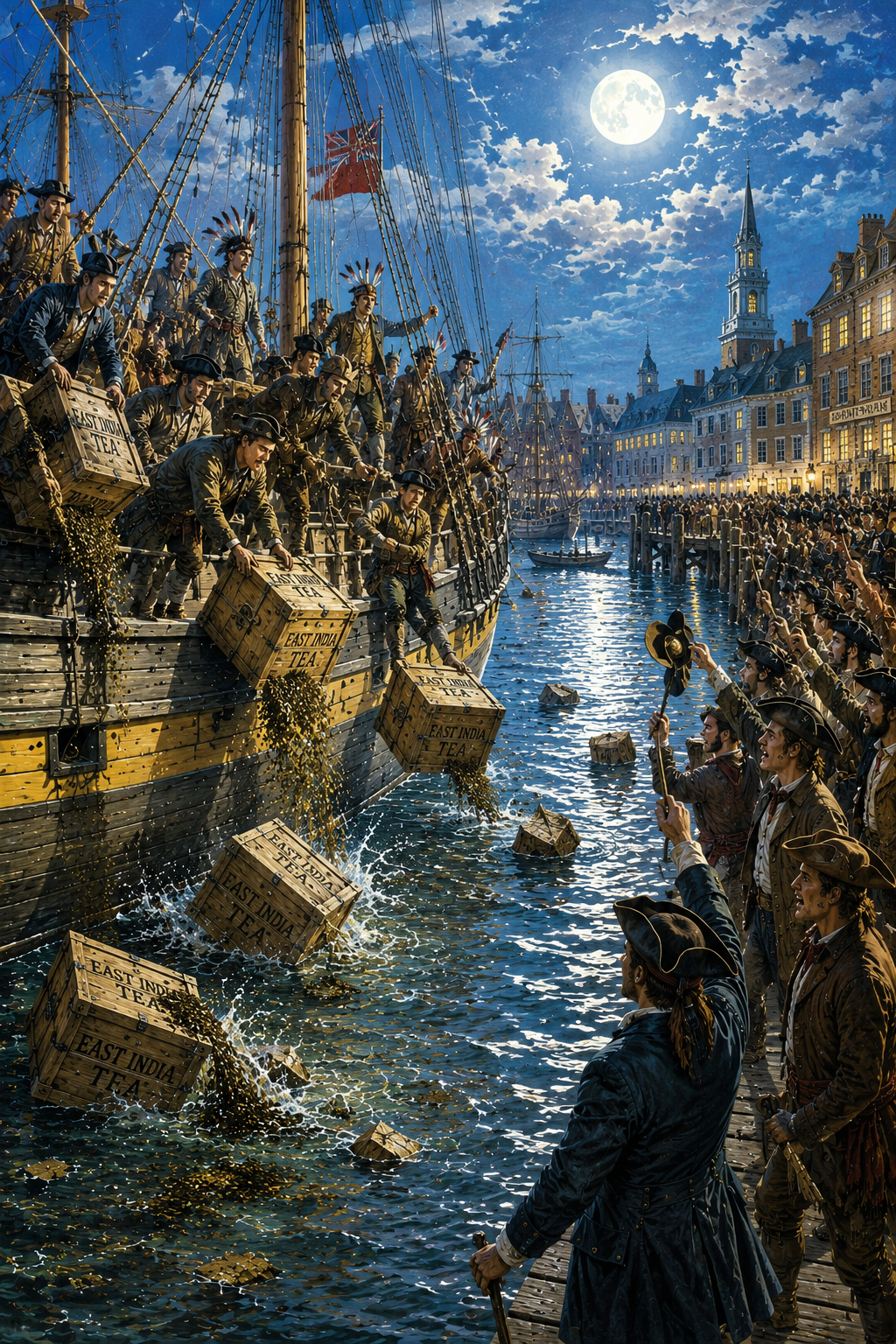
The Boston Tea Party took place on December 16, 1773. By that time, Irish immigrants were already part of life across the American colonies.
Many had come from Ulster in earlier decades, often referred to later as Scots Irish, and had settled in large numbers along the frontier. Others arrived from different parts of Ireland, including Catholic families, who tended to settle more often in growing port cities, such as Boston, New York, and Philadelphia.
Exact numbers are difficult to pin down; records were incomplete, and distinctions were not always carefully kept. But what is clear is that Irish-born and Irish-descended people, of different regions and traditions, were present throughout the colonies in meaningful numbers.
Their circumstances varied. Some prospered. Many did not.
Some worked small farms on the frontier. Others labored in trades, on docks, or in the early cities. Many carried with them memories, either personal or inherited, of rents, religious tension, and systems shaped far from the people expected to live under them. And so, as resistance to British taxation began to grow, many Irish colonists saw something familiar in it.
There is no reliable list showing exactly who took part in the Boston Tea Party itself. The protestors were disguised, names were concealed, and records were intentionally sparse. But given the presence of Irish people in Boston and throughout the colonies, it is reasonable to believe that they were among those who watched, supported, and ultimately joined in.
More importantly, Irish participation in the broader Revolutionary cause became unmistakable in the years that followed. They served in militias, fought in the Continental Army, settled the frontier, helped carry the Revolution beyond Boston Harbor, and into the growing American nation.
For many of them, the argument was not only about tea. It was about voice. And whether ordinary people would have any meaningful say in the systems that governed their lives.
When the Revolution finally came, Irish hands were already part of it. We know how the story turned out.
George Washington and his men endured hard-fought battles, death, disease, cold winters, and terrible hunger.
And against all odds, they defeated the British, the mightiest military on earth.
The Revolution was won. And a nation was born, conceived in liberty and forged by their courage. The people of this vast land began to understand the new nation’s destiny to become known as the land of the free, and the home of the brave.
Fast Forward 250 Years
Where do Irish Americans, and really, ordinary Americans of every background, find themselves now? Many families today feel the strain of rising costs and rising taxes, especially property taxes.
At the same time, they are trying to make sense of taxation systems that have grown larger, more complex, and increasingly difficult to follow. It is not always clear where the money is going; it is not always clear how priorities are set; and it is not always clear how decisions are made, even when those decisions affect the daily lives of families, homeowners, and taxpayers.
For most people, the financial reports are very difficult to read. The terminology is unfamiliar.
The explanations provided in the newspaper, when they come, can feel distant, confusing, incomplete, or buried in language that ordinary citizens do not use. Even those who want to stay informed struggle to understand what is really taking place.
And this is not limited to one level of government. It is no national secret that few people truly understand the spending in Washington. But the distance can also be felt at the state level, at the county level, and even within our cities and school districts. It is not an exaggeration to say that, for many, the connection between the taxes they pay, what exactly they are paying for, and the outcomes they experience is no longer clearly understood.
And perhaps most frustrating of all is the growing sense that no matter who gets elected, little really changes. Promises are made. Slogans are repeated and cheered for. But the spending continues upward, and the understanding of why, or for what, grows harder to follow.
That feeling, whether fully fair or not, creates something dangerous in a free society: A loss of trust.
Not because people have no vote. They do. But because many no longer believe their voice truly matters once the election is over.
And when enough people begin to feel that way, apathy follows close behind. A sound system of taxation supports strong, effective, and sustainable public institutions without breaking the backs or the trust of the people who fund them.
Right now, that ideal feels miles away. So, what are we to do?
The answer is probably not another Boston Tea Party. America does not need more outrage nearly as much as it needs more seriousness, from both citizens and those who serve them.
Perhaps the older lesson still holds: self-government only works when ordinary people stay informed, stay involved, and expect honesty, discipline, and accountability from those they choose to represent them. That responsibility belongs to voters, too.
Because in the end, the challenge before us is not to relive the past, but to meet it in our own time, to close the growing distance between those who collect taxes, those who decide how money is spent, and those who are meant to be served. Our future depends on it. And maybe that is the enduring thread connecting Ireland, the Revolution, and America today: the belief that ordinary people, and their voices, still matter.