



The Day at the Fair
My father never spoke of it. He is one of the quiet Irish. What I have are fragments gathered over recent years: two cows, sticks cut the night before, the road to Bangor.
My grandfather took that trip, and his grandfathers before him. The fair in Bangor was the money: the shop debt, the children’s shoes, the winter.
And it was twelve miles of dirt roads and two river crossings away. There was only one way to get two cows to Bangor, and that was to walk.
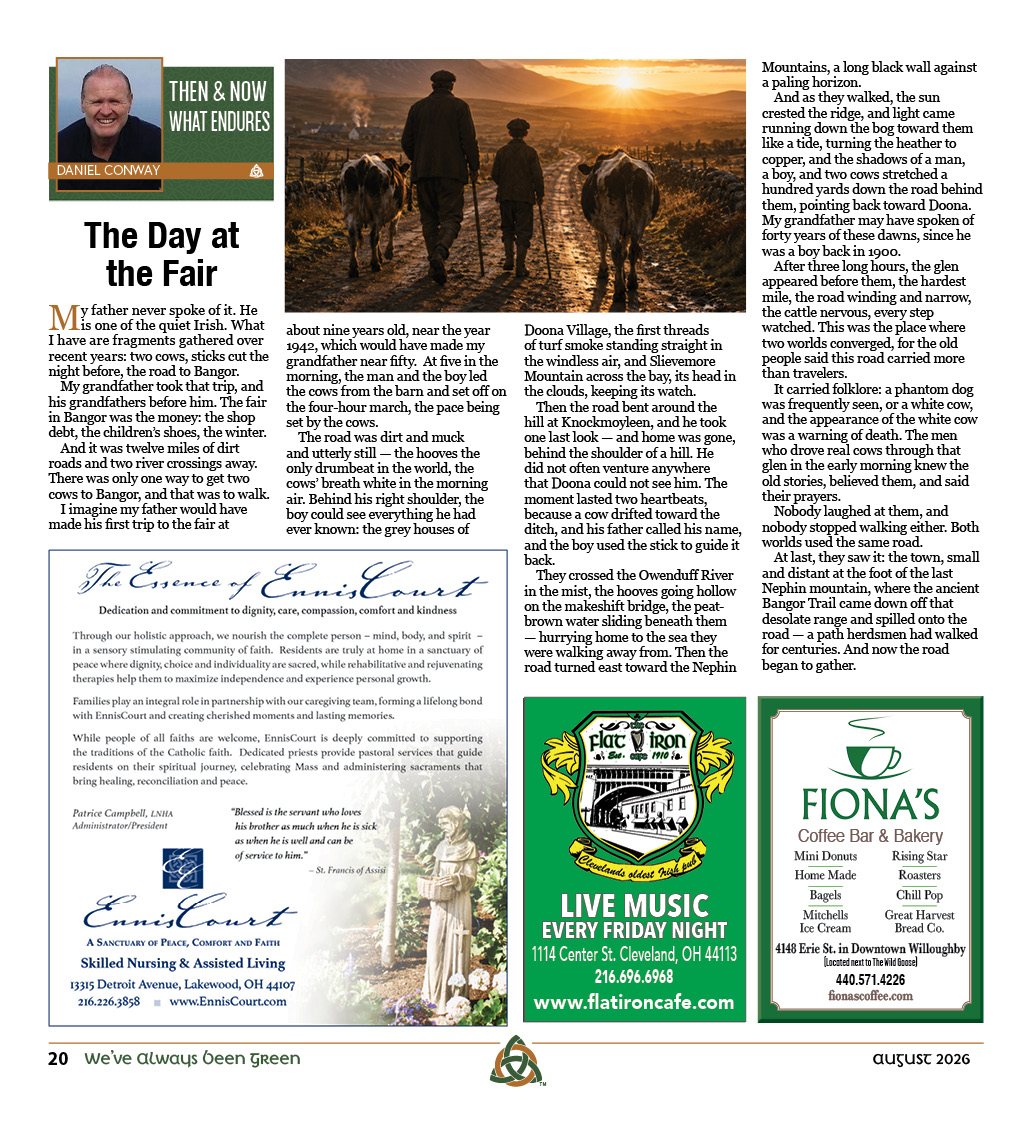
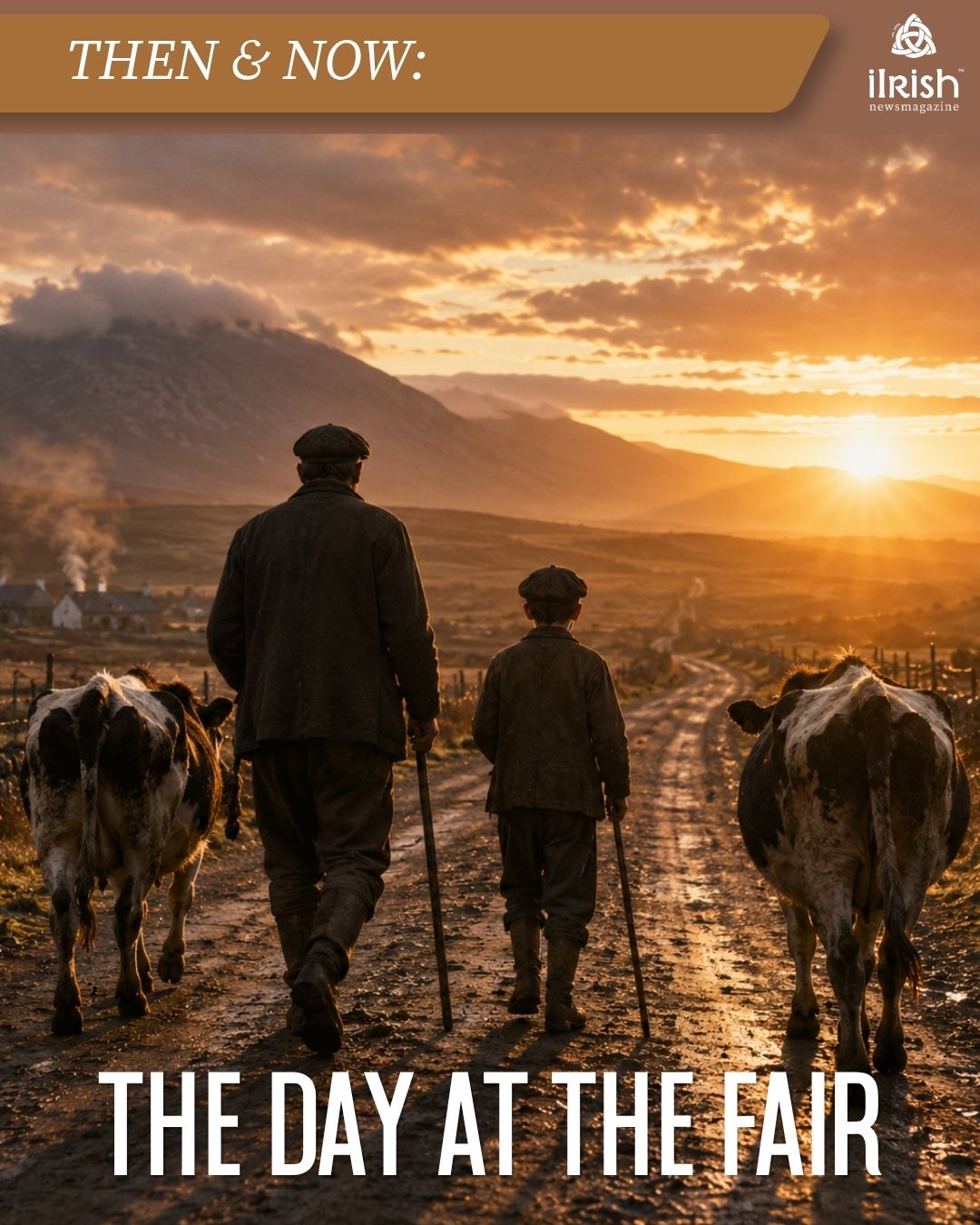
I imagine my father would have made his first trip to the fair at about nine years old, near the year 1942, which would have made my grandfather near fifty. At five in the morning, the man and the boy led the cows from the barn and set off on the four-hour march, the pace being set by the cows.
The road was dirt and muck and utterly still — the hooves the only drumbeat in the world, the cows’ breath white in the morning air. Behind his right shoulder, the boy could see everything he had ever known: the grey houses of Doona Village, the first threads of turf smoke standing straight in the windless air, and Slievemore Mountain across the bay, its head in the clouds, keeping its watch.
Then the road bent around the hill at Knockmoyleen, and he took one last look — and home was gone, behind the shoulder of a hill. He did not often venture anywhere that Doona could not see him. The moment lasted two heartbeats, because a cow drifted toward the ditch, and his father called his name, and the boy used the stick to guide it back.
They crossed the Owenduff River in the mist, the hooves going hollow on the makeshift bridge, the peat-brown water sliding beneath them — hurrying home to the sea they were walking away from. Then the road turned east toward the Nephin Mountains, a long black wall against a paling horizon.
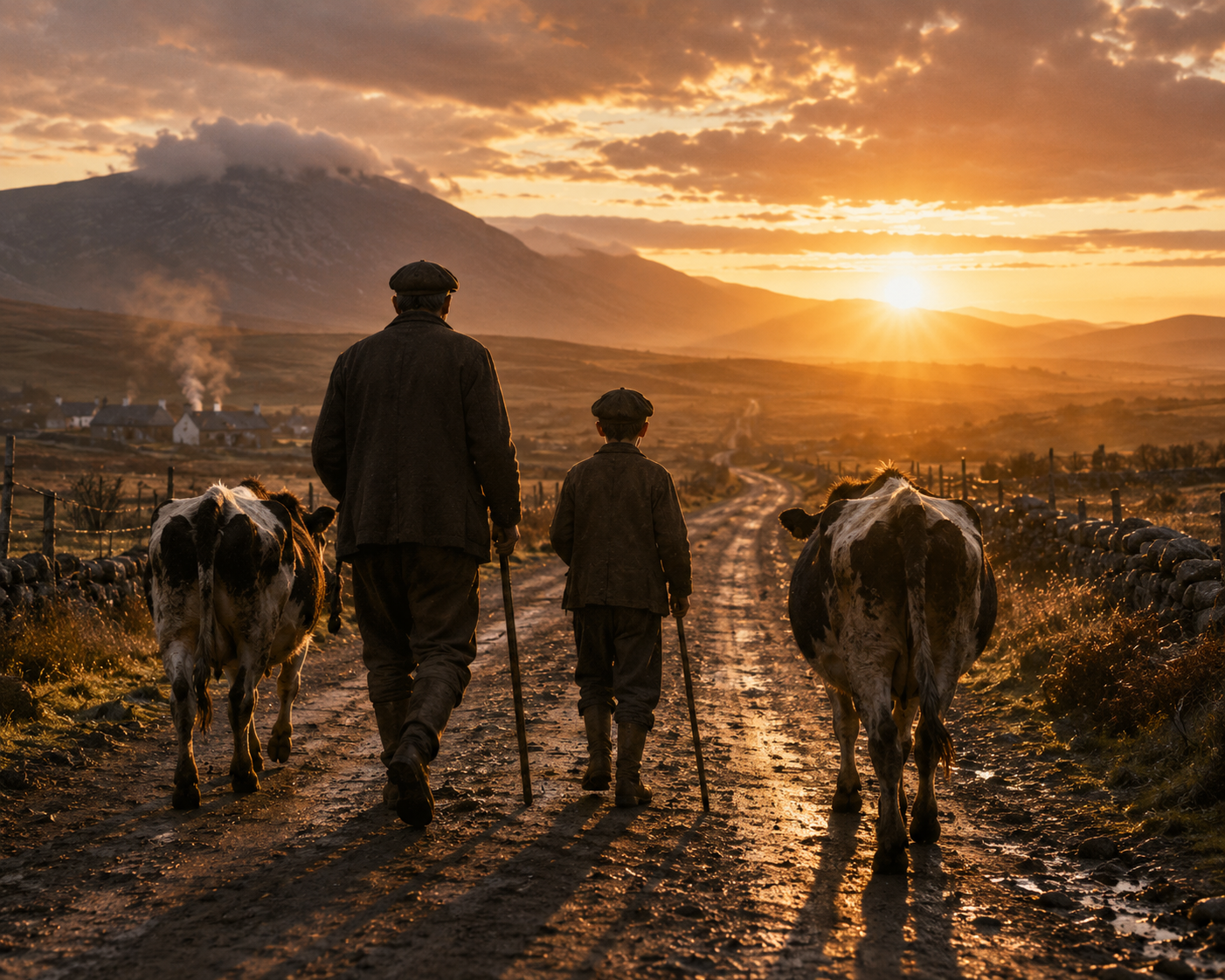
And as they walked, the sun crested the ridge, and light came running down the bog toward them like a tide, turning the heather to copper, and the shadows of a man, a boy, and two cows stretched a hundred yards down the road behind them, pointing back toward Doona. My grandfather may have spoken of forty years of these dawns, since he was a boy back in 1900.
After three long hours, the glen appeared before them, the hardest mile, the road winding and narrow, the cattle nervous, every step watched. This was the place where two worlds converged, for the old people said this road carried more than travelers.
It carried folklore: a phantom dog was frequently seen, or a white cow, and the appearance of the white cow was a warning of death. The men who drove real cows through that glen in the early morning knew the old stories, believed them, and said their prayers.
Nobody laughed at them, and nobody stopped walking either. Both worlds used the same road.
At last, they saw it: the town, small and distant at the foot of the last Nephin mountain, where the ancient Bangor Trail came down off that desolate range and spilled onto the road — a path herdsmen had walked for centuries. And now the road began to gather.
At every lane, figures and beasts folded in — a lowing ahead, one of their own cows answering, a neighbor’s nod, a word about the morning — until what had left Doona as a man, a boy, and two cows had become a slow river of cattle and people, a mile of moving backs, all pouring toward the same streets.
The sun was well up when they now crossed the other river, the Owenmore, and spilled into Bangor with the rest of Erris. The street was cattle flank to flank, and noise, and dealers moving through the crowd reading beasts with their eyes.
The fairs at Bangor were old, travelers noted them as far back as 1802, and the bargaining was older still, a theater with its own liturgy: the low offer, the refusal, the walk-away. The tangler — the go-between — catching the two men and pulling them back together, saying, “Divide the difference between ye.” The spit, the slap of hands, the deal, and the luck penny handed back to the buyer for a blessing on the beast.
But there were fair days when the price offered was too low, and a man would not give his cattle away. And so, some evenings, the hardest walk in Erris: driving the two cows the dozen miles home again, the whole year still on their backs, to wait for the next fair. My grandfather knew that walk. Every man on that shore did.
When the deal was good, the money went to work within days: the shop debt paid off, the shoes, the flour, and tea, all an important part of the year’s provisioning. If it were the fair in spring, a piglet would be bought and carried home squealing to be fattened through the summer and salted into the barrel before Christmas.
The fair money was turned straight back into the winter’s food. And somewhere in a pocket, the fairing — a few sweets for the children who had stayed home.
They walked home in the falling light, lighter by two cows, the money deep in a pocket. Somewhere past the glen, the boy stopped talking, and three hours later he was nearly asleep on his feet. Slievemore rose ahead of them to say they were nearly home; the day had begun there sixteen hours before.
We go to fairs now and think nothing of the getting there. We don’t wonder how our ancestors went to fairs or why, or what the day carried for them, or what an epic adventure it must have been for a small boy or girl with sticks in their hands.
My father never told me any of it, and I never knew my grandfather. But I have driven that road, past Knockmoyleen, through the glen, down into the crossroads town of Bangor, covering in twenty minutes what took them the whole of a morning.
I have walked it in my mind and in this article because it happened, and because it deserves telling. And I suspect I have written it not only for them, but for all of us who come from the silent fathers of that generation – the men who walked long roads as boys, because it was the life, and never said a word.