


A Glimpse of Forever
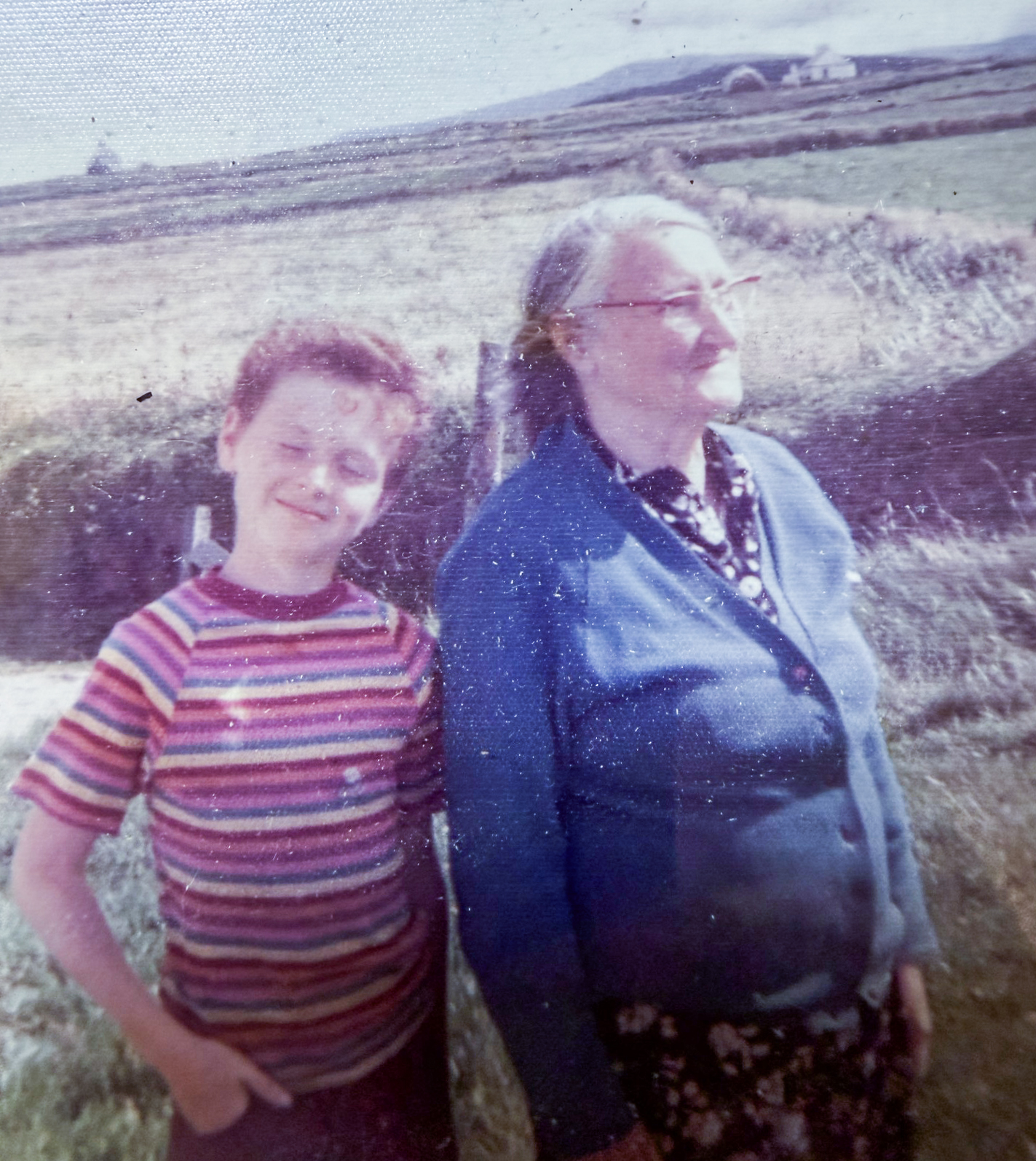
In the summer of 1973, I was nine years old — skinny, freckled, white as paper, and crowned with a blazing red afro, in a time when afros on white kids were not yet a thing. My dad took me to Ireland that summer; his sister, Nancy, took my cousin Albert, who was ten.
We landed at Shannon and drove two hours west to the coast to the village of Doona, in the parish of Ballycroy, one of forty-six villages knit so close they lived and breathed as one. The house had no electricity. No running water. No heat. No appliances. Nothing.
Slieve Mór loomed across the bay on Achill — the great mountain you saw every time you lifted your head. The Atlantic wind blew briskly whether the tide was coming or going, and the sand dunes, the Sandy Banks, the dunes Doona was named for, stood guard against the sea. Strangest of all was the light: bright at six in the morning, still bright until nearly ten at night.
Our host cousin Danny, five years old and fierce as they come, regarded Albert and me as Viking or Spanish invaders who were to be repelled except when leading us down the beach to help him dig for Armada treasure near the wreck site, which he insisted was there, and we believed him.
Next door was old Anthony, brown britches, suspenders, an Amish-style beard, a pipe never out of his mouth, who kept two calves in the field by his house, one orange and one black, only weeks old, and I sat with them every morning, petting them like dogs.
And there was my grandmother, who could not understand a word I said: the accent, the ocean, the sixty years between us, and who only laughed about me. It was the only language we had: a glance over, a few words I couldn’t catch, and the laugh.
Morning and evening, we walked the half mile to the community well, along the raised embankment trail between two fields, white stone, the water four feet deep and perfectly clear, seaweed swirling slowly inside it.
We carried the heavy buckets home along the same precarious path. It was a chore that never felt like one.
Inside the house, a small brown hutch held a loaf of bread, a bowl of eggs, and the orange pail of warm cow’s milk; by the door stood the two green pails of well water. The hearth in the center, with pots suspended to cook or boil water for tea. That was the kitchen.
We helped make the reek, the hay of the first cutting gathered in a single morning-to-night effort, every hand working, even ours. Now and then strange wagons came down the road, pulled by horses, whole families aboard, and we were told they were tinkers, and told nothing more.
Our days had no schedule at all, running and playing until the ten o’clock light gave out – and yet somehow there was always work, and nobody saw a contradiction. Neither did we.
Every morning, Danny, his little sister Teresa, Albert, and I drove the six cows up the cow path road, a mile or so, to the field above by the Sandy Banks, and every evening, we brought them down to the field below by the house. The arithmetic was absurd, little kids with sticks herding two-thousand-pound animals through the muck and the cow pies, and the cows bore it as unwilling patrons of our hosted walk, tolerating their tiny herdsmen.
Our daily running around took us through the whole world: over the dunes, along the shore, past Grace O’Malley the pirate queen’s castle, across the field where the 400 armada men once camped, and up to the old, abandoned church and graveyard, overgrown, its stones leaning every direction on wildly uneven ground. Inside the roofless church, sunk into the dirt and grass, lay hundreds of what looked like smooth, round, white rocks, and you dared not walk on them, because you knew they were skulls, set there over the centuries by respectful visitors who found them worked up from the shallow graves.
I never questioned it. At nine years old, I accepted it as naturally as the sea, the dunes, and the wind.
One evening at dinner, crowded around the small table and staring down potatoes I knew I could not eat, I mentioned to Uncle Sonny that one of the cows in the shed had looked sad, so I had helped him. How, he asked?
I let him out. Sonny rose from the table and charged out the door. Apparently, it was the bull. The borrowed bull.
The food of Ireland never agreed with me. One day we were woken early to go to the shore to pick winkles, buckets of them, hundreds, and I asked Uncle Sonny what we would do with them all.
“Why, we’re going to eat them!” The dismay that set in, I will never forget. The hundreds of winkles boiling in butter over the turf fire, and me starving the whole evening.
I survived on bread and butter. True salvation came twice a week, when the food truck rolled through Doona selling chips and candy.
And there was my father showing Albert we need not fear the incoming tide, then swimming calmly out and out from the shore while I stood scared to death, certain he was swimming into the great Atlantic abyss.
One warm August evening, around half nine, crossing from the field above toward the Sandy Banks, I climbed the wire fence. One leg over, pitched on top, mid-climb, I stopped. Slieve Mór on the left, the Sandy Banks ahead on the right. The Atlantic tide racing in, and the sun touching the sea before me. And time stood still.
It was as if the eternal world had opened for a moment, and what lay before me was a place called forever. I have sought that feeling ever since.
I learned only years later that the field belonged to my people, the McManamons, five generations back. No one had told me. But I had felt forever standing on my own ancestors’ ground.
We had lived a summer with nothing and never gave it a second thought. It wasn’t a world missing things. It was a world complete with everything a nine-year-old American kid could need.
Back in America, fifty years of a life rolled on, and Doona faded. Then it came roaring back, in my writing and in my heart. It had never left; I just didn’t know where or how to find it. But now, I will never let it go, because it is within me forever, and I hope to pass it on to the generations that follow.