


An Bhfuil Ocras Ort?
In the March issue’s Speak Irish column, we focused on food and drink. This month we’ll build on that topic by getting to know what we like as well as what our companions prefer.
The basics of conversation have been covered but should not be overlooked. By now we know how to greet one another, ask how someone is, introduce ourselves and even discuss the weather. If you would like a refresher on any past lessons go to iIrish.us, where you can find all of the previous Speak Irish columns.
Please and Thank you
In our class studies, we try to stress using le do thoil and go raibh maith agat as much as possible. When the question Cén chaoi a bhfuil tú? (How are you?) is asked, we can respond Tá mé go maith (I’m good), or a better response might be, Tá mé go maith, go raibh maith agat, agus tú fein? (I’m good, thank you, and yourself?). Remember too, that since Irish does not have a word for yes or a word for no, we respond to questions using the appropriate version of the verb used in posing the question. When the questioning version of the verb tá, an bhfuil is used, we can respond simply tá for a positive response or níl for a negative response. In English, we often use this same technique, Would you like a cup of tea? I would.
An bhfuil ocras? (ahn will ohkruss) Are you hungry?
Tá ocras orm. (taw ohkruss or-um) I am hungry
Tá, le do thoil. (taw leh duh hoyle) Yes, please.
Níl ocras orm. (neel ohkruss or-um) I’m not hungry
An bhfuil tú stiúgtha leis an ocras? (Ahn will too stoo-ga lesh ahn ohkruss) Are you starving with hunger?
An bhfuil tú lag leis an ocras? (ahn will too lahg lesh ahn ohkruss) Are you weak with hunger?
Tá mé stiúgtha leis an ocras. (taw may stoo-ga lesh ahn ohkruss) I’m starving with hunger.
Níl mé lag leis an ocras. (neel may lahg lesh ahn ohkruss) I’m not weak with hunger.
An itheann tú ….? (ahn ih-han too) Do you eat ….?
Arán (rahn) bread
Tósta (toe-sta) toast
Im (im) butter
Glasraí (glahs-ree) vegetables
Cabáiste (kah-bash-ta) cabbage
Ithim (ih-um) yes I eat
Ní ithim (nee ih-um) No I don’t eat
Ithim. Ithim gach cineál bia. (ih-um. Ih-um gahk kin-noel bee-uh) Yes. I eat every type of food.
An veigeatóir thu? (ahn veg-ih-toor who) Are you a vegetarian?
Is ea, is veigeatóir mé. (is-sha iss veg-ih-toor may) Yes, I’m a vegetarian.
Ní hea, ní veigeatóir mé. (nee hah nee veg-ih-toor may) No, I’m not a vegetarian
An mhaith leat bia ….? (ahn wah lyat bee-uh) Do you like…. food?
Franach (frah-nock) French
Iodálach (ih doh lock) Italian
Spáinneach (span-ehck) Spanish
Seapánach (shah pahn-uhk) Japanese
Indiach (inn-dee uhk) Indian
Is maith liom bia ….. (iss mah lum bee-uh) Yes, I like …. food.
Ní maith liom bia …. (nee mah lum bee-uh) No, I don’t like ….. food.
Is breá liom é. (iss brah lum ay) I love it.
Is fuath liom é (is foo-uh lum ay) I hate it.
An gceapann tú go bhfuil bia Indiach go maith? (ahn gap-ahn too guh will bee-uh in-dee uhk guh mah)
Do you think Indian food is good?
Ceapaim go bhfuil sé go deas / an deas. ( cap-um guh wiil shay guh jess / ahn jess) Yes, I think it’s nice / very nice.
Ceapaim go bhfuil sé ….
Spíosrach / an spíosrach (spee-us-rah / ahn spee-us-rah) spicy / very spicy
Blasta / an bhlasta ( blah-sta / ahn vlas-ta) tasty / very tasty
Te / an te (cheh / ahn cheh) hot / very hot
Milis / an mhilis (mil-ish / ahn vil-ish) sweet / very sweet
Och, is maith! (ohk iss mah) Oh yes, I love it!
Tá mé splanctha ina dhiaidh. (taw may splonk-ah ina yee-eg) I’m crazy about it.
Ní maith liom ar chor ar bith é. (nee mah lum ar kor ar bih ay) No I don’t like it at all.
Cén cineál bia a thaitníonn leat? ( ken kah-nol bee-uh ah hah-tih-neen lyat) What kind of food do you like?
Taitníonn …. liom. (tah-tih-neen……lum) I like….
An ólann tú tae? (ahn oh-lan too tay) Do you drink tea?
Ólaim tae. (oh-lum tay) Yes I drink tea.
NÍ ólaim tae (nee oh-lum tay) No I don’t drink tea.
Ar mhaith leat an biachlár anois? (ar wah lyat ahn bee-uh-klar ah-nesh) Would you like the menu now?
Ar mhaith libh an biachlár anois? (ar wah liv ahn bee-uh-klar anois) Would you all like the menu now?
Ba mhaith, le do thoil. (bah wah leh duh hoyle) Yes, please
Níor mhaith, go raibh maith agat. (neer wah gorra mah ah-gut) No thank you.
An biachlár, le do thoil. (ahn bee-uh-klar led hull) The menu, please.
An bhfuil sé seo go deas? (ahn will shay sho guh jess) Is this good?
Cad a mholfá dom? (kod a vulfah dum) What do you recommend?
Céard é béile an lae? (kyard ay bay-la ahn lay) What is the soup of the day?
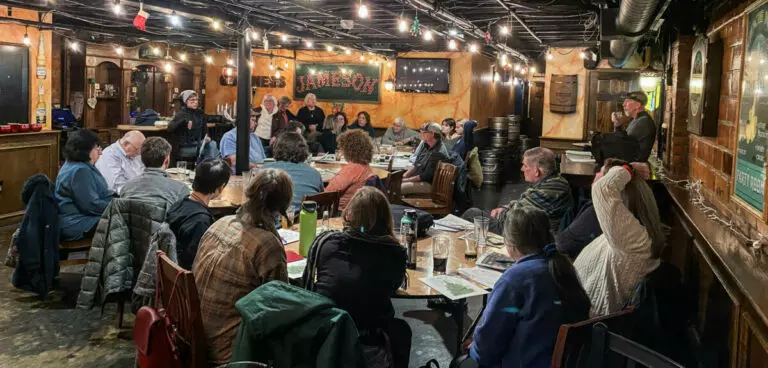
By the time you read this, our Speak Irish class will have wrapped up for the summer. For the past ten weeks, we have worked to be able to have conversations with one another around a visit to a pub or restaurant.
We’ve incorporated greetings to a known friend; someone we’ve just met; and got to know. We inquired about mutual friends or family, the weather, arranged a dinner date and a spontaneous trip to a pub. There we ordered food and drink and interacted with the waiter and each other.
We all started out slowly, embracing one word or phrase at a time and using our Irish in our daily conversations in English until Irish became part of us.
I ndiaidh a chéile a thógtar na caisleán. Stone by stone builds the castle.