


This Language is Weird!
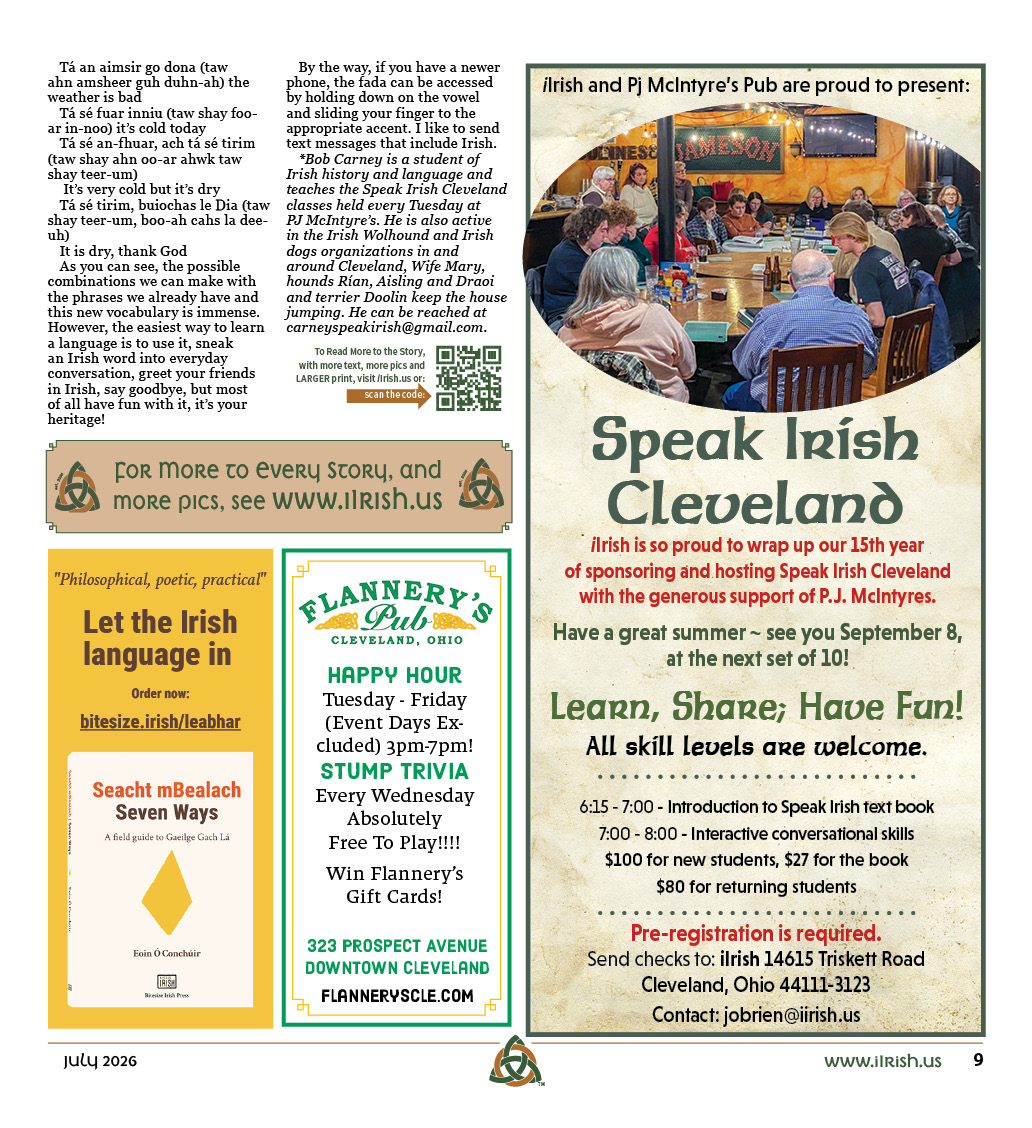
At Speak Irish Cleveland classes, the most common comment we hear is that Irish pronunciation and spelling is extremely difficult. The problem, I believe, is we try to use English “logic” on Gaeilge.
Professor of linguistics John McWhorter wrote, “English feels “normal” only until you get a sense of what normal really is, like the proverbial fish not knowing that it is wet.”
Once we let go of our preconceived notions of what is normal and what isn’t, Irish becomes much more accessible. In Irish spelling, vowels and consonant placement in a word dictate pronunciation, and this formula stays rather consistent. English tends to put letters in words for no apparent reason, for example; island, doubt, delight, and foreign.
Although, any linguist can tell you why the letters are there, today they no longer have a practical function. Pronunciation gives us more non-conformists; rough, bough, threw, through, yet we have learned not only to deal with all of these things but never even give them a second thought. English has many more exceptions than it does rules, and if we can express ourselves in this language, learning Irish can be easy and fun.
We know the Irish alphabet has 18 letters and that vowels can be long or short. Long vowels are marked by a fada, which happens to be the Irish word for long. Use this pronunciation guide to help sound out unfamiliar words.
Consonants
Lenited Eclipsis
Broad Slender Broad Slender Pronounced
b butter butte bh win view mb m
c cub cube ch loch ich gc g
d eddy edge dh agua you nd n
f ford fjord fh silent bhf bh
g got goo gh agua you ng n or ng as in sing
h similar to English h
l land loon never lenites
m men mew mh win view
n canon canyon never lenites
p pen pew ph ford fjord bp b
r run Dvorak never lenites
s sin shin sh similar to English h
t it itch th similar to English h dt d
The letter h rarely makes it’s own sound. It only sounds when it appears initially. Otherwise it is used to mark a change in the pronunciation of the previous consonant.
The slender r is the most difficult sound to make, to many of us it sounds like -rzh- . The dh and gh make similar sounds as do bh and mh. However when -bh- appears internally, it is usually pronounced like a -v- whereas the-mh- can sound like a -v- or -w-.
Vowels
short long
a bah law
e bet day
i pin see
o cot coat
u but nude
Now to expand on our conversational vocabulary. We can begin any conversation using phrases from last months lesson and expand it greatly using the simple forms of Tá (taw) is and níl (neel) is not.
Tá Tá sé Is it is Níl Níl sé is not it is not
fuar (foo-ar) cold tirim (teer-um) dry
te (tcheh) hot dorcha (doorkah) dark
fliuch (flyukh) wet geal (gale) bright
an-fhuar (ahn-oo-ar) very cold an-tirim (ahn- teer-um) very dry
an-te (ahn- tcheh) very hot an-dorcha (ahn- doorkah) very dark
an- fhuilch (ahn- lyukh) very wet an-gheal (ahn-yawhl) very bright
an lá (ahn- law) the day an oíche (ahn ee-kuh) the night
an aimsir ( ahn- am-sheer) the weather an mhaidin (ahn wadjin) the morning
ach (ahwk) but anois (ah-nesh) now
inniu (in-noo) today anocht (ah-nowkht) tonight
buíochas le Dia (boo-ah cahs la Dee-uh) Thank God
go breá ( guh braw) fine go hálainn (guh- hawl-in) beautiful
go deas (guh jess) nice go dona (guh duhn-ah) bad
go maith (guh maw) good go hiontach (guh hee-un tach) wonderful
mé (may) I tú (too) you
sé (shay) he/ it sí (shee) she
muid (mwidge) we sibh (shiv) y’all
siad (shid) they
Examples
Níl an lá go maith (neel ahn law guh maw) the day isn’t good
Tá an lá go deas (taw ahn law guh jess) the day is fine/ it’s a fine day
Tá an aimsir go dona (taw ahn amsheer guh duhn-ah) the weather is bad
Tá sé fuar inniu (taw shay foo-ar in-noo) it’s cold today
Tá sé an-fhuar, ach tá sé tirim (taw shay ahn oo-ar ahwk taw shay teer-um)
It’s very cold but it’s dry
Tá sé tirim, buiochas le Dia (taw shay teer-um, boo-ah cahs la dee-uh)
It is dry, thank God
As you can see, the possible combinations we can make with the phrases we already have and this new vocabulary is immense. However, the easiest way to learn a language is to use it, sneak an Irish word into everyday conversation, greet your friends in Irish, say goodbye, but most of all have fun with it, it’s your heritage!
By the way, if you have a newer phone, the fada can be accessed by holding down on the vowel and sliding your finger to the appropriate accent. I like to send text messages that include Irish.