




Ghostly Shipwrecks
“Call me Ishmael.” One of the most memorable opening lines in literature. Melville’s Moby Dick is a story of vengeance and retribution. Published in 1851, the epic novel was inspired by the true story of the sinking of the whale ship Essex in 1820.
November 1820, The Essex
The Essex was a 21 year old whaling ship, old for a whaler. Timber rot and rusted hardware had been repaired, but the owners had the ship slated for replacement. This would be her last season whaling.
The Essex left Nantucket on August 12,1819, heading to the Pacific Ocean with a first time captain and a very young crew. The Essex was two months into its scheduled three year trip, when the crew spotted and killed its first whale, a sperm whale, south of Rio de Janeiro.
It was November when the lookout spotted whale spouts again. The Essex was about a thousand miles west of the Galapagos Islands. Three boats were launched and all three harpooned a whale, one of the boats was struck and damaged by the tail of its prey and had to cut themselves loose. The other two were off on a “Nantucket sleigh ride,” being pulled by their whales miles from the Essex.
The damaged boat was hauled aboard deck for repairs. As the crew was working, they spotted an unusually large sperm whale acting strangely. It began to swim directly towards the Essex, picking up speed as it grew closer. It rammed the ship, rocking it side to side.
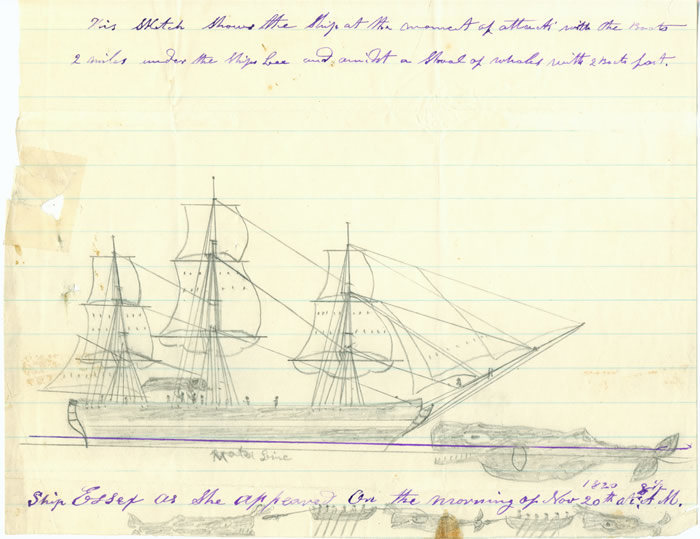
The crew was still trying to comprehend what had just happened, when the whale returned, even faster, ramming the bow with its massive head, crushing the bow. The whale shook its head free from the fractured timbers and disappeared under the waves.
The ship was filling with water and the crew ran below to gather what they could and placing supplies in the only spare boat on board. Navigation equipment and food and water would be essential to their survival.
The other two boats were about two miles away, but they could see the Essex was in distress. They cut their whales free and returned to the slowly sinking Essex.
The crew spent almost two weeks salvaging what they could from the ship before it went under. Food and water were rationed from the very beginning.
The men were two thousand miles from land on boats that were not designed for long voyages on the open sea. They were plagued by storms and rough seas causing constant damage to the whaleboats. Food was running out fast.
On December 20, exactly one month after the attack, the crew and their three boats landed on Henderson Island, an uninhabited coral atoll. There they found food, birds, eggs, fish and peppergrass, but water was almost non-existent.
After a week, they had just about exhausted the food supply. Three men decided to wait there until the other members of the crew were rescued and could send help to them. The remaining men set out to sea once more.
In January, the boats became seperated. Men began dying of exposure, dehydration and hunger. On one of the ships, the decision was reached to eat the body of the second man that died. Later, lots were drawn, the man with the short straw was shot and consumed.
A whaleship was later found washed ashore with four skeletons aboard, it was believed to be from the Essex. Of the twenty one crew members, seven survived, including the three men who opted to stay on Henderson Island.
Owen Coffin, age sixteen, was the only crew member to be shot and eaten. Three other men had died on their own before being consumed. The others were presumed dead and lost at sea.
The Lord Blaney
The Lord Blaney was a wooden paddle steamer that ran aground in Wales, killing all on board. The steamer had been a familiar sight along the coast of Carlingford Lough, carrying passengers and cargo from Warrenpoint to Liverpool. Many of the passengers on that fateful trip were from the Lough area. Over the years, there have been multiple reports of the ship still sailing up Carlingford Lough on the way to Warrenpoint, only to vanish beneath the waves as it nears the harbor.
MV Alta
The MV Alta was a cargo vessel built in 1976. Sailing in the mid-Altlantic near Bermuda, the ship suffered an engine failure in October of 2018.
The crew was rescued and the 250 ft. merchant ship was abandoned. It drifted unmanned across the Atlantic for over a year before washing ashore near Ballycotten, County Cork, February 16, 2020. A true-life modern ghost ship.
HMS Wasp
A Royal Navy gunboat, the HMS Wasp sank on September 22, 1884, after striking rocks off Tory Island. Fifty-two of its sixty-three crew members perished.
Locals believe the ship was cursed due to its role in evicting Irish tenants during the Land War. Local fishermen near Donegal claimed to have seen the phantom ship and heard the wailing of the lost crew, over the years.
The NMS
The earliest is a 11,000 year old log boat. Many of the wrecks have local ghost stories or folklore attached to them.
Stories are our oldest teaching tools. Childrens fairy tales and local folklore are a way to discuss fear, moral issues and failures of human values.
They are at their core a way to educate and inspire. As adults, the stories need to be more complex. Sometimes we need to be led into the darkness to find the light.
When we hear a tale that’s been around for centuries, we’re joining in a conversation that has helped people make sense of what was a chaotic troublesome event. Some are a lesson between good and evil, but some, like the Famine Road ghost stories, are a reminder and a warning to us.