


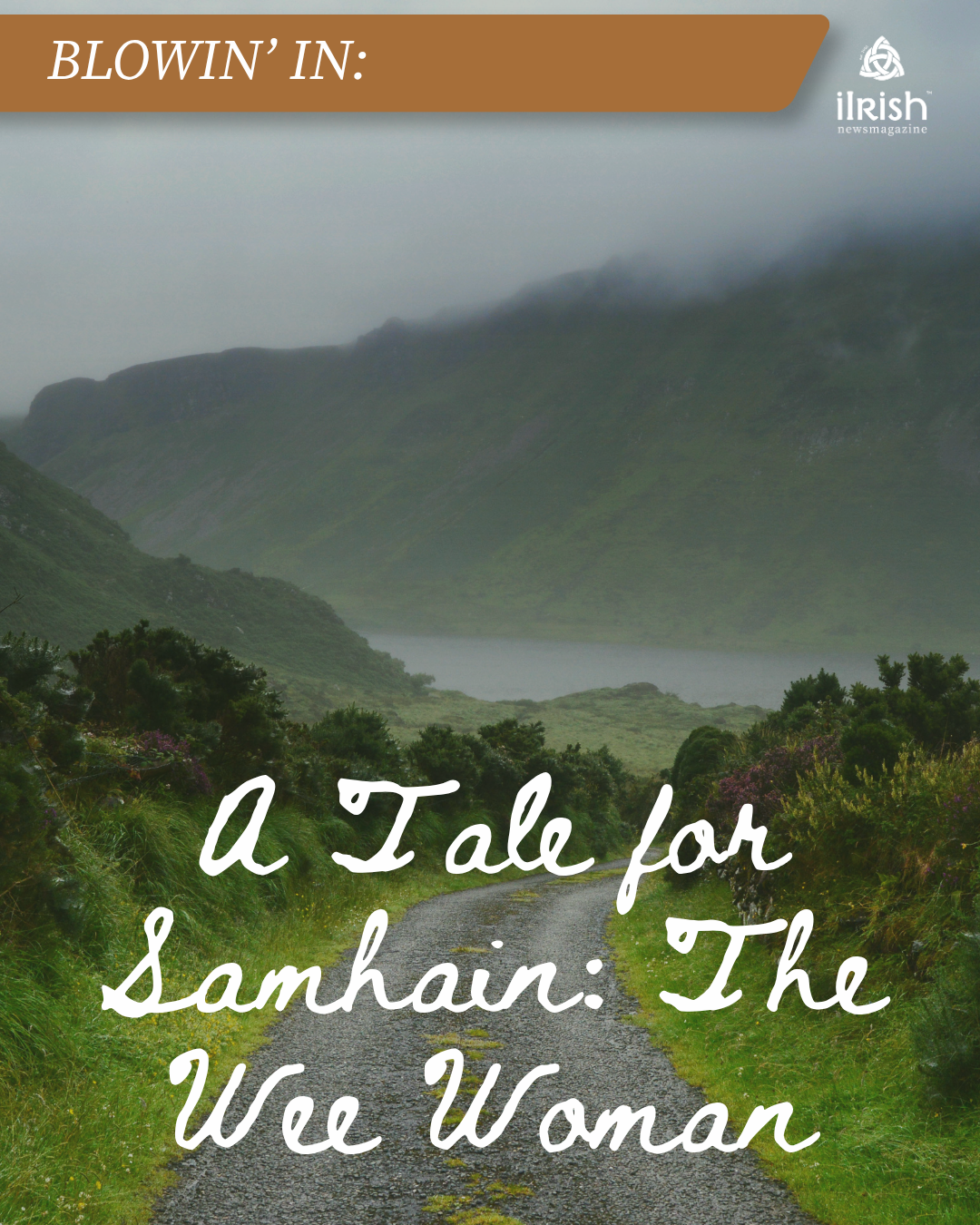


A Tale for Samhain: The Wee Woman
Clusters of deep purple blackberries are ready to burst along the brambles that line the path from St. Patrick’s School to the rolling hills above the village of Rock Strand. Petey and Paddy Corrigan know the route well as it winds through town and past all their favorite shops.
“Paddy, this time of year is surely heaven on earth. Just look, we have all the blackberries in the world ready to stuff into our mouths on one side of the lane and Big Tom’s Emporium of Sweeties on the other. Sure, life doesn’t get better than this.”
[Pic 1] The twins were known among the villagers for their mischievous charms, as well as their talents. Petey could sing like heaven’s own cherub and Paddy was St. Patrick School’s spelling bee champ.
On this autumn day, the sun dimmed pink and purple across the village of Rock Strand. The fields seemed even more beautiful because Bridie McCracken and her twin sister Rosie decided to allow Petey and Paddy to accompany them home from school.
Rosie was as sharp as a nettle in June, and her sister, well, she could sing like a robin in spring. Rosie and Paddy may have been rivals, but Paddy could only be so competitive when he thought of the grand freckles that dotted her nose. Sure, didn’t Petey reckon the wee spots that swept across her sister Bridie’s cheeks looked as sweet as a pack of chocolate buttons.
“Boys,” the girls lectured in unison like only twins can. “Big Tom won’t like it if you smear up his window with your greedy faces pressed against that glass. Sure, ye both are slobberin’ more than our collie Poppy!”
The Samhain Harvest Fete was a mere three weeks away, and Big Tom had all his sweets displayed in true celebratory fashion. Every year, Tom McIntyre hosted a homemade sweetie competition. Talented confectioners across Rock Strand vied for the win.
Big Tom would give the winning sweet a proud display in the storefront window. A miraculous confection in itself, Big Tom’s window was filled with carved turnip men, strange creatures with bulbous heads and hooked noses who peered into black vats teeming with wrapped candies.
In another window, branches of bog oak held willow baskets bursting with Licorice Allsorts and colorful Wine Gums shaped like tabby cats. The bowed windows were draped with tattered muslin curtains. Long branches of elderflower and prickly blackberries from the wood on the Stoney Bank Road draped the borders.
“Sure, isn’t it as eerie as the Banshee’s howl, Rosie,” whistpered Paddy. “This here window gives me the same shivers as those tales Mr. Yeats tells in his Celtic Twilight.”
Rosie began to recite, “In Ireland, this world and the world we go to after death are not far apart. I have heard of a ghost that was many years in a tree . . .”
“Aw, would ye two stop recitin’ poetry or prose, or whatever tis’. Ye are both diminishin’ my appetite for the sweeties in yer turnip man’s cauldron,” moaned Petey.
Pulling his thick black spectacles down the wide slope of his nose, Big Tom finally took note of the four children outside his shop. “Will ye youngsters stop droolin’ on my prize window and come in to say a proper hello?” laughed Big Tom McIntyre.
“Do forgive me Mr. Tom, but Bridie and I never slobber. That poorly habit is reserved for wee dogs and hungry lambs, like our companions here,” chastised Rosie with a nod toward the boys.
“Come in children,” welcomed Tom. Perhaps young Petey would trade a song for a pack of sweets? the jovial shopkeeper laughed.
After three rousing choruses of The Rattlin’ Bog, the children were rewarded with a bag of penny candy each. As the children turned outside the Emporium and walked toward the bog road that led out of town, the sun was nearly tucked into the horizon for the day.
Autumn nights fell swiftly in Rock Strand. The wind seemed to raise the branches of the rowan trees that grew sparingly in the bog. Sure, didn’t they look like the goblins in Big Tom’s window. Chilled, the children huddled together, hugging their heavy books and bags of sweeties close to their worn woolen jumpers, as they made their way home.
The Corrigan’s cottage rests just above McCracken’s Field. Though the night began to thicken over hills filled with heather and great tufts of McCracken’s famous holly bushes, the boys wanted to see the girls safely home before heading onto the stone path that led to the their own cozy cottage.
A fine baker, Mrs. McCracken always had baskets of fresh currant buns waiting for visitors. The children could just see the welcome figure of Mrs. McCracken through the candlelit window. She was standing at the hearth stirring a pot of deliciousness.

Sensing the change in weather, Bridie and Rosie’s da had already brought the cow into the shed for the night.
A man who could tell a tale as fine as any seanachie, Mr. McCracken would often remind the children, “When the wind shifts north and the autumn wind whistles like a fairy’s pipe through the furze, tis’ a night for the Sidhe, the fairy folk, to arise and traipse through the fields of Rock Strand.”
Before running up the path to the McCracken’s half door, the children carefully closed the sturdy gate. Mr. McCracken crafted it from ocean reeds and field stone. Surely, it could keep out a fairy or two.
As the gate creaked shut, however, the children thought they heard the shrill tune of a fairy’s pipe and the low moan of words floating on the wind. They looked at one another with terror in their blue eyes.
Sure, their collective imagination was as vast as the sea. They remembered a line from one of Mr. McCracken’s most haunting tales.
“Shree, shree, no more shall ye
traipse through the fields that belong to the Sidhe.”
Startled, Bridie grabbed hold of Petey’s hand. On a fine day, Petey would be pleased as punch with this endearment, but on this windswept night, he was as frightened as Bridie and grabbed tight to Paddy’s arm, while Rosie clutched her books even tighter.
The children were almost at the McCracken’s red half-door when a cloaked, bulky figure appeared to creep out the cottage’s side door. In the spare light of the new moon, the creature appeared hunched over and draped in dark linen.
“Rosie, Bridie, I do hope that is your neighbor Joe who lives on the road below the field,” whispered Petey.
“Sure, its knickers must be near as big as your Auntie Nor’s. I’ll swear off my readin’ if that t’isn’t a giant from the land of the Sidhe,” croaked Paddy.
Feeling brave, Petey took over, “Paddy, stop your squawkin’ and let’s get Bridie and Rosie safe to the door and the warmth of their mammy’s kitchen.”
Petey took Bridie firmly by the hand with her book satchel safely tucked under his arm, while Paddy stepped in front of Rosie, guarding her from phantom dangers. Feigning courage, the brothers were nearly faint with fear at the thought of the Sidhe creature.
“Mammy,” shouted Bridie and Rosie in unison. Mrs. McCracken smiled at the sound of her girls and teased, “By Saint Anthony’s donkey, ye wee’uns near gave me an early death.”
“Surely, the look in Mrs. McCracken’s eyes and stutter in her greeting was as queer as a fox cub howling at the summer sun,” thought Paddy and Petey. “Maybe the crayture took over the Missus’ kitchen already. A grown changeling!” whispered Paddy.
“Lads, I have your currant buns at the ready, but ye must be runnin’ along straight away. The wind is calling for a fairy night.”
Sure enough, the rowan trees sang to their fairies all through the long dark evening. At bedtime, Paddy and Petey were still unsettled as they huddled beneath their goose down blankets, comforted only by the dim glow of their new battery charged torches. To pass the dark hours, the boys read from Mr. Yeats’ Celtic Twilight and reread the tale of The Wee Woman.
Early the next day, the lads met Bridie and Rosie out in the field where they were helping their da with the cow. “Girls, we think t’was the Wee Woman who came to call on yer ma last night.”
“Sure, she didn’t appear wee to me,” questioned Bridie.
“Y’see, the Wee Woman t’isn’t really wee. She tends to the Little People, the fairies. So, they call her the Wee Woman. In truth, the Wee Woman is bigger than yer Auntie Nor,” whispered Petey.
“So, ye lads reckon that humped crayture we saw was the Wee Woman payin’ a visit to our mammy,” queried the girls.
“Aye, and trouble she is. She’ll make yer ma work twice as hard. Mr. Yeats says that the Wee Woman slips into the family life and on Hallow’s Eve will pass the night with yer ma by the hearth,” explained Paddy.
“Sure, the next day, there won’t be any saints at your table, only the Wee Woman who will have taken yer mammy’s place,” continued Petey.
Wee Woman or not, the two sets of twins had plenty to do in the upcoming weeks. The October days turned to night by the time the children finished play practice for the upcoming Harvest Fete.
Mrs. Honor Jack, the music teacher, was directing a brilliant play called The Hound of the Baskervilles. Petey and Bridie were to sing the part of the baying hounds, while clever Paddy and Rosie were cast as Sherlock Holmes and Watson.
Pockets loaded with treacle toffees from Big Tom, the children once again found their way through McCracken’s darkened field. Mrs. McCracken’s kitchen glowed with familiar light, but a rare scent of sea salt and golden syrup rose up from the chimney. Feeling like Hansel and Gretel approaching the gingerbread house, the children walked entranced toward the cottage.
The cow was again in the shed, and the night air was unnaturally still. A faint creak rose from the back of the cottage.
The eerie silence turned into a loud uproar when Bridie and Rosie’s collie Poppy and the boys’ own spaniel Blarney careened around the cottage corner with a torn willow basket and an oddly familiar brown tattered shawl.
“The hounds, the hounds have taken down the Wee Woman,” cried Petey. The three children almost fainted with the terror of it all, as the humped crayture, larger than any human, made its way toward the excited dogs.
“Holy Mary, what is all this racket about,” scolded Mrs. McCracken.
“Mammy, Mammy, watch yerself. Tis’ the Wee Woman comin’ to take yer place at our table,” cried Bridie.
“Well, I’ll be donkeyed,” laughed the shawled figure. “Wee, I ne’er been called!”
The four children turned a scarlet brighter than the dawn before a storm.
“Missus, uh Auntie Nor,” stuttered Petey. “We thought ye were The Wee Woman, the mother of the fairies stealin’ yer way into the McCracken home, and we aimed to stop ye,” said Paddy.
“The only thing you children are preventin’ is my winnin’ the homemade sweetie competition at the Harvest Fete,” laughed Mrs. McCracken.
“Nor here was visitin’ me as of late to share her secret recipe for treacle sweeties. Ah, with the bayin’ of the hounds and children, sure the whole of Rock Strand will know that I have a conspiracy tied to me apron strings!”
“We beg yer pardon, but would ye mind if the hounds and us starvin’ children could avail ourselves of these sweeties in the basket?”
With the full moon shining bright over the village of Rock Strand, Paddy and Petey spent an hour tasting the finest sweets in the county, while Rosie told her mother and Auntie Nor all about Yeats’ Celtic Twilight.
“Ach, surely if the Wee Woman were to come to your table Mrs. McCracken, she would never leave,” exclaimed Petey with a wink at Bridie and her grand freckles.