




The Hell Cave
Among the grazing sheep in a field in County Roscommon, are the remains of a monumental mound. Rathcroghan was at the center of the ancient kingdom of Connaught that thrived during the Iron Age, two thousand years ago. This important historical site is being considered by UNESCO as a World Heritage Site.
Rathcroghan’s archaeological sites date back even further, about 5,500 years. There are burial mounds, ring forts, standing stones, ritual sites and the entrance to a cave.
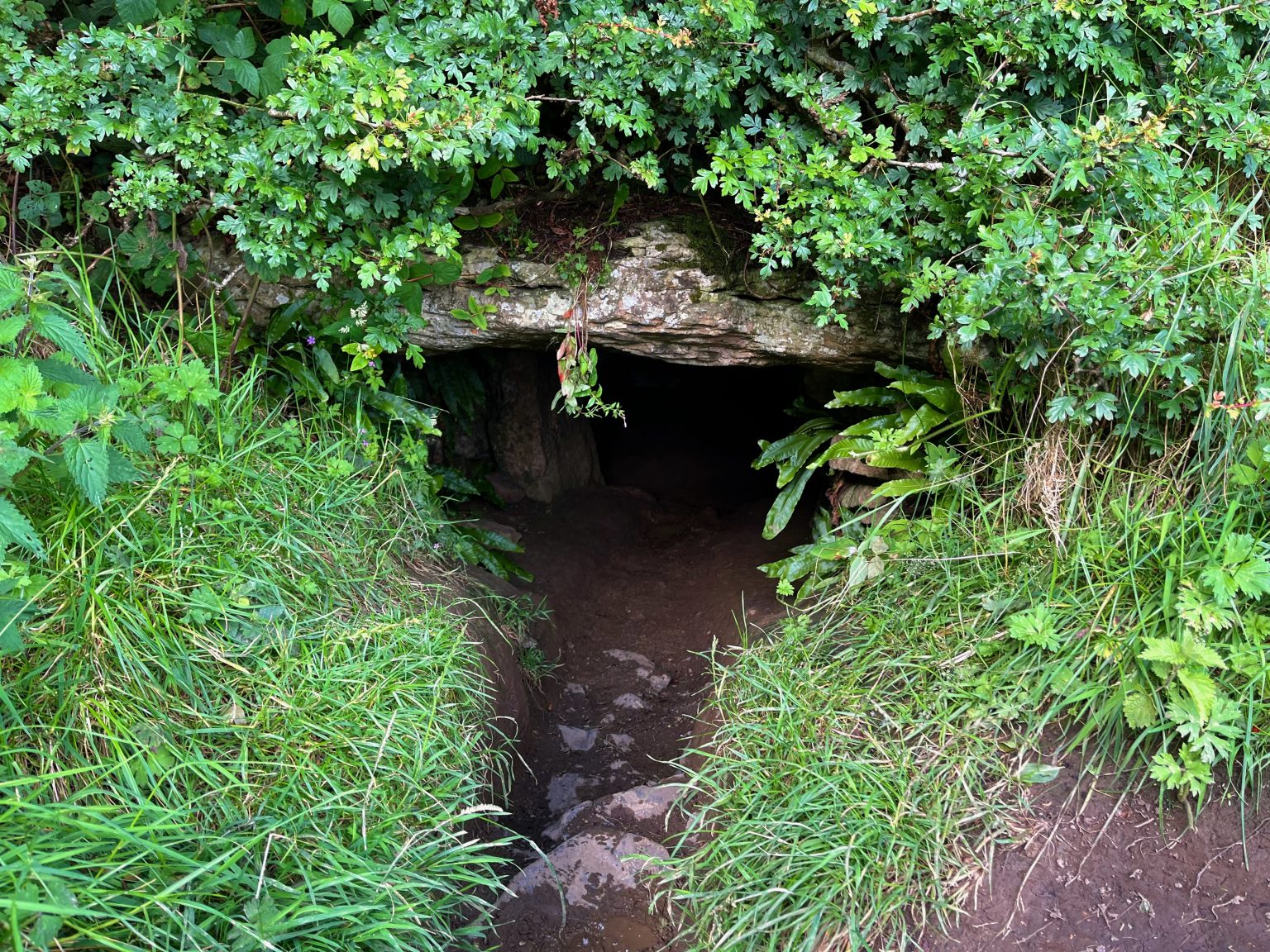
Oweynagat was believed to be a gate to the Otherworld. Druidic beliefs centered around nature and the interconnectedness of all life.
Many of their rituals honored the cycles of nature and the changing of the seasons. The druids believed in a type of reincarnation, where the soul could be reborn into a new form of life after death. All, alive or dead, were members of the community.
Yearly Festivals
Historians believe that it was at Rathcroghan two thousand years ago that the feast of Samhain, the Irish New Year, originated. In pre-christian times, the year was divided into summer and winter. There were four important festivals observed during the year.
They were more than just feast days, they brought the entire community together. Disputes would be arbitrated and settled, community protection was discussed, marriages, trading and all manor of social activities would occur.
Imbolc was celebrated on the first of February, it coincided with lambing season. Bealtaine followed on May 1, and marked the end of winter. A time for growth and fertility.
The harvest was celebrated on the first of August, it was dedicated to the god Lugh and called Lughnasadh. Samhain was on the last day of October. It marked the end of the year and the beginning of another. It was also the time of year when the inhabitants of both worlds were at their closest.
At Rathcroghan, the celebrations would include offerings to the spirits of the Otherworld. Animal and sometimes human sacrifices would be among the offerings.
The Otherworld was home to Tir na nÓg, the land of the immortals, demons, beasts and monsters. At Samhain, they could pass between both worlds, many finding passage through Oweynagat Cave.
Oweynagat (oh-ee-na-gat) is the anglicized form of the original Uaimh na gCat, which translates to cave of the cats. So named due to the legends of the wildcats that were sent to test the warriors and heroes from the Ulster Cycle of Irish mythology. It is also home to the Morrighan.
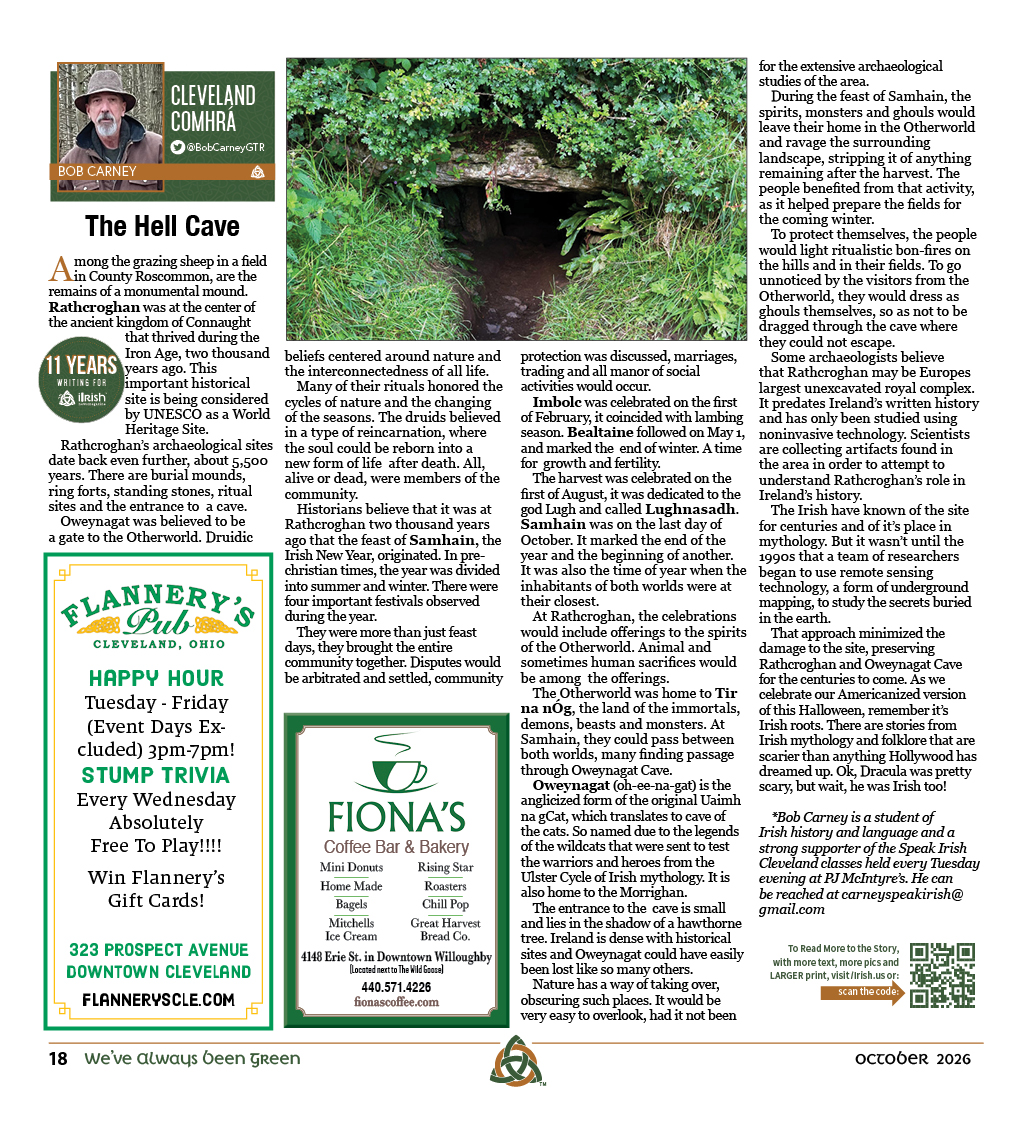
The entrance to the cave is small and lies in the shadow of a hawthorne tree. Ireland is dense with historical sites and Oweynagat could have easily been lost like so many others.
Nature has a way of taking over, obscuring such places. It would be very easy to overlook, had it not been for the extensive archaeological studies of the area.
During the feast of Samhain, the spirits, monsters and ghouls would leave their home in the Otherworld and ravage the surrounding landscape, stripping it of anything remaining after the harvest. The people benefited from that activity, as it helped prepare the fields for the coming winter.
To protect themselves, the people would light ritualistic bon-fires on the hills and in their fields. To go unnoticed by the visitors from the Otherworld, they would dress as ghouls themselves, so as not to be dragged through the cave where they could not escape.
Some archaeologists believe that Rathcroghan may be Europes largest unexcavated royal complex. It predates Ireland’s written history and has only been studied using noninvasive technology. Scientists are collecting artifacts found in the area in order to attempt to understand Rathcroghan’s role in Ireland’s history.
The Irish have known of the site for centuries and of it’s place in mythology. But it wasn’t until the 1990s that a team of researchers began to use remote sensing technology, a form of underground mapping, to study the secrets buried in the earth.
That approach minimized the damage to the site, preserving Rathcroghan and Oweynagat Cave for the centuries to come. As we celebrate our Americanized version of this Halloween, remember it’s Irish roots. There are stories from Irish mythology and folklore that are scarier than anything Hollywood has dreamed up. Ok, Dracula was pretty scary, but wait, he was Irish too!