



Kylemore Abbey, the Awakening
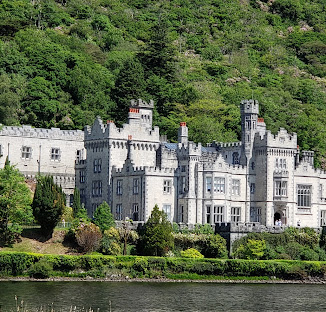
I just finished watching a most interesting programme. The series, The Hills Are Alive: A Year at Kylemore Abbey, documents different aspects of the Benedictine monastery in Galway’s Connemara. This Order of nuns came to Ireland from Belgium in 1920 and, since their arrival, has managed to transform the whole place.
Originally owned by a wealthy Englishman, Mitchell Henry, Kylemore became home to he and his wife. After Henry’s passing, the castle changed hands again before the nuns bought it. Kylemore has a fascinating history and boasts up to half a million visitors a year.
When I first visited Kylemore in the ‘80s, I was with a good friend who was a Benedictine priest. His status allowed us to see parts of the Abbey closed to visitors. The nuns were running a very successful school and farm.
I remember being in awe of the spectacular countryside surrounding the monastery. There was, and is, something quite special about this incredible place.
Since I was much younger then, I climbed up to the Sacred Heart statue, which is no mean feat. I’ve been back to the Abbey a couple of times since, and what amazes me each time I visit is how entrepreneurial these nuns are.
Given the Order’s diminishing numbers, I expected the whole place to fall into disrepair, but that wasn’t the case. Kylemore continues to thrive.
When the school closed in 2010, the sisters were forced to adapt to the changing times. Investing their time and effort in transforming the grounds, they were able to restore the gardens to their former glory.
By enlisting skilled environmentalists, they made a conscious choice to be sensitive to the new reality of climate change. What impresses me most about the sisters’ decision-making process is their deep sense of maintaining community.
With the new acquisitions of a shop and a restaurant to meet the demands of a growing tourist industry, the community refuses to become sidetracked from its spiritual goal of building a place of prayer. They have shown that you can sell homemade soaps and chocolates without selling your soul to the corporate world.
On my first visit to the Abbey, I saw no evidence of what it would later become. There was a simple modesty about the community struggling to keep its head above water. You can’t live in a Victorian castle with lavish grounds and not worry about paying the bills.
I’m sure that there are lots of communities who are faced with the same challenge. You either adapt or die. Thankfully, the nuns took on the challenge without feeling they’d sold their soul by doing so. During my second visit, we took a couple of friends with us from Chicago. The nuns still held Mass in the castle, and we were able to watch them at prayer.
Midges
What I remember most about the first visit—and it’s funny how things like this stay in your head—was the midges. For those who don’t know what midges are, they are small flies, little gnats that bite. I have not-so-fond memories of encountering these little beasts at Glenveagh Castle in Donegal, so I’m familiar with the pain and annoyance they can cause.
At dawn and dusk, those little flying monsters have a ferocious appetite for human flesh. And that’s why, on our second visit, I was not leaving the safety of an indoor space. We’d arrived at the wrong time for humans and the right time for midges.
I was back at Kylemore for a third time last May. Thankfully, we planned ahead and managed to have a midge-free visit.
Much had changed since the previous times I had visited. Visitors to the Abbey had obviously grown exponentially. There were crowds of people queuing up to buy tickets to tour the castle and its grounds. The shop and the restaurant were professionally run to meet the demands of enthusiastic tourists.
While it was still the same place, the changes were so noticeable. For one thing, the nuns had moved out of the castle and into a new purpose-built monastery. There was a bus to transport visitors to the walled gardens, where there was another café.
What we were seeing was the amazing talent and foresight of a small group of women to give people an experience they wouldn’t forget. I was impressed, but I was even more impressed after watching the series on Amazon Prime.
A Year at Kylemore
A Year at Kylemore opened my eyes to the behind-the-scenes work involved in keeping the castle up to date and relevant. And while the ageing community is facing these challenges with vigour, there is one challenge that is proving harder to meet head-on.
Vocations have not been forthcoming. There is a legacy to be passed on to a younger generation, but interest in this cloistered way of life is lacking.
This is not a new problem. Religious orders around the world face the same dilemma. How do you make such an archaic form of spirituality appealing to a generation weaned on social media?
It could be that this form of spirituality needs a radical change in order to recruit younger members. The canonization of the fifteen-year-old Carlo Acutis in 2006 showed a dramatic change in how saints were chosen. By choosing a young computer nerd, the Catholic Church became relevant to a younger generation. I’m not sure this step will make much difference, but it does show a willingness to make changes.
Kylemore’s future is at a very interesting juncture. Will it be surrendered to the Government because the nuns can no longer run it as a spiritual centre? Can the sisters meet the challenge of vocations in a world governed by technology?
If the nuns were able to transform their work to make Kylemore viable, if not profitable, then maybe they can find new ways to present their form of spirituality. It takes a creative mind to awaken such natural beauty. The nuns have proven this with the gardens, but can they awaken the soul?