



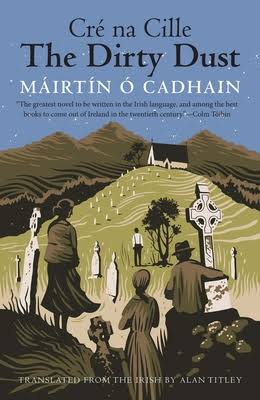
Máirtin Ó Cadhain’s Irish language novel is considered as one of, or possibly the most important works in modern Irish. The book was his third and his first novel. His goal was to “write a better novel than had previously been written in Irish.”
Ó Cadhain’s novel received critical aclaim upon it’s publication and has continued to win numerous awards. It was chosen by UNESCO as an outstanding work.
Máirtin Ó Cadhain was born January 4, 1906 in An Spidéal, Ireland. He became a school teacher, but his career was short-lived. He was dismissed as a result of his membership in the Irish Republican Army. In the 1930s he worked as an IRA recuiter, even enlisting the great Irish writer Brendan Behan.
He was also an active participant in the Land Campaign of native speakers and helped establish Ráth Cairn Gaeltacht in Co. Meath. His involvement with the IRA led to his subsequent arrest and confinement at the Curragh Camp in Co. Kildare.
Ó Cadhain’s politics were Republicanism mixed with Marxism. Privately he opposed the Catholic Church but was practical with his writing about the clergy. He knew the Church was there to stay, so he pushed for a commitment from the Catholic priests to conduct their services the Irish language.
Prior to Ó Cadhain’s works, modernist literature written in Irish had diminished after the execution of Padraig Pearse. Ó Cadhain revived that style, writing mostly in the Connacht dialect of Irish, but would borrow from other dialects, including Scottish Gaelic. This made his works difficult to understand for non-native speakers and even more difficult to translate into English.
Ó Cadhain’s politics were at the forefront of his activities after his dismissal from his teaching position. By 1939, the Irish authorities were after him. He was arrested in September and interned until December of that year.
n 1940, he gave a speech at Tony Darcy’s funeral. Darcy had died on a hunger strike at Mountjoy Prison. He had been seeking political prisoner status. After Ó Cadhain’s speech, he was once again arrested and spent four years with IRA members in the Curragh.
During his time in the Curragh, he taught many of his fellow inmates the Irish language. He also refined his writing prowess. When he was released in July of 1944, Éamon de Valera, the Taoiseach at the time, asked him to work on the English-Irish Dictionary.
In 1945, he married a teacher and fluent Irish speaker from Cavan. She was a noted teacher to the infant classes in South Dublin for many years. They settled in Dublin, where she continued her teaching career.
Ó Cadhain was appointed to the Parliamentary Translation Staff in Dublin in March of 1947. They had been tasked with forming a standardized spelling of Irish based on the spoken dialects along with the written language, leading to the Irish language reforms of the early 1950s.
His two books preceding Cré na Cille,were collections of short stories. Fellow writer and poet Eoghan Ó Tuairisc, speaking of Ó Cadhain’s 1948 book, An Braon Broghach said, “the born teacher discovering himself as the born writer.”
Cré na Cille (Graveyard Clay) was written over a couple of years, and was published in 1950. The novel is a dark comedy, it’s characters are all dead, buried in a graveyard in the west of Ireland.
Catríona Pháidín is one of the main characters. In death, as she was in life, she is a petty woman who holds grudges against those who survived her. Her living sister Nell is a favorite gripe, whom she spent the better part of her life feuding with.
She concerns herself with where she is buried as well, is it the affluent part of the cemetary, where someone of her perceived status should be, and what of her headstone, did her son obtain the best stone for it? When new arrivals are buried she questions them about it and becomes agitated when they are unable to provide her with details.
The subterranean conversations and monologues are as varied as their participants. Two men argue over football matches; a Frenchman, whose aircraft was shot down, is learning Irish in order to converse with his fellow corpses; there’s a schoolteacher, angered and obsessed with his younger wife who survived him, but married too soon after his demise for his liking.
The residents are no different in death than they were when alive. Their words, prejudices and social status have followed them to their graves. In short, the novel is a study of human behavior and a closer look at the hardships of life in the rural west coast of Ireland in the early 1940s.
The book was written in Connacht Irish and remained un-translated until 2015, when Alan Titley published Dirty Dust. Within a year, a second translation by Liam Mac Con Iomaire and Tim Robinson titled Graveyard Clay was released; in my opinion, an easier read.
Ó Cadhain published a third collection of short stories, Cois Caoláire, in 1953. He wrote another novel, Athnuachan, which he chose not to publish in his lifetime. That book first appeared in print in 1995.
During the remainder of the 1950s he wrote a regular column for the Irish Times. In 1962, he wrote a rather scathing satirical essay for the journal Comhar, lambasting individuals and institutions who he felt were remiss in their duty to the Irish language.
His renewed vigor in the political movement for Gaeltacht civil rights seemed to reinvigorate his creative writing as well. A fourth collection of short stories, Antsraith ar lár was published in 1967.
He was awarded the Irish- American Cultural Institute’s Butler prize for this work. He followed that with An tsraith dhá tógáil in 1970, his final collection of stories.
His main focus in the last decade of his life was fighting for the Irish language. He joined Misneach, a group dedicated to resisting the populist movement to make the language non-compulsory for students to receive a Leaving Certificate. They also fought to keep it mandatory for perspective government employees to speak Irish.
Ó Cadhain also renewed his affiliation with the IRA, supporting armed resistance to British Rule and a united Ireland. Máirtín Ó Cadhain passed away in a Dublin hospital on October 18, 1970.
I started to read Graveyard Clay a few years ago, but set it aside. I found it difficult to follow the conversations between the characters. I gave it a second try earlier this year and found it easier to follow and appreciate the characters. I think I had first expected a horror or folktale from the title as opposed to the study of the human condition.