


Beyond the Edge of the World
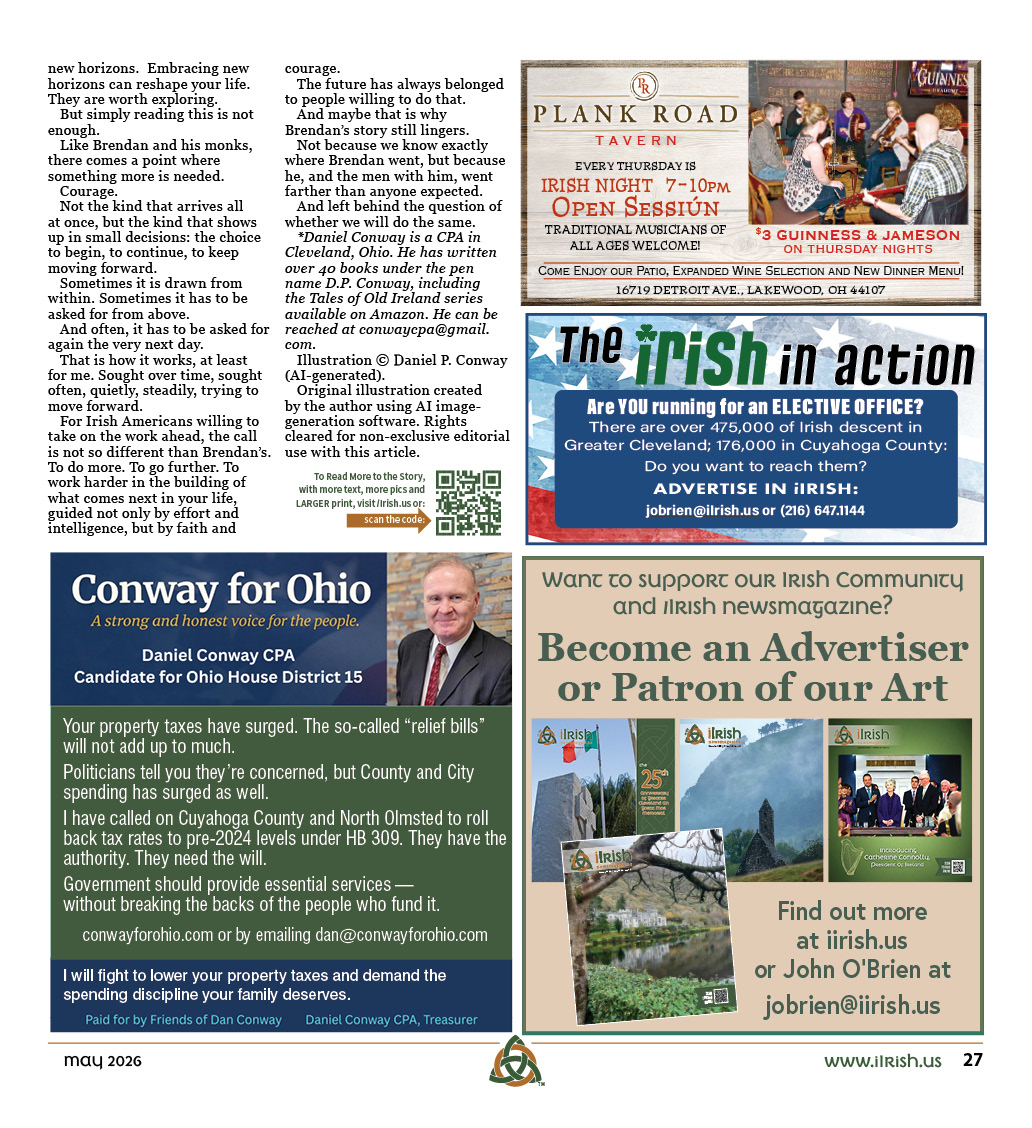
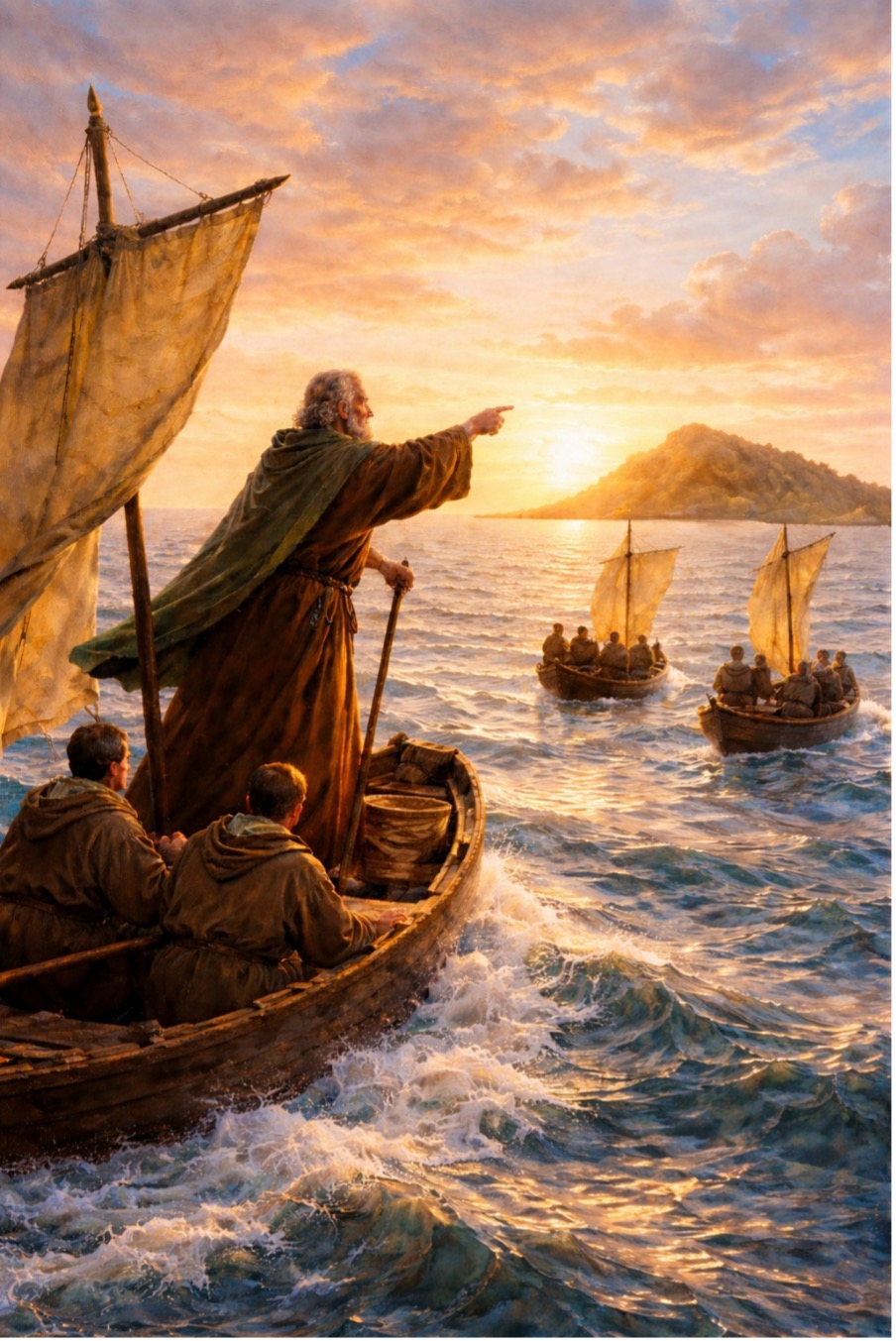
There were three curraghs, boats light and flexible, their wooden frames wrapped tight in stretched leather, sealed against the sea. Built for skill, not size. They rested at the edge of the western coast of Ireland, where the land breaks apart into rock and wind and open water.
Fourteen monks, all in simple brown robes worn from use, not ceremony had said Mass the day before with their community. They had eaten together one last time on land—nothing elaborate, just bread, perhaps fish, quiet conversation, and the unspoken understanding that something final was taking place.
At dawn, they gathered again. They turned east, as they always did, and prayed.
The rising sun touched their faces—warm, steady, familiar. It would be the last time they felt it from solid ground for a long while.
As the men stood ready, Brendan lowered his head for a final prayer, probably for strength, probably for courage. The three boats were pushed into the waves.
Behind them, Ireland, the only home they had ever known. Ahead, only the horizon.
By nightfall, they would pray again—at sea, watching the sun slip below the water to the west. And then, quietly, through the night, they would keep going, taking turns, moving forward.
Brendan, and those with him, knew why. It was not for land, it was n ot for wealth., it was not to prove anything at all. It was something older than that – a willingness to leave – not to find a new world, but to leave the old one behind. In their time, to step away from what was known was an act of faith.
At times, the sea turned against them – sudden winds, waves rising higher than the boats were made to bear. Storms that tested wood, leather, and men alike. There was sickness and loss.
There were moments when turning back would have made sense. But they pressed on.
At some point, something changed. It was not sudden. But slowly, steadily, the sea water grew colder. Heavier. The air sharpened.
The birds were different, larger, moving with a purpose that did not belong to the coast they had left behind. Even the light seemed to linger longer than it should.
They made Iceland, and probably Greenland, but did they eventually make it to North America? Some way, yes. And there is, in truth, a way across that ocean.
From Ireland to Iceland. From Iceland to Greenland. And from there, west again—to Newfoundland, in North America.
Not one long crossing, but a series of passages instead. Each is within reach; each is guided by wind and current, and it leaves open the possibility that long before the Vikings, long before Columbus, a small group of Irish monks may have stepped ashore in North America.
They did not stay. That is what makes the moment different from all that would come later in history.
No flag. No claim. No attempt to take hold of what they found. For reasons the story never fully explains, they left it all behind, and six years later, long given up for dead, they returned to the west of Ireland.
The story of Brendan does not end at the western shore of the Wild Atlantic Way. It carries forward in every generation that chooses to move ahead—to build, to grow, to take on what lies in front of them.
For those who came after – for those who crossed oceans of their own, who built lives in new places, who carried their faith, their hopes, their habits, and their way of seeing the world with them – the pattern remained. Not waiting, but going forward. Taking the next step toward something more.
Today, there are no new continents left to discover. But discovery itself hasn’t ended. It has shifted. New horizons are still out there waiting.
One of the most important new horizons is artificial intelligence. Across every field of human endeavor – science, medicine, finance, technology, education, even the way we understand ourselves, new frontiers are opening. And with AI, they are opening faster than ever before.
AI
It reveals patterns we could not see, offers new ways of understanding what was always there, and unlocks levels of productivity that would have been hard to imagine even a few years ago.
I embraced Chat GPT two years ago, and I will never look back. I encourage everyone to download it on your phone and turn to it instead of Google.
But not every new horizon is found in technology. Some are much closer. They appear in everyday life.
Because the most important frontiers are not always far away. Sometimes, they are right in front of you.
In relationships: reaching out when it would be easier not to, repairing what has been left unattended, opening yourself to new friendships or new circles. In discipline: taking care of your health, starting a daily gym routine, or simply getting out to walk each day.
In habits: letting go of what holds you back, what’s in the way, and making room for something better. In faith: returning to prayer, coming back to Mass, perhaps even weekday Mass, going to confession again, or finding a way to serve at your parish or local food pantry.
These are the horizons waiting to be discovered by many of us. For me, becoming a writer, meeting Bridgie Ned, and running for office are a few ways I’ve stepped forward toward new horizons. Embracing new horizons can reshape your life. They are worth exploring.
But simply reading this is not enough. Like Brendan and his monks, there comes a point where something more is needed.
Courage. Not the kind that arrives all at once, but the kind that shows up in small decisions: the choice to begin, to continue, to keep moving forward.
Sometimes it is drawn from within. Sometimes it has to be asked for from above. And often, it has to be asked for again the very next day.
That is how it works, at least for me. Sought over time, sought often, quietly, steadily, trying to move forward.
For Irish Americans willing to take on the work ahead, the call is not so different than Brendan’s. To do more. To go further. To work harder in the building of what comes next in your life, guided not only by effort and intelligence, but by faith and courage.
The future has always belonged to people willing to do that. And maybe that is why Brendan’s story still lingers.
Not because we know exactly where Brendan went, but because he, and the men with him, went farther than anyone expected. And left behind the question of whether we will do the same.
Illustration © Daniel P. Conway (AI-generated).
Original illustration created by the author using AI image-generation software. Rights cleared for non-exclusive editorial use with this article.