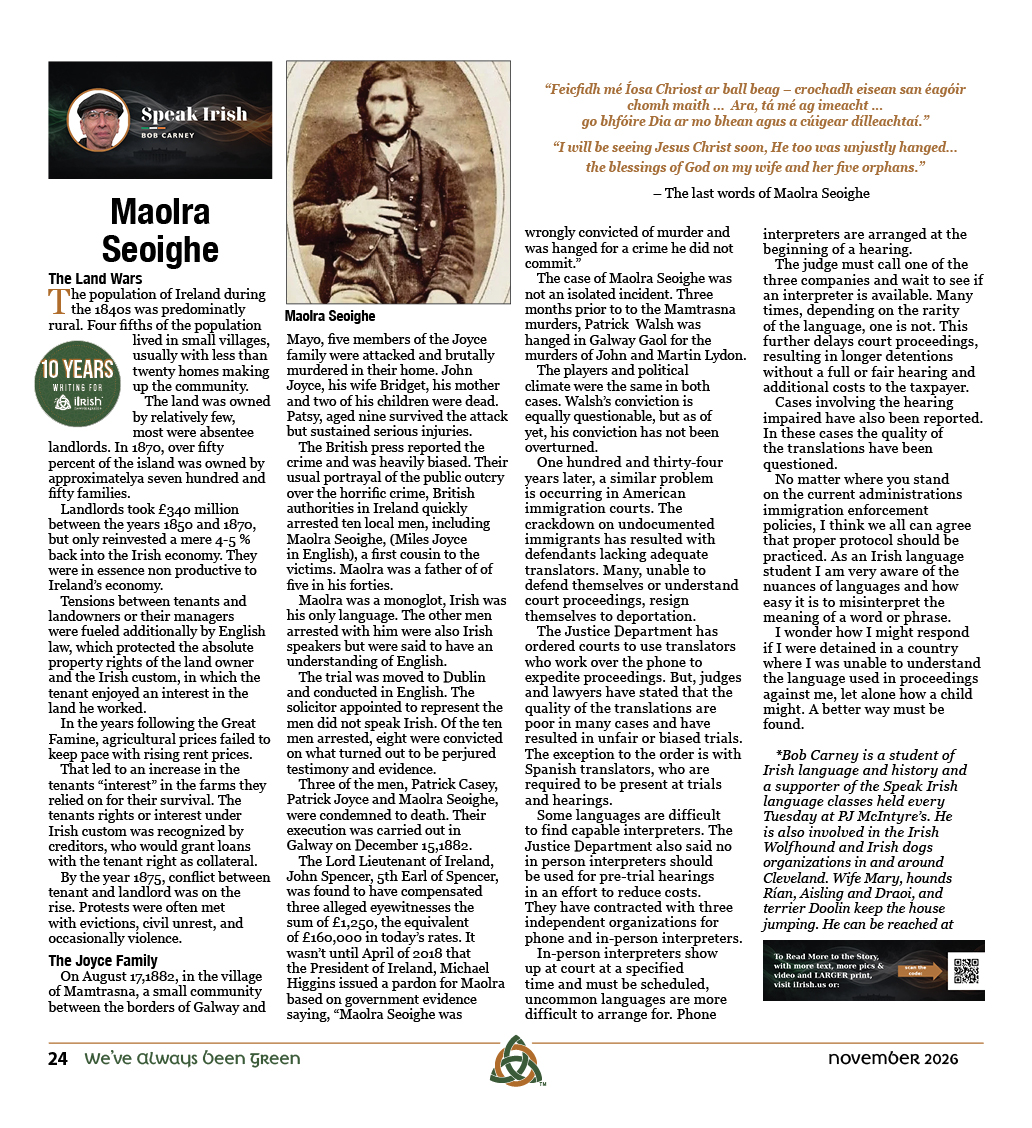




Maolra Seoighe
“Feicfidh mé Íosa Chriost ar ball beag – crochadh eisean san éagóir chomh maith …
Ara, tá mé ag imeacht …
go bhfóire Dia ar mo bhean agus a cúigear dílleachtaí.”“I will be seeing Jesus Christ soon, He too was unjustly hanged…
the blessings of God on my wife and her five orphans.”– The last words of Maolra Seoighe
The Land Wars
The population of Ireland during the 1840s was predominatly rural. Four fifths of the population lived in small villages, usually with less than twenty homes making up the community.
The land was owned by relatively few, most were absentee landlords. In 1870, over fifty percent of the island was owned by approximately seven hundred and fifty families
Landlords took £340 million between the years 1850 and 1870, but only reinvested a mere 4-5 % back into the Irish economy. They were in essence non productive to Ireland’s economy.
Tensions between tenants and landowners or their managers were fueled additionally by English law, which protected the absolute property rights of the land owner and the Irish custom, in which the tenant enjoyed an interest in the land he worked. In the years following the Great Famine, agricultural prices failed to keep pace with rising rent prices.
That led to an increase in the tenants “interest” in the farms they relied on for their survival. The tenants rights or interest under Irish custom was recognized by creditors, who would grant loans with the tenant right as collateral.
By the year 1875, conflict between tenant and landlord was on the rise. Protests were often met with evictions, civil unrest, and occasionally violence.
The Joyce Family
On August 17,1882, in the village of Mamtrasna, a small community between the borders of Galway and Mayo, five members of the Joyce family were attacked and brutally murdered in their home. John Joyce, his wife Bridget, his mother and two of his children were dead. Patsy, aged nine survived the attack but sustained serious injuries.
The British press reported the crime and was heavily biased. Their usual portrayal of the public outcry over the horrific crime, British authorities in Ireland quickly arrested ten local men, including Maolra Seoighe, (Miles Joyce in English), a first cousin to the victims. Maolra was a father of of five in his forties.
Maolra was a monoglot, Irish was his only language. The other men arrested with him were also Irish speakers but were said to have an understanding of English.
The trial was moved to Dublin and conducted in English. The solicitor appointed to represent the men did not speak Irish. Of the ten men arrested, eight were convicted on what turned out to be perjured testimony and evidence.
Three of the men, Patrick Casey, Patrick Joyce and Maolra Seoighe, were condemned to death. Their execution was carried out in Galway on December 15,1882.
The Lord Lieutenant of Ireland, John Spencer, 5th Earl of Spencer, was found to have compensated three alleged eyewitnesses the sum of £1,250, the equivalent of £160,000 in today’s rates. It wasn’t until April of 2018 that the President of Ireland, Michael Higgins issued a pardon for Maolra based on government evidence saying, “Maolra Seoighe was wrongly convicted of murder and was hanged for a crime he did not commit.”
The case of Maolra Seoighe was not an isolated incident. Three months prior to to the Mamtrasna murders, Patrick Walsh was hanged in Galway Gaol for the murders of John and Martin Lydon.
The players and political climate were the same in both cases. Walsh’s conviction is equally questionable, but as of yet, his conviction has not been overturned.
One hundred and thirty-four years later, a similar problem is occurring in American immigration courts. The crackdown on undocumented immigrants has resulted with defendants lacking adequate translators. Many, unable to defend themselves or understand court proceedings, resign themselves to deportation.
The Justice Department has ordered courts to use translators who work over the phone to expedite proceedings. But, judges and lawyers have stated that the quality of the translations are poor in many cases and have resulted in unfair or biased trials. The exception to the order is with Spanish translators, who are required to be present at trials and hearings.
Some languages are difficult to find capable interpreters. The Justice Department also said no in person interpreters should be used for pre-trial hearings in an effort to reduce costs. They have contracted with three independent organizations for phone and in-person interpreters.
In-person interpreters show up at court at a specified time and must be scheduled, uncommon languages are more difficult to arrange for. Phone interpreters are arranged at the beginning of a hearing.
The judge must call one of the three companies and wait to see if an interpreter is available. Many times, depending on the rarity of the language, one is not. This further delays court proceedings, resulting in longer detentions without a full or fair hearing and additional costs to the taxpayer.
Cases involving the hearing impaired have also been reported. In these cases the quality of the translations have been questioned.
No matter where you stand on the current administrations immigration enforcement policies, I think we all can agree that proper protocol should be practiced. As an Irish language student I am very aware of the nuances of languages and how easy it is to misinterpret the meaning of a word or phrase.
I wonder how I might respond if I were detained in a country where I was unable to understand the language used in proceedings against me, let alone how a child might. A better way must be found.