



May 1916, Retribution
“Sometimes my heart hath shaken with great joy,
To see a leaping squirrel in a tree,
Or a red lady-bird upon a stalk,
Or little rabbits in a field at evening,
Lit by a slanting sun.”
Excerpt from “The Wanderer” by Padraig Pearse
Written on the eve of his execution by firing squad at Kilmainham Gaol May 3, 1916.
Ireland was ruled from London in the early twentieth century. Home Rule had been promised, but had been delayed so many times, Irish nationalists felt it would never happen.
With the outbreak of World War I, nationalists believed that the cultural revival in the Irish language and literature, the political frustration that was growing across the land and Britain’s distraction in Europe provided the perfect opportunity for armed rebellion. “England’s difficulty is Ireland’s opportunity.”
The Rising was organized by a group of men with little to no experience in military operations. The British had learned of the planned rising and had made arrests throughout the country, mainly limiting the rebellion to Dublin alone.
The rebels siezed a number of government buildings and held them at great expense for a few days. They were outmanned, outflanked and outgunned. By Saturday, April 29, they surrendered to British officers, hoping to prevent further deaths and destruction.
Fifteen participants of the Easter Uprising were executed between May 3rd and 12th, 1916. Those executions became the true catalyst for the Irish War of Independence.
James Connolly, who had been shot in the ankle and leg during the Easter Rising, was tied to a chair to face the firing squad on May 12. A 16th, Roger Casement, was hung in London on August 3rd of the same year.
In addition, over 3,000 men and 79 women were arrested, two-thirds of them were sent to British internment camps. The executions and arrests were conducted under martial law, declared by Major-General Sir John Maxwell.
The aftermath of the events of May 1916 became a turning point in Irish history. Irish public opinion went from one of indifference or even hostility toward the rebels into an almost universal support for Irish Independence.
The men that were at first blamed for causing the deaths of innocents and the destruction of Dublin were now being hailed as martyrs. The change in public opinion allowed a failed military operation to become a political victory.
A wave of resentment swept the country. Police observed an increase in Memorial Masses for the executed rebels, financial aid funds being set up for their surviving families and a growing number of songs and ballads recounting the events of The Rising. The government also noted the decrease in recruitment levels into the British Army in the middle of “The War to End All Wars.”
Dáil Éireann
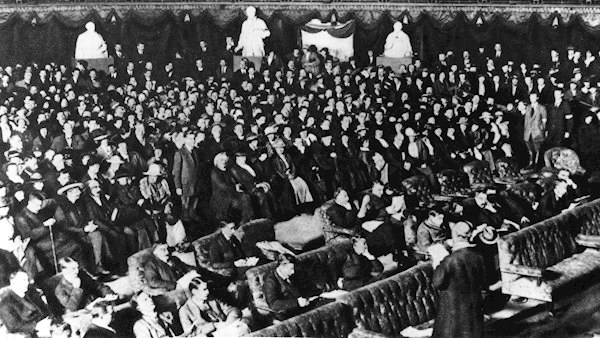
Support for independence grew. Sinn Féin, became the main political voice for an independent republic. In 1918, Sinn Féin won a landslide victory in the elections, defeating moderates. Instead of taking their seats in Westminster, they formed Dáil Éireann in Dublin and declared independence.
Public opinion has changed the way governments and politicians operate in modern times. It can dictate the platform a potential canidate for public office might use. It is now used by legislators and policy makers in all decisions.
Public opinion has set policy and regulation in almost all nations at one time or another. The U.S. policies on pollution in the early seventies only came about because a large number of American voters demanded action.
Vietnam
The end to the Vietnam War came about because voters demanded it. Two instances where public opinion changed policy. There are many, many more.
Today, public opinion is gathered through the use of polling. Ideally, asking a cross-section of voters, should provide the pollster an informed understanding of what the public thinks on matters of importance.
Now, if polling on a given topic agrees with your own point of view, you will side with the accuracy of it’s conclusion. If it doesn’t, you will likely dismiss the findings and become skeptical of the manner in which the poll was conducted.
Did the pollsters ask the right questions? Were the questions worded to get a response the pollster required to make the results work?
Who did the poll? Who paid for the poll? These questions are generally not asked if the poll coincides with your own opinion, but they should be.
“…we all know that in all matters of opinion that every man is insane- just as insane as we are… we know exactly where to putour finger upon his insanity: it is where his opinion differs from ours… all Democrats are insane, but not one of them knows it. None but the Republicans. All of the Republicans are insane, but only the Democrats can perceive it. The rule is perfect: in all matters of opinion our adversaries are insane.” – Mark Twain
Another very important question to consider is our own knowledge on the topic of the poll. A popular saying today is that “everyone is entitled to their own opinion,” but that statement is questionable when it comes to uninformed opinions.
“You are not entitled to your opinion. You are only entitled to what you can legitimately argue for.” – Professor Patrick Stokes, Deakin University, Melbourne
Possessing critical thinking skills safeguards against the pitfalls of unfounded opinions. Opinions based on feelings or a lack of knowledge are worthless to society as a whole.
Equally dangerous are opinions that are echoed instead of being researched. When that occurs, we truly have become sheep, pawns at the mercy of paid talking heads. We lose all power when we allow someone to spoon feed our opinions to us.
Modern media is a major factor in contributing to public opinion, but for us to accept only one avenue of thought before arriving at an opinion is not an informed judgement.
With social media and AI reshaping how we receive information, it requires work on our part to make crucial decisions regarding government.
Years ago, a friend went on one of his political rants that he was known for after a beer or two. He said that professional sports in the U.S. were designed by the government to keep people from discussing the important issues of the day.
He told us to go to work on Monday and see if anyone talks about what the government is doing or are they all too busy talking about the “Big Game” the day before. The game that really has no bearing on most peoples lives.
We all laughed at his rant, but he did make legitimate points. Too many of us remain in the dark until it is too late. This administration and it’s devisive policies would not exist had we all paid attention sooner.
Dar liom féin! (“So says I!)”