



The Cry to Heaven
In early September, Marisa and I were gathered for the Rosary at St. Brendan’s Adoration chapel, the evening Rosary that honors Our Lady of Knock. A woman we know came in late from her busy day. She walked over, genuflected, knelt down on the carpet as she always does, and quietly lifted the rosary from around her neck and began to pray.
Maybe it was how the evening sunlight was falling on her. But for a moment I was not looking at one woman in Cleveland. I was looking at Irish women of centuries past, pausing the day’s labor, kneeling on the ground, taking out the beads, and beginning the cry to Heaven.
That is what the Rosary was to our people. Not a devotion added onto life, but the sound their sorrow made.
They were a people with no power and no recourse. No parliament heard them. No landlord answered them. No doctor could reach them in time. What they had was the Mother of God and the beads on the nail by the fire.
The Unkillable Church
There were long years when even the Mass was taken from them. The priest had a price on his head, saying Mass at a rock in the glen while a boy stood watch on the hill. So, the church came down to its unkillable core: the family on the floor, and the mother leading the mysteries.
Just the voices, and a rosary made small for the times, a single decade on a cord, little enough to hide in a fist. They could take the priest. They could take the building. They could not take the murmur by the fire.
For a hundred years, that murmur was the Catholic Church in Ireland, kept burning by mothers on dirt floors. That is how the beads became bone-deep in us. The Rosary did not decorate the faith of the Irish. It carried it, through the years when nothing else could.
And ever after, the beads came out at every extremity of life. In the black years, when the evening prayer rose over empty pots. When the child drowned off the rocks, or was taken by fever in a night, and the neighbors were kneeling in that kitchen within the hour, because there was nothing else on earth to be done.
When a mother labored in the room below and the household knelt by the fire, listening for the cry of new life, or bracing for the other silence. At the midnight wake, the room packed, the dead laid out among them, the answering voices rolling through the house like low thunder.
The old people did not recite the Rosary. They cried it. It rose and fell like keening, the leader’s voice and the answering murmur, sorrow given words when sorrow had nowhere else to go.
Heaven was not far away to them. Heaven was the nearest door, and the beads were the knock upon it.
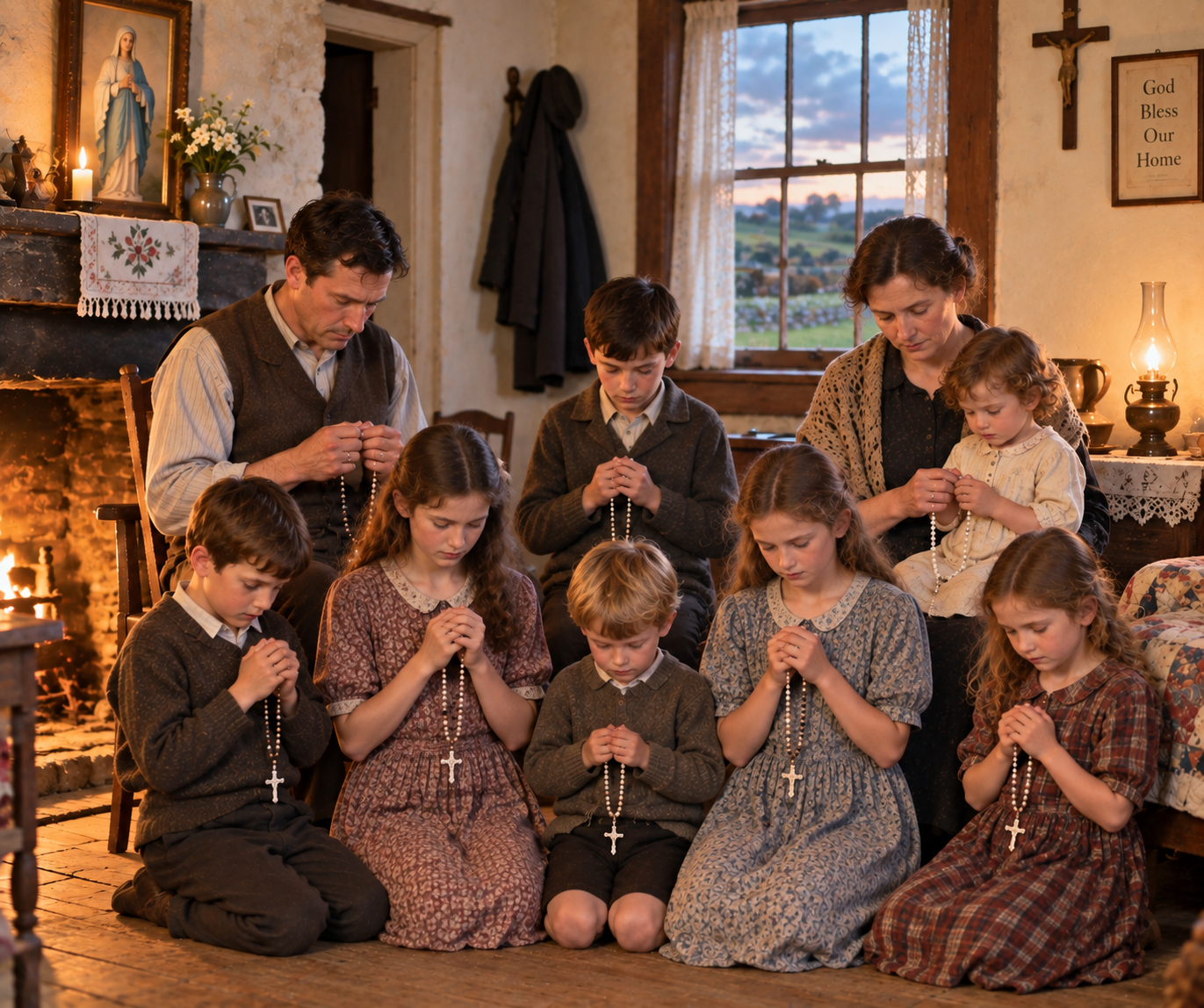
And on the ordinary nights, which were most nights, it was simply the end of the day. As the light went long, the mother or father stood at the door calling the children in, and the older ones rounded up the young from the lanes and the yards.
After supper, in every house in Doona village and most of the west of Ireland, the beads came down off the nail. Knees found the dirt floor, elbows found the chairs, and the youngest learned the prayers the way they learned everything, by kneeling next to someone who already knew.
The voices rose and fell like a tide. If neighbors had called in for the evening, they knelt where they were. Whatever house the hour caught you in, that family’s Rosary was yours.
And at the end came the trimmings, the old prayers added on. For the sons and daughters in America, by name. For the dead, by name. For the sick, for the harvest, for the mother near her time.
Every night, every soul on that shore was named aloud somewhere. If you could have stood above the west of Ireland at nine o’clock, the whole coast would have been one low murmur, rising.
Almost everything made the crossing from old Ireland to America. The music came over. The wake came over. The Mass, the fast, the feast days came over. But the family Rosary, the church of the home, for many, stayed behind. It carried for some, at least at first.
But in many homes it faded on American air, and no one ever said why. My father never said the Rosary in our home. As a Catholic kid I knew what it was, and that was all I knew.
For me, like many firstborns of Irish immigrants, wild years came, and desperation with them, and somewhere in that darkness I began saying Hail Marys one at a time, the way a drowning man grabs at anything.
Then came the unlikely girl who introduced me to Christ, and a marriage, and a wedding gift that would change our life. Someone gave us a little booklet from a group called the Word Rosary Intercessors. It has scripture verses in the midst of each decade.
Marisa and I began to pray the Rosary as a couple. When our children were small, we turned the lights down in the evening, lit a candle, and felt the church come into the home. Our routine we called Rosary, Snack, Story, Bed. We thought we had started something new. It is something our children fondly remember.
Then one day an old cousin from Ireland, Molly Cleary, who had been raised in my grandfather’s house, said to me in passing, “You know, your grandfather used to say the rosary with his family every night.”
I had never known. Daniel Patrick Conway of Doona, born 1892, knelt with his family on a dirt floor every evening of their lives. Daniel Patrick Conway of Cleveland, born 1963, said the Rosary with his family by candlelight, never knowing he was continuing anything at all.
The beads had crossed the ocean without a hand to carry them. The cry to Heaven had found its way back.
Our Lady of Knock
October is the month of the Rosary. And I keep thinking of Our Lady of Knock, who came to the poorest people in Mayo in the rain, at a gable wall, and said not one word. She did not need words. She came to stand with them.
She will stand with us too. This fall and winter, we can bring her into our evenings the way our people always did: quiet the house, turn our eyes to Heaven, and cry out for those around us in need.