


The Passing of Old Ireland
On the fourth of August, my father died. Patrick James Conway, whom everyone called PJ, aged 92. As I sat with that date, another August rose up behind it.
In August of 1846, 180 years ago, the potato failed a second year running, and this time entirely. One bad year could be endured, and had been before. Two could not.
Black 47
What followed was Black ’47, among the darkest years any nation has endured. Two Augusts, one story that belong to the same telling.
The famine did not simply wound Ireland. It ended one world and forged another.
Before it, eight million people lived on land divided and re-divided among the sons. After it, the farm passed whole to one son, and the rest were raised for the boat.
Emigration became an institution: the letter from America, the passage money, the expected path. And a shattered people, those who left and those who stayed alike, bound themselves to the faith that had not failed them when everything else had.
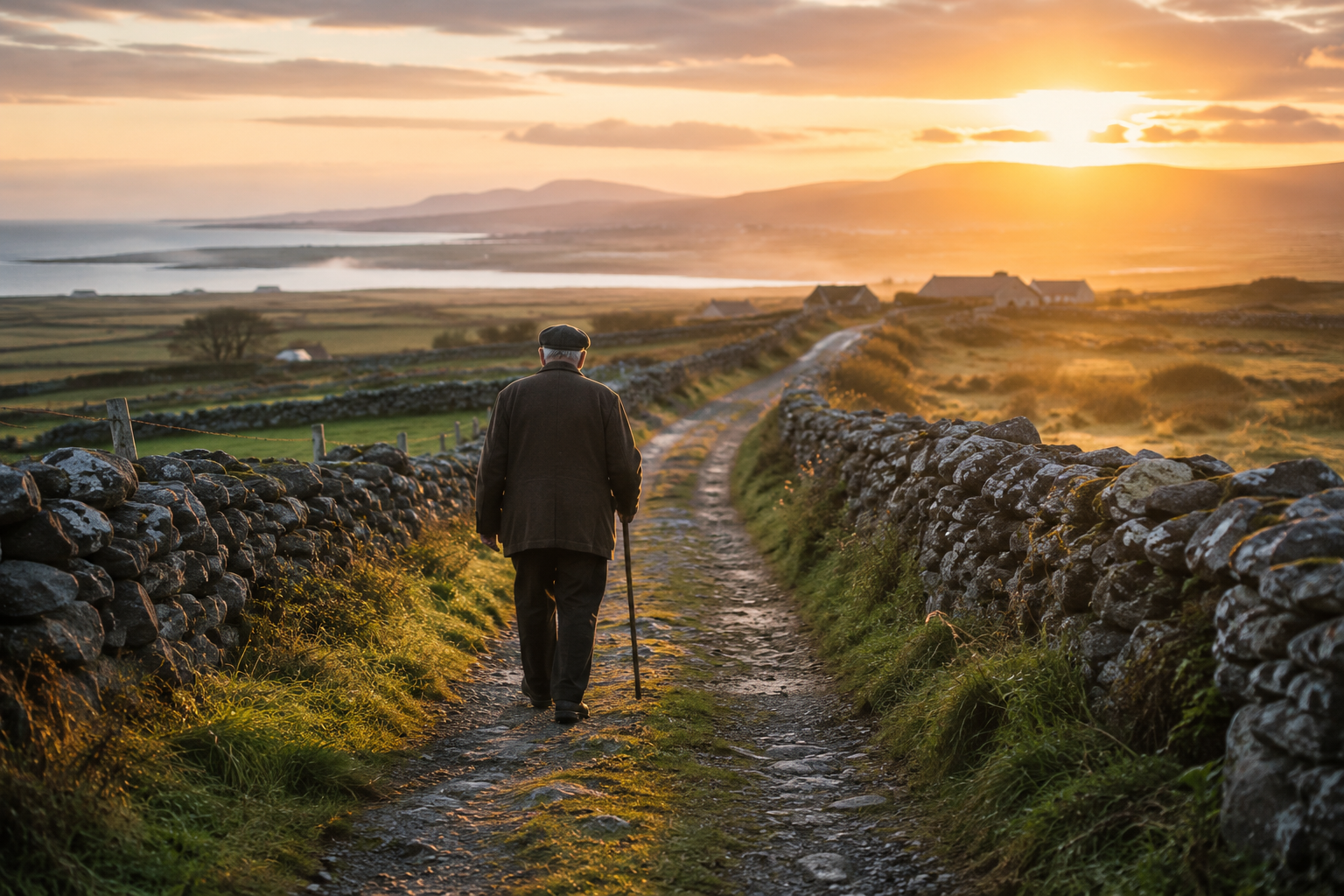
Then, at home, the remarkable thing happened: the world the famine made simply stopped changing. It held for 125 years. Doona, Ballycroy, and most of the west in the early 1970s were, in their daily bones, the same as 1848.
The well, the turf, the fields, the lamp in the window, the cow walked to the fair. What we call old Ireland was the famine’s long afterlife, and it lasted into living memory.
Some who are still with us today stood inside it. PJ was born in Doona in 1933, into the world the famine made, while the famine’s last children still walked the earth. That world was not history to his elders; it was their parents and grandparents.
PJ was the boy in last month’s column, driving two cows beside his old father through the dark to the fair in Bangor. He became the emigrant to Cleveland, the working man, the quiet father who spoke little of any of it.
He died in the age of the screen, having watched the famine’s century dissolve. One life held the whole passing.
The house he was born into had no electricity and no tap, and never would while he lived in it. It was the same house, the same cow path, the same fire it had been for over a hundred years.
When I stood on a fence post above the Sandy Banks in 1973, nine years old, and felt for a moment that time had stopped and forever lay in front of me, I was looking across the field beside the sea where my ancestors, the McManamons, lived through the hunger itself.
I did not know it then. The famine ground and the forever ground were the same ground.
What held a people together through such a century? Not wealth; they had none. Not ease; there was none. Four things held them, and the famine forged each into something stronger.
Faith
The four-mile walk to church in rain and wind; the beads by the fire every night; the practice of a people who had watched the crop fail, the landlord fail, the government fail, and found that one thing had not. They knelt because they knew exactly how much depended on what was above them.
Hope
The seed potato saved even in hunger; the letter from America read aloud by lamplight; hope in that world was not a feeling; it was a discipline, practiced daily against the evidence.
Kindness to One’s Neighbor
The wake sat through the night; the grave dug in the rain; the shared work of the hay field; the door never locked; the famine had taught the lesson beneath the custom: the year could come when it was your house, your hunger, your field, your dead.
Hard Work
The turf cut, the reek built, the hay saved before the weather broke, the road walked at five in the morning. The winter forgave nothing, so nothing was left undone. Work was not ambition; it was devotion, the daily keeping of one’s family against the dark.
Faith, hope, kindness, work – they were not virtues hung on the wall – they were survival. For generation after generation, whenever the old world could no longer hold its children, they carried those four things onto the ships.
They built churches from stone. They laid the rails, raised the beams, nursed the sick, taught the classrooms, filled the police forces and fire brigades of half the world.
Suffering had enlarged their hearts; the nations they entered were the better for it. The world after the famine raised them; the whole world received them.
My father was one of the carriers. Doona to Cleveland, the whole gift in one quiet man who never called it a gift, or called it anything at all.
In Cleveland and a hundred cities the carriers made little Irelands in the parishes, the kitchens, the halls, the music, and held the old world alive another half century. Now, one by one, we are losing them: the revered elders of the last wave, the men and women who drew water from wells as children. My father among them.
And as they pass away, we are not mourning our own alone. We are witnessing the final passing of old Ireland itself.
My father never spoke of his boyhood road. But in 1973, he took a nine-year-old son across an ocean and set him down in the world that made him and let the world do the telling. The well path, the cows, the turf fire, the fence above the Sandy Banks; I felt forever on my ancestors’ field because my father put me there.
I understand it now. The silence never stopped the inheritance. The handing was the love. The passing is complete. The man and the world went together.
But the famine’s terrible lantern was never the only light in this story. Against it, in the worst of the dark, a people lit a lamp: faith, hope, kindness to a neighbor, the dignity of hard work – and it did not go out. It crossed on the ships; it burned in Cleveland, New York, and Boston.
And now it passes to us. For those of us who carry responsibility, and every one of us does, in a job, a home, a parish, a city, a nation: ours is to hold to the old values, for they held a people together. For parents and grandparents, ours is to hand down the faith, the work, and the remembrance of whom we came from. And to the young men and women behind us, the workers, parents, and leaders of tomorrow: it falls to you not only to know where your ancestors looked in the dark, but to rely on the same God, who asks us now to carry the light.
Old Ireland asks nothing back. It asks only to be carried.