


How I Became Irish: Reflections of my First Year as a Columnist
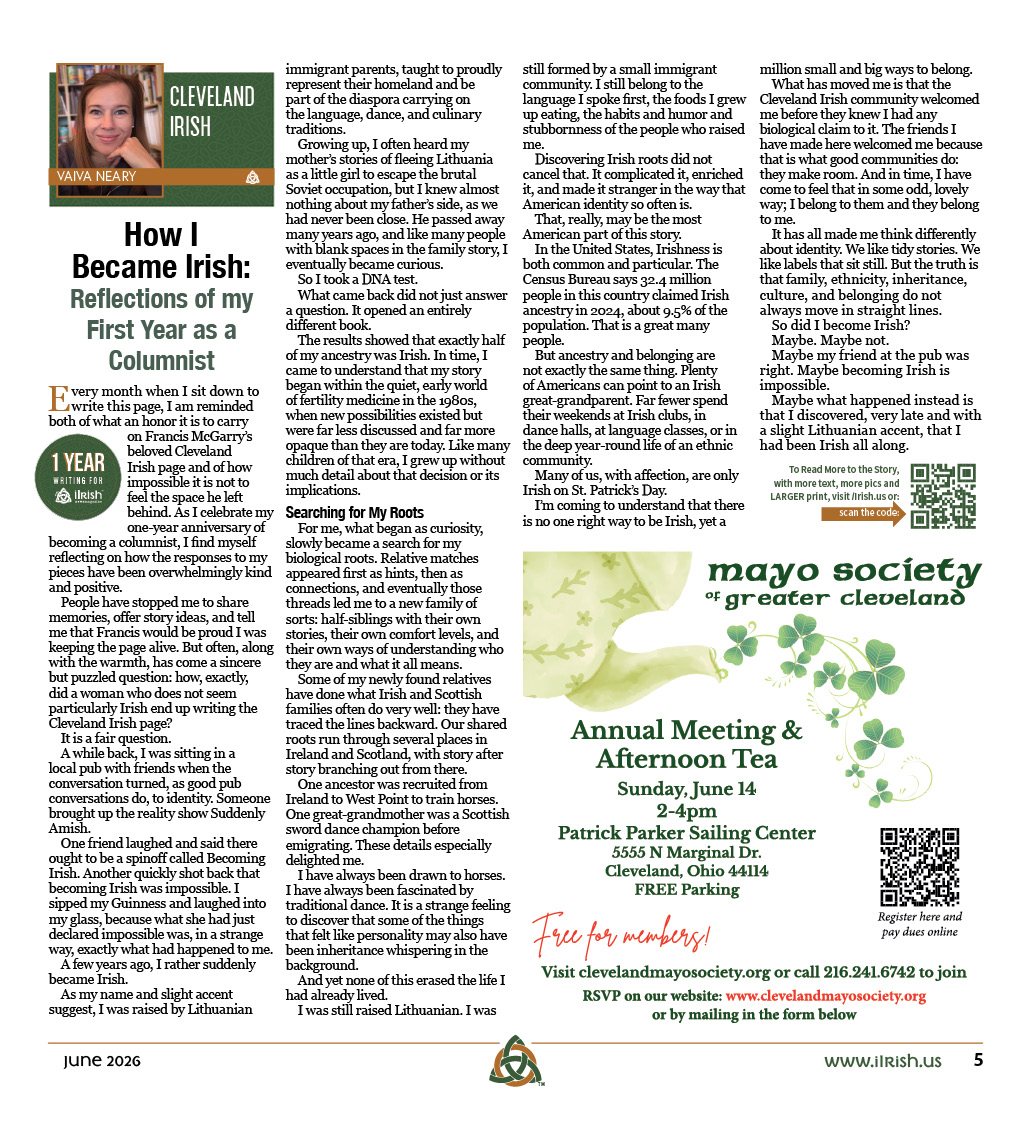
Every month when I sit down to write this page, I am reminded both of what an honor it is to carry on Francis McGarry’s beloved Cleveland Irish page and of how impossible it is not to feel the space he left behind. As I celebrate my one-year anniversary of becoming a columnist, I find myself reflecting on how the responses to my pieces have been overwhelmingly kind and positive.
People have stopped me to share memories, offer story ideas, and tell me that Francis would be proud I was keeping the page alive. But often, along with the warmth, has come a sincere but puzzled question: how, exactly, did a woman who does not seem particularly Irish end up writing the Cleveland Irish page?
It is a fair question. A while back, I was sitting in a local pub with friends when the conversation turned, as good pub conversations do, to identity. Someone brought up the reality show Suddenly Amish.
One friend laughed and said there ought to be a spinoff called Becoming Irish. Another quickly shot back that becoming Irish was impossible. I sipped my Guinness and laughed into my glass, because what she had just declared impossible was, in a strange way, exactly what had happened to me.
A few years ago, I rather suddenly became Irish. As my name and slight accent suggest, I was raised by Lithuanian immigrant parents, taught to proudly represent their homeland and be part of the diaspora carrying on the language, dance, and culinary traditions.
Growing up, I often heard my mother’s stories of fleeing Lithuania as a little girl to escape the brutal Soviet occupation, but I knew almost nothing about my father’s side, as we had never been close. He passed away many years ago, and like many people with blank spaces in the family story, I eventually became curious. So I took a DNA test.
What came back did not just answer a question. It opened an entirely different book.
The results showed that exactly half of my ancestry was Irish. In time, I came to understand that my story began within the quiet, early world of fertility medicine in the 1980s, when new possibilities existed but were far less discussed and far more opaque than they are today. Like many children of that era, I grew up without much detail about that decision or its implications.
Searching for My Roots
For me, what began as curiosity, slowly became a search for my biological roots. Relative matches appeared first as hints, then as connections, and eventually those threads led me to a new family of sorts: half-siblings with their own stories, their own comfort levels, and their own ways of understanding who they are and what it all means.
Some of my newly found relatives have done what Irish and Scottish families often do very well: they have traced the lines backward. Our shared roots run through several places in Ireland and Scotland, with story after story branching out from there.
One ancestor was recruited from Ireland to West Point to train horses. One great-grandmother was a Scottish sword dance champion before emigrating. These details especially delighted me.
I have always been drawn to horses. I have always been fascinated by traditional dance. It is a strange feeling to discover that some of the things that felt like personality may also have been inheritance whispering in the background.
And yet none of this erased the life I had already lived. I was still raised Lithuanian. I was still formed by a small immigrant community. I still belong to the language I spoke first, the foods I grew up eating, the habits and humor and stubbornness of the people who raised me.
Discovering Irish roots did not cancel that. It complicated it, enriched it, and made it stranger in the way that American identity so often is. That, really, may be the most American part of this story.
In the United States, Irishness is both common and particular. The Census Bureau says 32.4 million people in this country claimed Irish ancestry in 2024, about 9.5% of the population. That is a great many people.
But ancestry and belonging are not exactly the same thing. Plenty of Americans can point to an Irish great-grandparent. Far fewer spend their weekends at Irish clubs, in dance halls, at language classes, or in the deep year-round life of an ethnic community.
Many of us, with affection, are only Irish on St. Patrick’s Day. I’m coming to understand that there is no one right way to be Irish, yet a million small and big ways to belong.
What has moved me is that the Cleveland Irish community welcomed me before they knew I had any biological claim to it. The friends I have made here welcomed me because that is what good communities do: they make room. And in time, I have come to feel that in some odd, lovely way; I belong to them and they belong to me.
It has all made me think differently about identity. We like tidy stories. We like labels that sit still. But the truth is that family, ethnicity, inheritance, culture, and belonging do not always move in straight lines.
So did I become Irish? Maybe. Maybe not.
Maybe my friend at the pub was right. Maybe becoming Irish is impossible. Maybe what happened instead is that I discovered, very late and with a slight Lithuanian accent, that I had been Irish all along.