


In the Stillness
Thursday, 21 August 1879. 10:30 pm.
Father Cavanagh, seventy years of age and feeling each of them in his bones, did not like traveling after dark. The rain had eased to a warm drizzle, but the road from Claremorris to the Village of Knock was thick with mud.
A blanket lay across his knees, more for the ache in his joints than for comfort. The small horse and cart moved carefully through ruts he knew by memory.
He thought of the morning. Friday Mass, must not be late. Afterward, he would visit a young woman, bedridden and dangerously weak after losing her child. He would bring Communion to her.
The road passed the ruins of stone cottages, long roofless. Thirty years earlier, when he was a younger priest here, the famine had emptied them. He remembered the hunger, the burials without coffins, the silence in homes where life had simply stopped.
He was grateful for the meal his housekeeper would leave for him. It was always enough after enduring the famine. As he neared the rise toward the church, he saw lamps lit in cottages where darkness should have settled.
The village was awake. Soon, the horse slowed before his small stone house. A lamp burned inside and he wondered who would be here so late.
He climbed down stiffly, mud thick beneath his boots. The door opened before he reached it. His housekeeper, Mary McLoughlin, stood there, and beside her, Mary Byrne, both pale, eyes wide in the lamplight.
“What are ye doin here at this hour?” he asked gently.
“Father… something has happened. They appeared to us.”
“Who are ye talkin’ about?”
Mary McLoughlin, a woman near forty-five, her dark hair drawn back beneath a rain-damp shawl, said quietly, “At the back of the church, Father. On the gable. There were figures there. The Blessed Virgin… and others.”
“On the back of the church?”
“Yes, Father,” both women nodded.
“Show me.”
They crossed the yard toward the church. The ground behind it was dark and muddy, the drizzle steady. The whitewashed wall rose pale in the night.
“There, Father. There they were,” Mary Byrne said, pointing.
They all stood in silence, staring at the blank gable, eyes straining as they adjusted to the dark. After a long moment, they went back to the house.
Father Cavanagh sat down and removed his hat slowly. “Mary,” he said at last, “tell me from the beginning what happened.”
Mary McLoughlin drew a slow breath. “Well, I had finished me duties for the evenin’, Father. I set your meal out, as I always do. It was near seven, and I thought I would visit old Margaret Byrne.”
She paused, remembering. “It was rainin’ steady, and I passed the church as I’ve done a thousand times. And there, on the gable, I saw what I took for statues. Three of them.
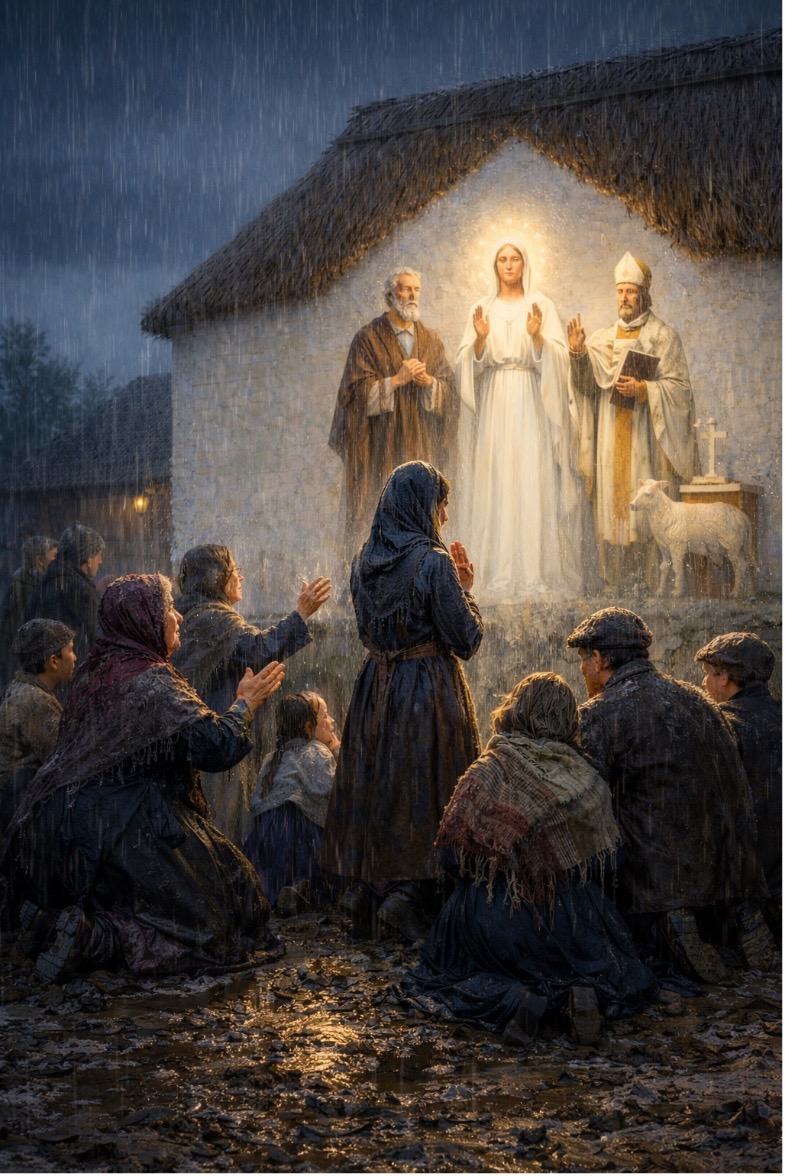
Original illustration created by the author using AI image-generation software. Rights cleared for non-exclusive editorial use with this article.
“Bright against the wall. I thought maybe you’d put them there, but because of the rain. I hurried on. When I reached Margaret’s house, I mentioned to Mary here, that I had seen somethin strange upon the church wall. We finished our tea, and when I rose to go home, Mary here said, ‘I’ll walk with ye till ye pass the church.’”
Mary Byrne, twenty-nine, slight and quick, stood listening, her wet shawl drawn tight about her shoulders. Mud stained the hem of her skirt.
Mary McLoughlin continued, “We walked, talkin’ ordinary-like, Father. And then, as we drew near, the light was still there. And that is when we saw them.”
Father Cavanagh’s eyes narrowed. “Who was there?”
Mary McLoughlin answered steadily, “The Blessed Virgin, Father. And St. Joseph. And St. John. All three.”
Mary Byrne’s breath caught at the memory. “I gasped and cried out, Father. I did. But then we grew quiet, because they were quiet, and we began to pray.”
Mary McLoughlin added, “They were in the air, hovering, out from the wall. The Blessed Mother with her hands raised, her face lifted to heaven. St. Joseph beside her. And St. John as though preachin’, though we spoke no word.”
Mary Byrne spoke quickly, “Mary told me, ‘Run and fetch Margaret and the rest.’ So I ran. They all came back with me. Margaret, the boys Patrick and Thomas, little Maggie, and our neighbor Mary Beirne.”
“We all gathered and stood praying in the rain. Others then came, Father, Jude and Mary Campbell, Bridget Trench, Catherine Murray, Margaret Sheridan, Dominick, Patrick Hill, and little John Curry.”
Mary McLoughlin’s voice rose somberly, “We stood there together, Father. Many of us fell to our knees in the mud. The rain poured down upon us, yet the wall behind them was bright and dry. We were wet through, but none of us thought of it.”
Mary Byrne seemed to drift, “The Blessed Mother’s face was beautiful, lifted up to heaven. There was no sound… only stillness.” Her voice thinned. “It was as though heaven had come down to us.” She paused, then said, “We were there two hours father, though we hardly knew it, and then, they were gone.”
Mary McLoughlin moved her head slowly, as if still trying to understand it. “It has left me different. I cannot tell you how. Only that I am not as I was before. There was such a quiet there… it changed something in me.”
Silence filled the small room. Father Cavanagh did not speak immediately. They said a prayer together, then the women left.
In the morning, the village would rise as it always had. Fires would be lit. Floors swept. Bread kneaded. Cows driven out along wet, muddy lanes.
Father Cavanagh would say Mass. The whitewashed wall would stand silent in the daylight, giving no sign of what had stood there.
At first the telling would move quietly – from cottage to cottage, from field to field, across the western roads of Mayo. Then farther, across Ireland and into the wider world.
Letters would carry the story where the people themselves were going — across the sea, into Liverpool streets and Boston tenements, into small wooden churches in places that did not yet feel like home. The name of the Lady of Knock would travel with them.
In Knock, years would pass. The thatched church would give way to larger walls. Pilgrims would come. Knees would press again into damp earth. Candles would burn where once there had been only rain, darkness, and a bright unforgettable light.
Prayers would rise there – and from far beyond it. From homes, hospitals, churches, flats, and country farms from voices that had never been to Knock but had heard the telling. No word had been spoken that night. Yet the silence endured. And through that silence, across generations, the Irish people would kneel and whisper the same hope – that heaven, once seen standing in the rain of a forgotten village, was still near.