


Oscail do Chroí
Exercise is an important ingredient for a healthy life. As we age, the need for it doesn’t go away. We are, for the most part, less active than we were in our younger years.
There is a great song that was written by the late John Prine, where he sings of a fellow who had muscles in his head that had never been used (a line I’ve often used!). During our younger days, work, raising a family, social activities, hobbies, all kept our minds active. We still exercise our minds when we read or learn new things.
This week I learned something new. I, like many others, believed that learning a new language as a child was much easier than learning as an adult. I was wrong.
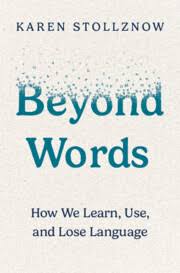
Beyond Words: How We Learn, Use and Lose Language
Karen Stollznow is a linguist and other of the forthcoming book, Beyond Words: How We Learn, Use and Lose Language. In a recent essay, she tells us there is no point at which the ability to learn a language switches off.
It is true that when it comes to language, babies and children are more sensitive to the sound patterns of speech. ACH! We never lose the ability to learn a new language no matter our age.
I think it feels more difficult at times because of all the things we juggle in our adult lives. But, our mental capability is there, just waiting to be exercised. As a adults we can approach language learning more systematically, looking for and recognizing patterns in spelling and pronounciation.
For many years, at the beginning of a new Speak Irish session, I would share an essay written by Professor of Linguistics, John McWhorter, titled, “English is not Normal.” “It’s a wonder English ever caught on, because it’s weirder than just about every other tongue.”
In his essay, he goes on to point out why. It’s beginnings; it was, by the way, primarily the Celts that spoke early English; its strange evolution to what is spoken now and why it has hung on.
Irish, on the other hand, is a much older language, and all though there are outside influences, Irish maintains its “rules.” For instance, we still greet one another by saying HI, but we use the Irish spelling Haigh, to keep things consistent. There are far fewer exceptions in Irish than we have grown accustomed to in English.
McWhorter says, “Our monolingual tendency leaves us like the proverbial fish not knowing it is wet. Our language feels “normal” only until you get a sense of what normal really is.”
Machán Magan
Machán Magan was one of my favorite Irish authors. I looked forward to his books, anticipating the next as I finished his latest one. We lost him last October. He was a prolific writer, but his books that appealed to me the most were his nature books that highlighted his love of the Irish language.
It was the poetry of the Irish language that first drew me in. The phrase for “thank you,” go raibh maith agat, may there be good at you, or gabh mo leithsceal, accept my half story, when excuse me would be appropriate in English.
Some of the best examples of this poetic aspect of Irish can be found in nouns. One of many names for a puddle is lochán uisce. Loch is the word for lake, lochán is a small lake or pond and uisce is water, so lochán uisce is a little lake of water.
In Magan’s book, “Tree Dogs, Banshee Fingers and Other Irish Words for Nature,” he gives us a further glimpse of this lyrical facet of Irish as it pertains to nature. In the introduction, he says that Irish words are often more friendly than their English counterparts when describing animals or things “with the open curiosity of a young person rather than with the catergorizing instincts of a neologist.”
The book is not a dictionary, but more of an introduction. Each word is translated and is followed by a brief essay containing alternate words used in naming the thing along with some interesting information.
My favorite passages are the ones concerning animals, where the use of the Irish word for dog, madra, is used. A tree dog, madra crainn, is one of the names for squirrel, crann being the word for tree. A cat crainn or tree cat is a pine martin.
Madra rua, or red dog, is one of the names for a fox. Madra allta, wild dog, is a wolf, also called mac tíre, son of the land, possibly derived from the legend of the Ossory. They were an ancient tribe of shapeshifters who could transform into wolves. Madra uisce is a water dog, sometimes called dobharchú or water hound, in English, an otter.
Magan’s books are full of information but it is presented in a fun and concise way, that even if your interest in the Irish language is only casual, you can’t help but enjoy them. An earlier book by Magan, “Thirty Two Words for Field,” I also recommend for any lover of nature or Irish language enthusiast.
Oscail do Chroí
I want to finish up with a short little song, Open your Heart, that ties in with Earth Day celebrations happening this month. You can find recorded versions on YouTube and sing along with the Irish lyrics.
Gaeilge Phonetic Bearla (English)
Oscail do chroí uscal duh kree Open your heart
Eist leis an talamh aaysht lesh an tallav Listen to the earth
Oscail do chroí uscal duh kree Open your heart
Oscail do chroí uscal duh kree Open your heart
Eist leis an tine aaysht lesh an tinnah Listen to the fire
Oscail do chroí uscal duh kree Open your heart
Oscail do chroí uscal duh kree Open your heart
Eist leis an amhain aaysht lesh an ow-ann Listen to the river
Oscail do chroí uscal duh kree Open your heart
Oscail do chroí uscal duh kree Open your heart
Eist leis an aer seo aaysht lesh an air shuh Listen to the air
Oscail do chroí uscal duh kree Open your heart
Do chroí, eist le do chroí duh kree aaysht le duh kree Your heart, listen yo your heart