


Speak Irish: Táin Bó Cuiligne
“Is hí aidchi sin ra dechaid in Morrígu ingen Ernmaiss, go m-bái oc indloch, ocus oc etarchossait eter na da dúnad chechtarda. Acus rabert-si na briathra sa: Crennait brain braigte fer brunnid fuil. Feochair cath mescthair tuind. Fadbaib luind. Faib imthuill nithgalaib luibnig. Lúth fiansa fethal ferda fir Chruachna scritha minardini. Cuirther cath bha chossaib aráile. Ebhlatt ar réim. Bochin Ultu bhómair Érno. Bhochin Ulto.
Issed dobert i cluáis n-Erand Ní firfet anhglé fail for a cind.”
The Mythological Cycle of Irish mythology is home to some of the darker stories of mythology, but one of the goddess’ The Mórrighan appears in the other cycles as well. The excerpt above is from the Táin Bó Cuiligne or The Cattle Raid of Cooley, from the Ulster Cycle, here she is doing what she does best, stirring things up.
The passage comes towards the end of the story. The Morrighan is inciting what will be the final battle between the warriors of Ulster and Connacht. The first two sentences tell us that Mórrighan, the daughter of Ernmas, late at night turns her attention to something deceptive and divisive.
In order to bring about a confrontation between the two armies, she casts the following spell: “Ravens devour throats of men men’s blood flows. Severe battle attacking flesh. Violent spoils. Sides swelling furious combat deceitful thrashing. Powerful warriors appearance of virility men of Cruachan screaming shattering dignity. Inviting battle death marching together. They will shout. Cow-plundered Ulster Cow in the possession of Erna Cow-plundered Ulster.”
The narrative then explains, “ This is the evil trick she put in Erna’s ear, something done without goodness in the place of their settlement.”
Mór means large or great in Irish and rígan is thought to be a loose translation of queen. Rí is one of the words for king, today bánríon (bahn ree un) is more widely used, and means woman king. Ríonaigh (ree-nay) is used for the chess piece, while ríonaí (ree-nee) means queenly.
The Mórrighan isn’t defined as one specific goddess, but is mostly associated as a goddess of war. She is part of a trio of war goddesses called the Mórrígna, with Badb and Macha. Some scholars argue that Badb and Macha are just aspects of Morrighan.
She doesn’t always engage in combat herself but affects the outcome of battles by frightening warriors, spreading false information and inciting conflict. The Mórrighan rejoices in bloodshed and chaos.
The Cattle Raid at Cooley
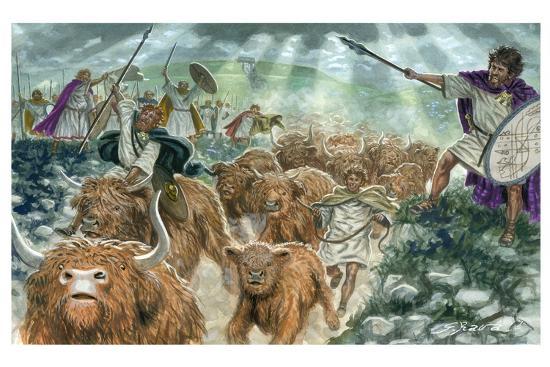
In the Táin Bó Cuailnge, she appears as a heifer at one point but also leads an army of fifty thousand, comprised of warriors from all four provinces of Ireland. When the battle starts to go against her, she grabs a sword and joins in.
Mórrighan is a shapeshifter, able to take on the form of a bird, fish or animal, allowing her to appear on the land, sea or air. In some stories she is a beautiful young woman, in others a frightful old hag.
Her mother Ernmas, was a farmer and sorceress of the Tuatha De Danaan. Her father was Delbaeth, one of the kings of the gods.
One of her earliest appearances in mythology is in the Cath Maighe Tuireadh, or the Battle of Moytura, that took place in what is now Connacht. Cath Maighe Tuireadh consists of two battles that occured over three thousand years ago.
The Tuatha De Danaan fought the Fir Bolgs in the first battle and the Fomorians in the second. In both, Morrighan is portrayed as a strong, powerful warrior using soothsaying and magic to defeat the enemies of the Tuatha De Danaan.
She flew above the battlfield screaming her frightful cries and raining down blood and fire on the Formonian warriors until their defeat and the death of their leader Balor, who dies by the hand of Lugh. Those screams tie her to stories of the bean sí, a harbringer of ominous death.
In other tales of the Ulster Cycle, we hear of her stormy relationship with Cú Chulainn. She first tries to seduce him as a beautiful young girl. He dismisses her, saying he has no time for her. She then comes after him as an eel, but he breaks the bones of the eel.
Next she attacks him in the form of a wolf, but he puts the animals eye out. Lastly she comes in the form of a heifer and he breaks it’s leg.
Later Cú Chulainn comes across an old woman, lame with one eye standing with a milk cow. He asks for a drink and the old woman allows him to drink directly from the cow. With each drink he takes, she is healed and Cú Chulainn realizes she has tricked him.
In the texts of the Mythological Cycle there is a story where Mórrighan lures away a bull from a woman from Tara named Odras. Odras pursues her to the otherworld, through the cave of Cruachain, which is believed to be the home of the Mórrighan.
A fatal mistake for her, Mórrighan cast a spell and Odras falls asleep before she is turned into a pool of water that empties into the River Shannon.
Vocabulary
Scéalta (shkal-ta) stories
Farrairí (fhar-ee) warriors sometimes dragan was used to describe a warrior
Cath (kah) battle
Cath a chur ( kah ah kur) to wage a battle
Tír (teer) land
Aer (ayr) air
Uisce (ish-ka) water moirigh (morig) is another word for water
Bean og álainn (bahn oeg ahlann) beautiful young woman
Cailleach uaigneach (kahl-ahk uhwig-nach) a frightful old hag
Cailleach ( kahl-ahk) hag or witch
Asarlai (ass-ur-lee) a wizard or sorcerer
Draoi (dree) another word for wizard
Draíocht (dree-ocht) witchcraft or magic
Digla (dig-la) evil
All of the mythology we have was passed down from the oral tradition for generations before being written down. The stories would have changed with each retelling and even when written out would be at the mercy of the writer who would put his own sense of morality and spin on it.