




From Belfast’s Heartbeat to the Giant’s Causeway
Shannon Relates: The Europa Hotel:
Chateau Marmont. The Savoy. The Ritz Paris. Some hotels become legends, places travelers seek out not just to stay, but to experience.
When you have a travel agent book all your hotels for a trip, there is a leap of faith you are participating in. You let go and let God, so to speak, and I’m certainly glad I did when Becky arranged our stay at the Europa Hotel in Belfast.
Admittedly, when I first saw the name of the hotel on our itinerary, I didn’t yet understand the complex and richly layered history behind it. It wasn’t until I set foot in the hotel that I began to understand what it represents—not just for Belfast, but for Irish history as a whole.
Known as the “heartbeat of the city”, the hotel is centrally located. It opened in 1971 on Great Victoria Street in the center of Belfast, built on the site of the old Great NorthernRailway Station. Where the hotel attained most of its notoriety is during The Troubles.
The political violence during this time earned the hotel the nickname “the most bombed hotel in Europe” with as many as 33 attacks on the hotel. This is astonishing, especially since the hotel is now seen as much of a tourist attraction as the Titanic in the city.
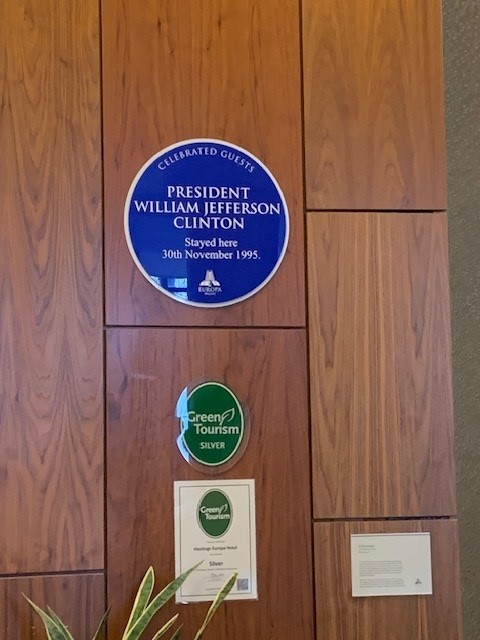
The hotel itself is nice. I don’t recall feeling over or underwhelmed with the décor and ambience upon walking in. What I do remember noticing was the blue commemorative plaque honoring Bill Clinton as the first US sitting president to visit Belfast, in 1995.
It was a small detail, but it made the place feel suddenly larger, as if the hotel had quietly played host to moments of political and social history far beyond an ordinary overnight stay. That moment has stayed with me.
Local Belfast Haunts
You truly can’t beat the location. The hotel feels like the nucleus of the city, with each street radiating outward toward everything Belfast has to offer. You won’t have to travel far to experience some great trad music and a proper pint because across the street stands Fibber Magee’s.
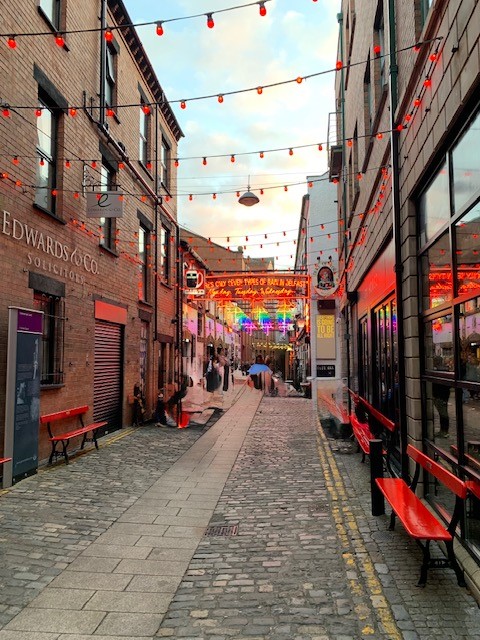
If you are willingly to walk 15 to 20 minutes, you can experience Belfast’s Cathedral Quarter, where pubs are nestled along alleyways and a culture that values art and community is clearly thriving. Cobblestone streets are paired with the buzz of nighttime energy that is reflected with bright signs and even brighter crowds.
Looking back, the Europa Hotel was never just a hotel on an itinerary. It was the gateway into Belfast’s history and spirit and I am proud to say I got to see a tiny part of the heartbeat of Belfast.
Karen Relates:
Giant’s Causeway
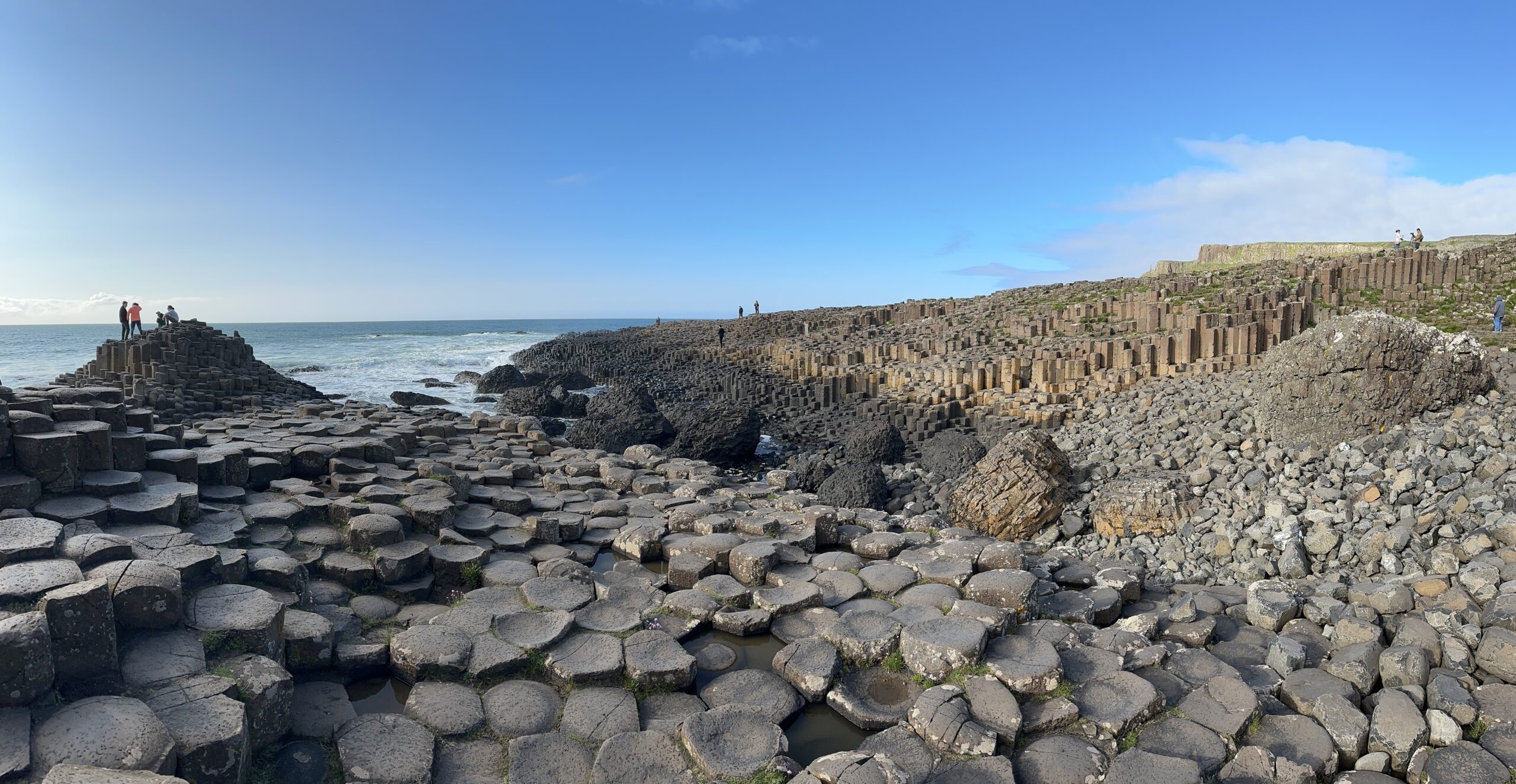
Standing on the north coast of County Antrim, it is hard not to stop and stare at the landscape of the Giant’s Causeway. More than 40,000 tightly packed stone columns stretch from the cliffs into the Atlantic. Most form natural hexagons that stack together like giant steps leading into the sea. Looking down from above, the formations spread along the shoreline in a pattern that almost looks carefully placed. For centuries people have wondered how such a place came to exist.
How Giant’s Causeway Was Formed

Long before geology explained it, Irish folklore offered another answer. According to legend, the Irish hero Fionn mac Cumhaill built the causeway to challenge a rival giant in Scotland, named Benandonner, throwing chunks of rock into the sea to create a pathway of stepping stones toward Scotland.
Benandonner turned out to be much larger than Fionn expected. Fionn retreated home, but his wife Oonagh disguised him as a baby and placed him in a cradle. When the Scottish giant saw the enormous “child,” he imagined how large the father must be and fled back to Scotland, tearing up the causeway behind him. The broken stones, according to legend, remain along the Antrim coast today.
The real story of the Giant’s Causeway began about sixty million years ago, during a period of volcanic activity. As lava cooled, it cracked into geometric basalt columns, most often forming hexagons. Over time, erosion exposed the formations along the coast. Similar columns appear across the water on Scotland’s island of Staffa, home to Fingal’s Cave.
The Causeway Journey
Our visit to the Giant’s Causeway is one I will always remember. We began with a walk to the overlook, where the entire coastline comes into view. From above, the formations stretch along the shore like a stone mosaic, with Atlantic waves breaking against the dark rock below.
The view was impressive, but we wanted to see everything up close and at its true scale. I wanted to stand on the fabled stepping stonessteppingstones said to lead to Scotland.
The walk down to the coastline took about fifteen minutes, though we were warned the climb back would take three times as long. As we passed visitors making their way back up, we asked if the effort was worth it. Every single person said yes.
They were right. Standing among the basalt columns, the stones fit together like a giant puzzle stretching from the cliffs down into the sea. It was one of those moments where you stop talking and simply take it in, realizing you are standing in a place you have seen in books and photographs for years.
As we prepared to make the long walk back, we received a call telling us to stay where we were and pretend one of us was injured. Phillip, always the clever one, drove down the path to fetch us. When we saw the van arrive, we both started limping. It was after hours, and Phillip had found a way to rescue us and get us back on the road for the rest of the day’s adventure!.
Today the Giant’s Causeway is both a natural wonder and a place shaped by storytelling. Science explains the stones, but the legend of Fionn mac Cumhaill still shapes how many people experience the site. Standing among the basalt columns with the Atlantic wind rising off the sea, it is easy to understand why people once believed giants walked this coast.