



The Story of the Sash
On the morning of Cleveland’s 2025 St. Patrick’s Day Parade,the city’s largest and most cherished Irish celebration, 14-year-old Clare stepped onto Superior Avenue with the Jack McDonough Fife & Drum Corps. Draped across her shoulders was a green and gold sash that read: Patrick J. Byrnes, 1975 Grand Marshal. In that moment, she carried not just her fife, but five generations of Irish American legacy, woven together in silk and memory.
“This year in the parade,” said Clare’s great-aunt Colleen Laffey, “my great-niece wore my grandpa’s sash—hee look. O was Grand Marshal 50 years ago this year.
Local Irish historian and columnist Francis McGarry learned about the legacy of the sash during rehearsals and events in the days leading up to the parade. He spoke with Colleen about how meaningful the moment was and planned to feature the story in an upcoming column, recognizing, as he often did, the quiet power of heritage passed through generations. I am honored to now carry that intention forward and share this story in his spirit.
From Ballysalaugh to Superior Avenue
The story begins in Ballysallagh, a townland within the village of Doolin on Ireland’s rugged Atlantic coast in County Clare, a place the family remembers as breathtakingly beautiful, with rolling green fields, stone walls, and music in the air. Patrick Joseph Byrnes was born there in 1902, the second of 14 children and the oldest son.

“He got halfway through second grade when they pulled him out of school,” his grandson Mike Laffey explained. “He had no real formal education. But he was happy. He would’ve inherited the farm.”
He might have lived out his life on that land if not for a determined young woman from Lisdoonvarna. Hannah McMahon, the daughter of a sheep herder, who had no interest in spending her life in a thatched-roof cottage surrounded by livestock and in-laws.
“She said she wasn’t going to marry him until they left Ireland,” Mike shared. “She said, ‘We can go to England, or we can go to America, but I won’t marry you till we get there.’”
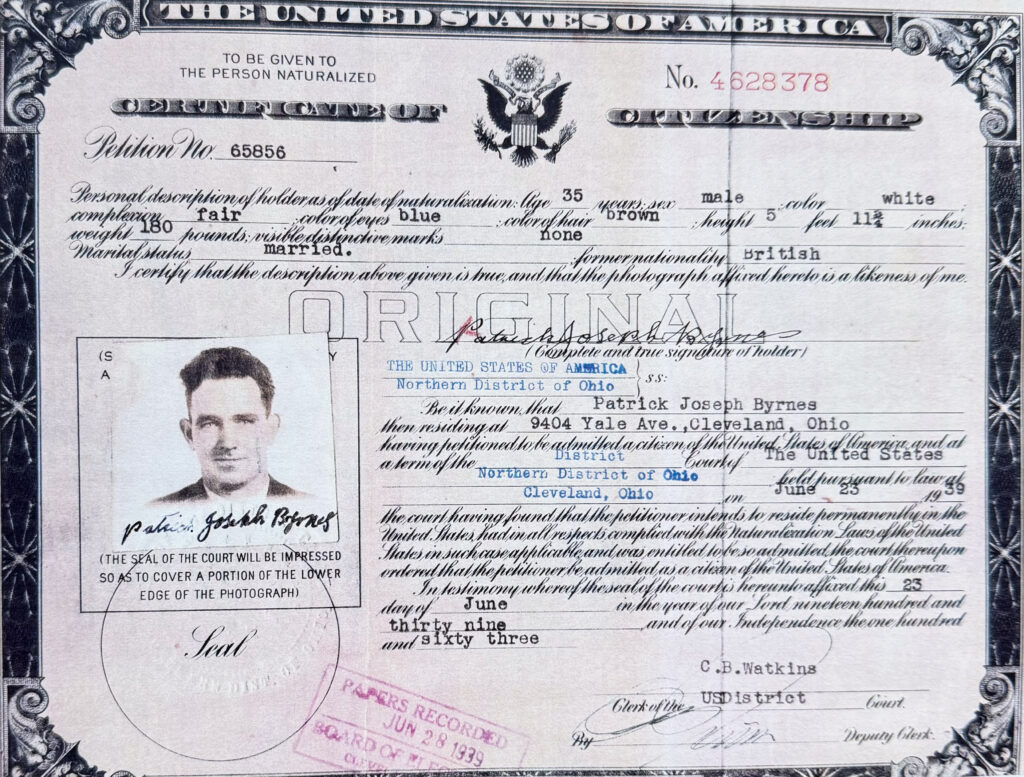
Hannah arrived in the United States in 1927 with a letter of recommendation from the Irish police sergeant she had worked for as a nanny. Patrick had come the year before, settling in Cleveland after a short stop in Worcester, Massachusetts. The two were married at St. Philip Neri Parish and began their life together in a modest apartment near Glenville.

“They had nothing,” said granddaughter Therese Hasul, “but she loved it here. She used to say she came for the flushing toilets. That was enough.”
Steel, Stories, and Set Dancing
Patrick worked for decades in the blast furnaces of Republic Steel, donning a heavy asbestos suit to withstand the heat. “He never complained,” said Mike. “He liked that he could provide for his family.”
Despite the hard work, Patrick and Hannah brought joy to everyone around them. “They were champion set dancers,” Colleen said. “They went to New York, Chicago, Boston—everywhere.” Their home was filled with music. “Grandpa played the mouth organ,what they called a Jew’s harp,and Grandma played the concertina. They’d have sessions in the backyard.”
The Byrnes raised three children: Patricia, Mary Ellen, and Joseph. “We were always at their house,” Therese remembered. “Their porch was our favorite place. And even into their seventies, they’d come home at two or three in the morning from dancing at the Irish Club.”
Patrick never lost his connection to Ireland. He returned for a visit in 1960, his first time back in over 30 years. When his grandchildren traveled to Ireland years later, they met his brother Michael for the first time. “When the door opened and we saw his brother Michael, we all cried. It was like seeing Grandpa standing there again.”
Grand Marshal, Grandfather
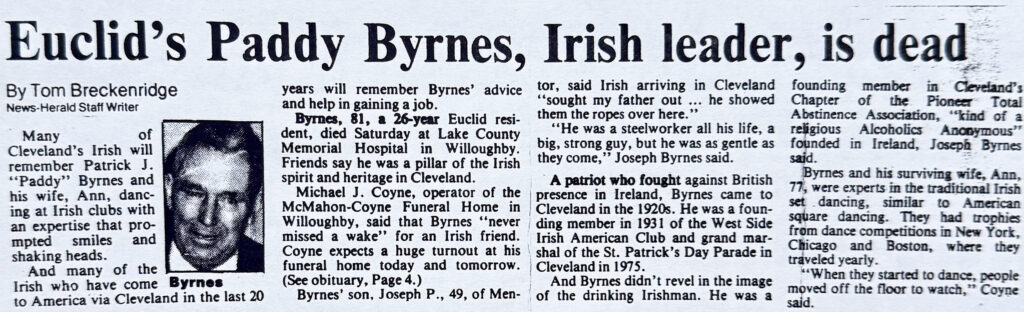
In 1975, Patrick was honored as Grand Marshal of Cleveland’s St. Patrick’s Day Parade by the United Irish Societies. “He was very tall, very dignified,” Colleen said. “When he walked down that avenue, you could see how much it meant to him — this boy from County Clare, who’d made good in America.”
The honor recognized a lifetime of service to Cleveland’s Irish community. Patrick was a founder of the West Side Irish American Club in 1931 and was a member of the Gaelic Society and the Pioneer Total Abstinence Association. He also helped countless Irish immigrants navigate life in a new country.

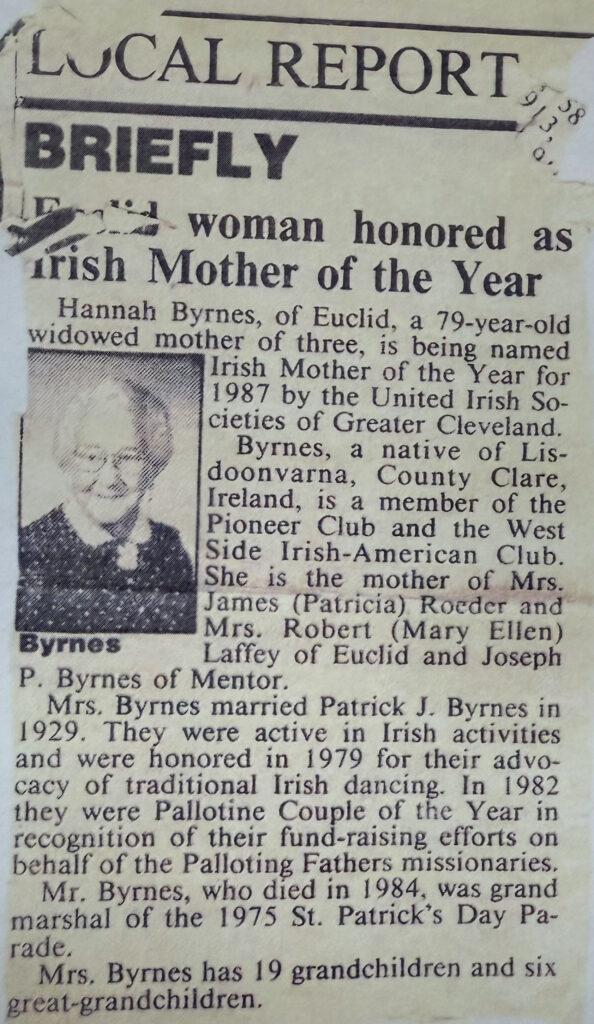
Twelve years after Patrick’s honor, Hannah was recognized as Irish Mother of the Year. Their daughter, Mary Ellen, continued their tradition of service, becoming a beloved volunteer at the Irish American Club East Side and earning Member of the Year in 2003.
From Co. Clare to Clare
The Byrnes family’s participation in Cleveland’s St. Patrick’s Day celebration spans five generations. Patrick marched as Grand Marshal; his daughter Mary Ellen danced with the Daughters of Erin in the 1950s; his grandchildren, including Colleen with the fife and drum unit and Therese with the Hibernians,continued the tradition; his great-grandson marches with the Cleveland fFrefighters. And now Clare, the fifth generation, carries on the legacy.
Many of Patrick and Hannah’s grandchildren and great-grandchildren have participated in the parade over the years and are active in a variety of Irish organizations and societies throughout Northeast Ohio. Their involvement reflects a broad and lasting family commitment to Irish heritage and community life.
“When Francis and I spoke about it, we thought, ‘This is great—from Co Clare to Clare,'” Colleen explains, referencing both the county and her great-niece. “It’s the continuation of Irish heritage all sort of identified through a sash. Because sashes identify groups and belonging.”
For Clare, wearing her great-great-grandfather’s sash was both an honor and a responsibility. Her aunt Colleen spent weeks preparing her for the moment, sharing stories of Patrick’s journey from a thatched cottage in Doolin to the blast furnaces of Republic Steel, of Hannah’s determination to escape poverty, of their championship dancing and musical sessions, of the 14 siblings left behind in Ireland.
Clare wore the sash with pride. “She soaked it all in,” Colleen said. “We were lining up and someone said, ‘Colleen, you’re behind Clare.’ And I just thought – wow.”
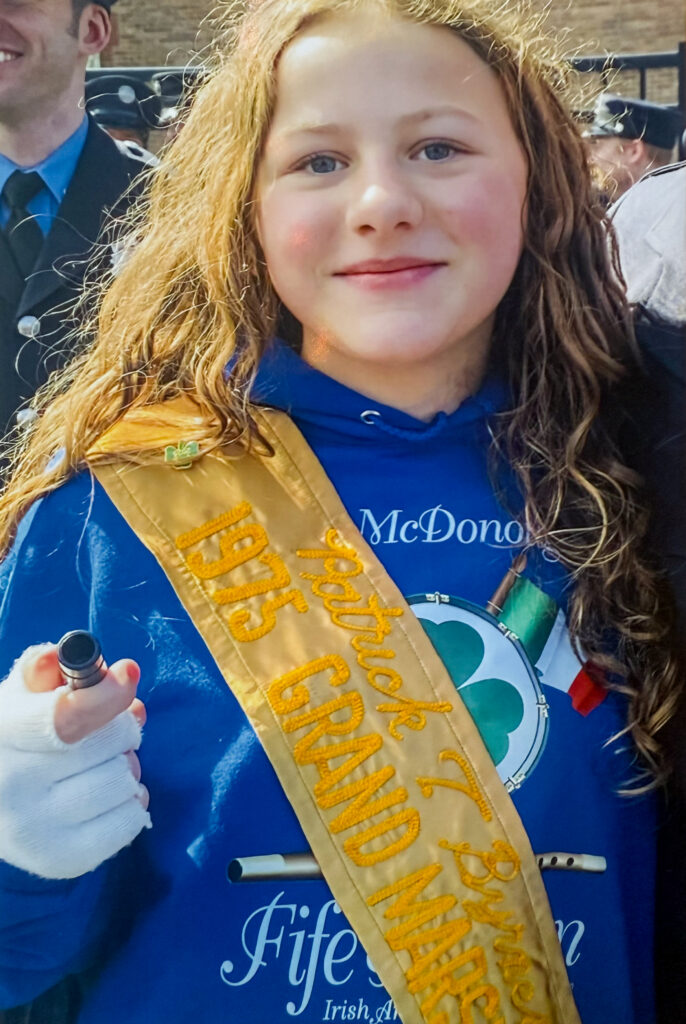
As Colleen put it: “If Grandpa was sitting here and knew that his great-great-granddaughter was in the parade wearing that sash, and that the heritage continued—he would be so happy.”