
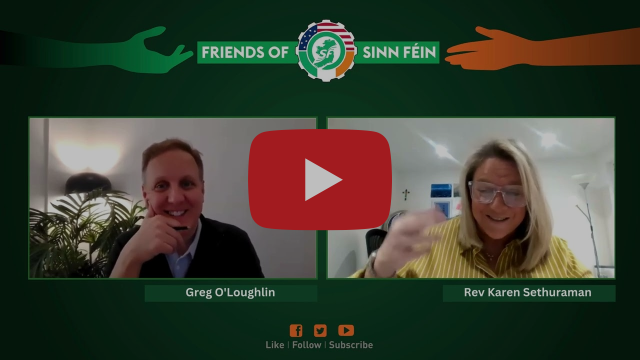

I had the opportunity to sit in on this month’s Irish Unity Webinar, a monthly video interview on the Irish Peace Process, Unity efforts and people involved in that process, hosted by Greg O’Loughlin, Executive Director, Friends of Sinn Féin.
I make the effort to block out that time each month, it is important to me. Why? Because I learn so much by listening in, get opinion and perspective of/from different leaders in the ongoing and substantial effort for Irish Unity.
Usually the following week, the recording of the webinar is made available to everyone. You can watch any of them on our iirish.us website. As I mentioned, the webinars are very good in being clear, answering sometimes forgotten issues and perspectives, and issues that must be overcome for Irish unity to happen. They generate ideas, and share what others are doing too.
I am no expert, I continue to strive, to learn and to invest each day in learning more, refining and expanding both my brain and iIrish’s perspective to our readers here in America, putting that knowledge to good use in my own search for truth and justice and hopes for One Ireland, for all involved.
Truth matters most, no matter how often some parties refuse to tell it, stark and as obvious to the average person with even a cursory view of Ireland’s past and prison, as it may be. I will not state those party’s position as far as left, right or center, without their authoritative response of what that is.
I have reached out to the largest parties (my opinion only: there are roughly 18 political parties in Ireland). Seven of them hold significant numbers to be considered those with real power or sway, though it may rise or fall, depending on cross party partnerships (Coalition governments) and the issue being addressed.
A Bit of Background on Irish Government
& Largest Irish Political Parties
Dáil Éireann (Assembly of Ireland – “Dahl Air in“) – the Irish government has a lower house, called the Oireachtas (“Ore rock tus“), manned by 174 elected members, each called a Teachta Dála (“Tea ahtah Dahlah“), referred to as a “TD”. Each TD is elected, and represents a constituency between 20,000 and 30,000 people.
Each area has three to five TDs. No government can be elected for more than five years, but a call for dissolution of the government, and therefore a new election, can happen simply by the call for dissolution, which then has to be approved by the president of Ireland.
[Each Oireachtas includes the president of Ireland. Catherine Connolly is the President, elected to a seven year term in October of 2025, and an upper house or senate, called Seanad Éireann (“Shawn ahd Air in”). Each Senator is appointed, not elected].
My opinion is that these are the seven parties with the most impact today:

Sinn Féin – (Shinn Fayne) Leader: Mary Lou McDonald, Sinn Féin President, referred to as The Leader of the Opposition.
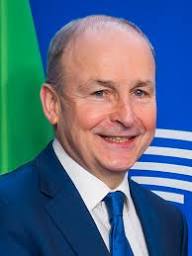
Fiánna Fail – (Fee uh nuh Foyle) Leader: Micheál Martin, called an Taoiseach (Tea- shuck”). This is the Irish head of government, similar to Prime Minister, since January 2025, and from 2020 to 2022 as well. Any party can be elected Taoiseach; if not enough members of that party are elected, the parties work the system maneuvering to try to arrange coalitions that will give them the majority in voting for or to block legislation.
Leo Varadker (Fine Gael ) was the previous Taoiseach. He and Martin were elected to swapped positions as two-year terms expired.

Fine Gael – (Fee uh nuh Gayl) Leader: Simon Harris, Tánaiste (“Taw nish tah”), similar to Deputy Prime Minister.
Green Party – Leader: Roderic O’Gorman

Labour Party – Leader: Ivana Bacik. Other names you will recognize from the Labour Party include Michael D. Higgins, and Mary Robinson, Ireland’s first female president, before resigning and becoming an Independent.
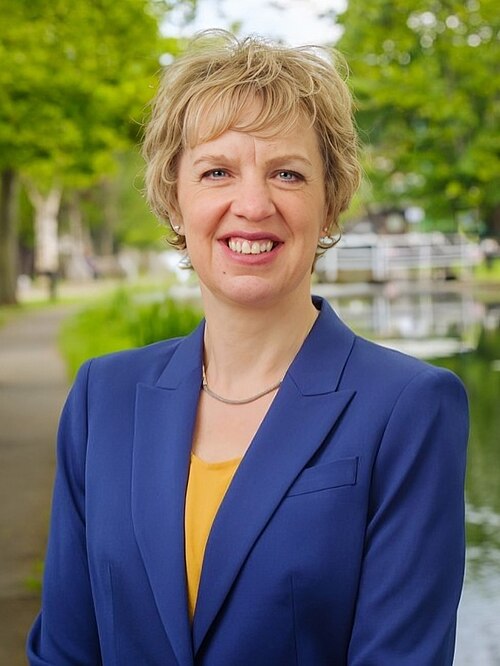
Social Democrats – Leader: Holly Cairns
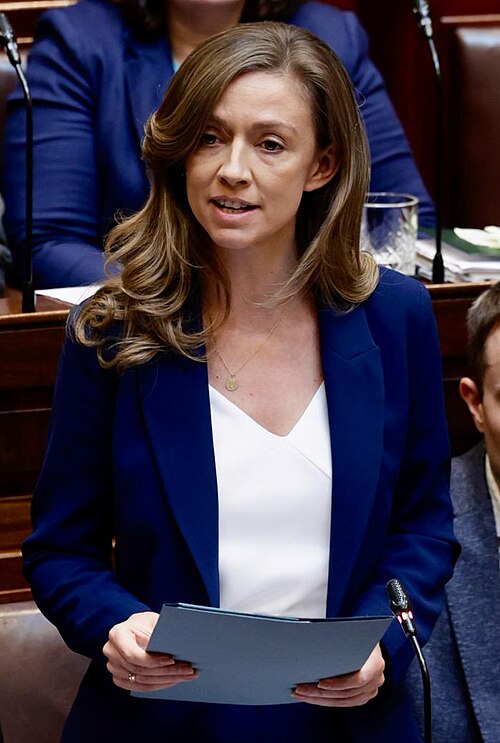
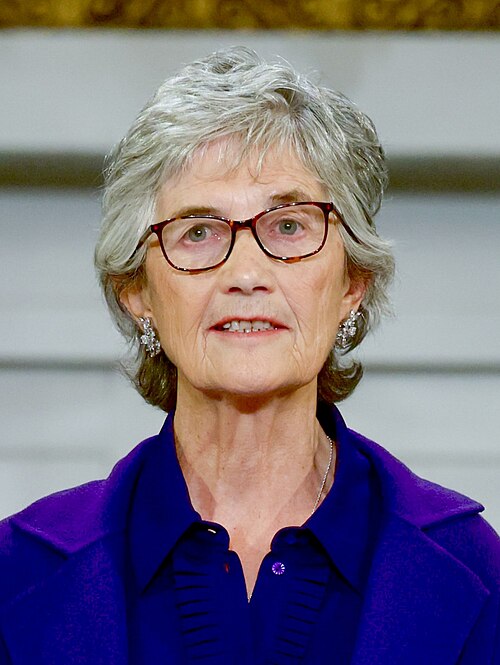
Independents – such as the President of Ireland, Catherine Connolly
Currently, no single party has a majority to control the government, so they form coalitions with other parties with the goal of getting enough votes to pass what they are advocating for.
What each believes in or propagates can be debated, so I will not tackle that here, as the internet is not big enough to hold it all.
iIrish strives to present a representative view of the Irish leadership perspective, from the parties themselves when possible. It is harder to present different perspectives if the parties won’t talk to you, and never have. The only party that has responded to my requests, at all – let alone in a consistent, periodic basis, is Sinn Féin.
These requests have been made by me specifically, not farmed out to anyone, to allow the Irish political parties to reach the American public, which as you know, has a pretty large Irish population. The requests to be added to any distribution lists, for interviews, for any response at all … has been made several times a year, year after year, all of our 19 years in print, without ever receiving any response whatsoever, from any Irish party. They owe us nothing, but surely they are wiser then that?
We have also asked for ANY update from a legitimate/respected party, authority, or elected or appointed representative, from all of the parties, not just the seven mentioned above – weekly, monthly, quarterly – for party perspective on Irish issues. We can’t get ONE, let alone weekly, as Sinn Féin does.
So who represents the people? Those who talk to and with the people, or those whose received emails go to … the never to be recycled can? Sharing the knowledge wealth is part of my job responsibilities. I strive to keep an open mind, despite the results from requests and the walls.
Onward … Check out this month’s Irish Unity Education Webinar with Greg O’Loughlin and Rev. Karen Sethuraman.
So, what do you think?