





Remembering St. Brigid
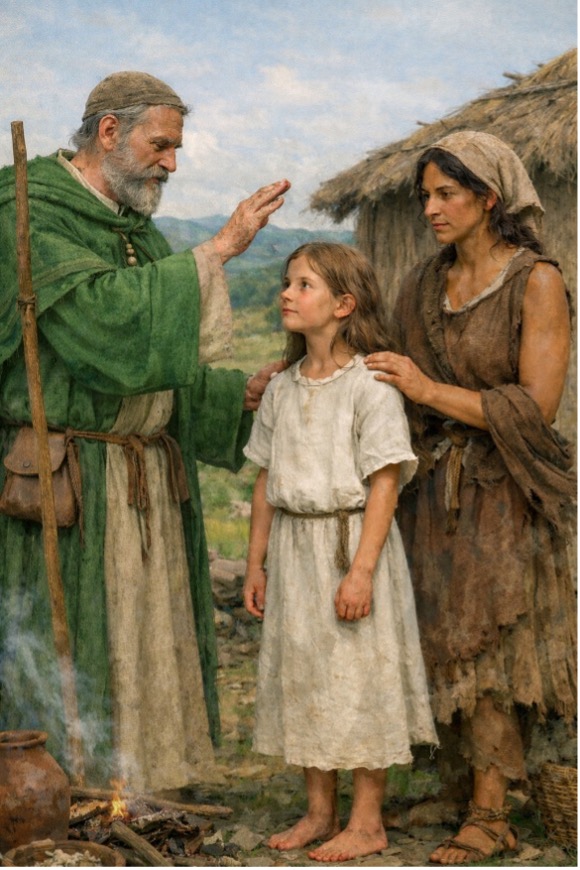
She came down the lane barefoot, the frost sharp beneath her feet, the earth cold but familiar. A white tunic hung to her ankles, simple and clean, tied at the waist with a narrow cord. Her long brown hair fell loose down her back, catching what little light the night allowed.
When she lifted her face, her eyes were bright, clear blue, steady, alive with purpose rather than haste. She looked no older than thirty, though the night did not trouble itself with such reckonings.
She stopped at a good house. The door was unlatched. Rushes lay ready by the hearth, some already woven into small crosses and hung along the wall for protection.
A small cloth had been left out, folded with care. The fire was banked low, breathing softly in the dark. She crossed the threshold without a sound. She touched the cloth once, gently, as if remembering something the hands already knew.
Near the fire, a bed had been made, not for comfort, not for sleep, but for welcome. She lay down only a moment. Long enough to give what had been asked.
Then she rose again. And she was gone, back onto the lane. There were many homes yet to visit, many thresholds waiting.
When the family woke the next morning, nothing appeared changed. The fire burned as it always had. The walls stood firm. The day began as any other.
But the house had been blessed. St. Brigid had come.
Before Ireland Wrote about Brigid, It Lived With Her
St. Brigid was not first remembered as a figure in a manuscript or a name on a calendar, but as a presence, one who crossed thresholds, entered ordinary homes and stables, and moved quietly through the turning of the year. The oldest memories of her are not sermons, but actions: a cloth left out, a fire banked, a bed prepared, a door left unlatched. Faith was not explained; it was enacted.
Early Irish Christianity did not separate belief from daily life. Families carried it forward in homes and fields, byres and workshops, along winter roads and coastal paths. They invoked Brigid as patron of women and mothers; of farmers, dairy workers, and brewers; of poets and learning; and of the poor and the sick, seeking her protection over family, work, livestock, and bread. Brigid belonged there first, in the ordinary places where faith had to sustain real lives.
Proximity to Patrick
Brigid was born into a house where Patrick’s name was already spoken. Her mother, Brocca, was an enslaved woman converted by St. Patrick, and tradition holds that he baptized Brigid as well. Christianity was present when she learned to walk, in prayer, in nightly stories, in the quiet understanding that this faith had a cost and was worth it.
Patrick was still alive during Brigid’s childhood, and tradition holds that she was about ten years old when he died. Ireland then was small in the ways that mattered: memory was oral, authority personal, reputation immediate.
Patrick was not yet a monument, but a man who had come, taught, baptized, suffered, and endured. Brigid did not receive the faith at a distance; she grew up in Patrick’s living wake.
The Holy Wells
Across Ireland, wells dedicated to Brigid became places of pilgrimage, visited generation after generation by people who came with need rather than curiosity. Water was drawn. Stations were made. Prayers were offered for healing, fertility, protection, and endurance. These were not abstract symbols or pious ideas; they were physical points of contact between belief and daily reality.
Among the best-known are the wells at Tully in County Kildare and at Faughart in County Louth, her traditional birthplace. In the West of Ireland, Brigid’s presence remains vivid at her holy wells. In north Mayo’s Kilbride parish, near Ballycastle, generations have visited St. Bride’s Well – a site long revered for its healing waters, especially for ailments related to fertility and conception.
The Leader of Men and Women
Brigid founded a double monastery for women and men in Kildare and served as its first abbess. Working with Bishop Conleth, she built other centers of prayer, learning, and charity all over Ireland.
In accounts of her veiling ceremony, the rite for ordaining a bishop was accidentally read over her rather than the rite for a nun. The story endures not as a claim about ordination, but as an acknowledgment of how Ireland understood her leadership, recognized, accepted, and exercised without apology.
Grace O’Malley
The world that produced Grace O’Malley was already shaped by this understanding of faith and strength. She ruled ships, territory, and men in a landscape that left little room for weakness, in a culture that had long accepted that women could exercise authority without setting faith aside, a path Brigid had made imaginable centuries earlier.
In folklore, St. Brigid’s Day anchors more than devotion. Clare Island lay at the heart of Grace’s seafaring realm. It’s holy well is a place of Brigid’s enduring protection over midwives, mothers, and the vulnerable.
On one February 1, Grace joined a pilgrimage to the holy well there. In some tellings, news of a nearby shipwreck near Achill interrupted the observance. Undeterred by storm or sacred hour, Grace put to sea, salvaging what she could and rescuing a young survivor: Hugh de Lacy, who became her lover and a pivotal figure in her life.
The story binds prayer and bold action in the same breath. Faith, for Grace, was not separate from command or risk; it stood alongside them, a quiet ally when the stakes were highest.
Strength Passed Down
The faith Brigid learned from Patrick gave her the authority to claim land, shelter the poor, protect the vulnerable, and speak plainly to kings and clerics alike. Her courage was not borrowed; it was grounded in belief that Christ was real and that life did not end at the grave.
Men and women alike understood this through the centuries. Husbands and wives guided their families with her in mind, invoking Brigid’s protection over home, work, and livelihood, and trusting her help in times of need.
That understanding crossed the sea and took root in America. Irish families carried it into a new world, where the same faith steadied households facing uncertainty and hard beginnings. That same faith remains. It did not belong only to Brigid’s century; it belongs to ours. It speaks to men and women alike, especially to women, and to the women of tomorrow, calling all of us to remain faithful without shrinking and to stand steady when life is tested.