

By Dan Conway
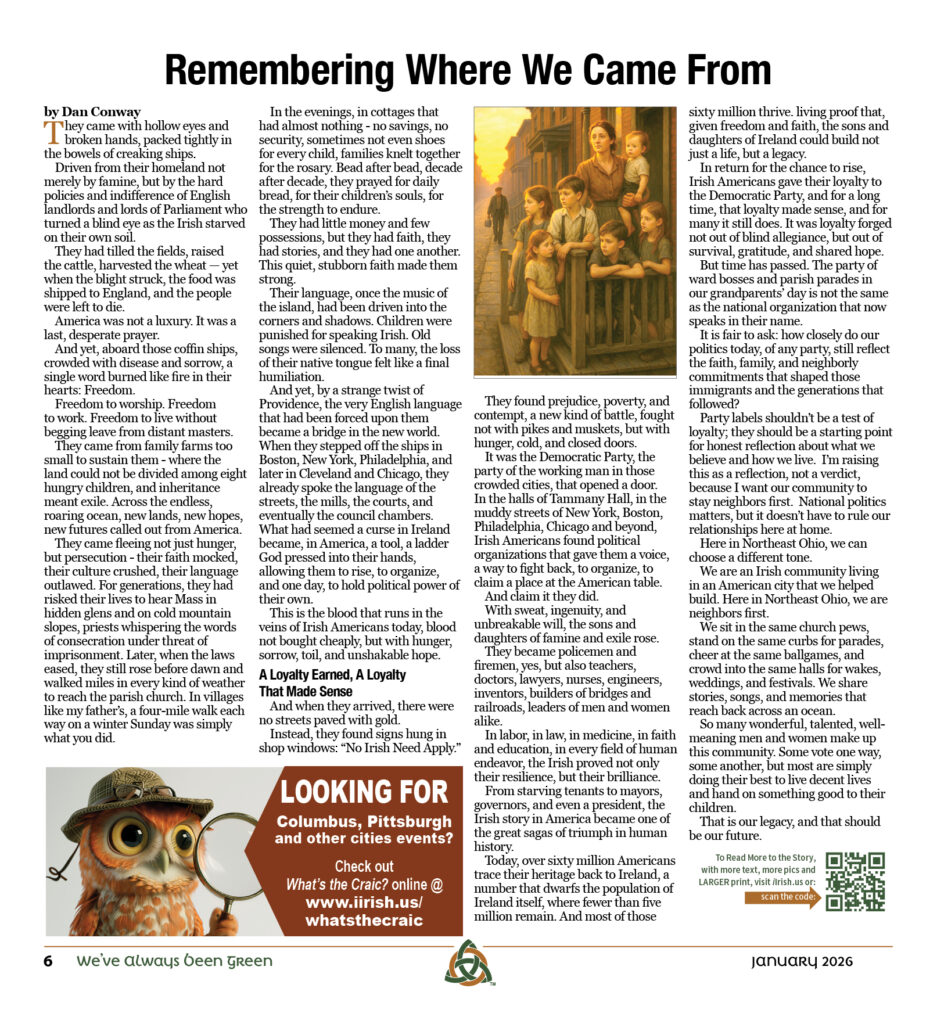
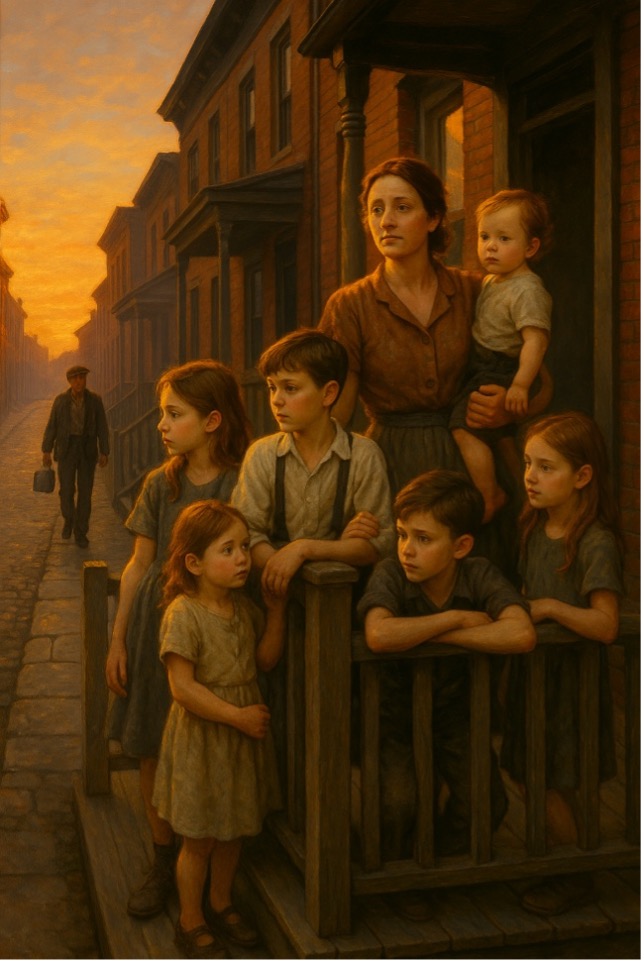
They came with hollow eyes and broken hands, packed tightly in the bowels of creaking ships. Driven from their homeland not merely by famine, but by the hard policies and indifference of English landlords and lords of Parliament who turned a blind eye as the Irish starved on their own soil.
They had tilled the fields, raised the cattle, harvested the wheat — yet when the blight struck, the food was shipped to England, and the people were left to die.
America was not a luxury. It was a last, desperate prayer.
And yet, aboard those coffin ships, crowded with disease and sorrow, a single word burned like fire in their hearts: Freedom.
Freedom to worship. Freedom to work. Freedom to live without begging leave from distant masters.
They came from family farms too small to sustain them – where the land could not be divided among eight hungry children, and inheritance meant exile. Across the endless, roaring ocean, new lands, new hopes, new futures called out from America.
They came fleeing not just hunger, but persecution – their faith mocked, their culture crushed, their language outlawed. For generations, they had risked their lives to hear Mass in hidden glens and on cold mountain slopes, priests whispering the words of consecration under threat of imprisonment. Later, when the laws eased, they still rose before dawn and walked miles in every kind of weather to reach the parish church. In villages like my father’s, a four-mile walk each way on a winter Sunday was simply what you did.
In the evenings, in cottages that had almost nothing – no savings, no security, sometimes not even shoes for every child, families knelt together for the rosary. Bead after bead, decade after decade, they prayed for daily bread, for their children’s souls, for the strength to endure.
They had little money and few possessions, but they had faith, they had stories, and they had one another. This quiet, stubborn faith made them strong.
Their language, once the music of the island, had been driven into the corners and shadows. Children were punished for speaking Irish. Old songs were silenced. To many, the loss of their native tongue felt like a final humiliation.
And yet, by a strange twist of Providence, the very English language that had been forced upon them became a bridge in the new world. When they stepped off the ships in Boston, New York, Philadelphia, and later in Cleveland and Chicago, they already spoke the language of the streets, the mills, the courts, and eventually the council chambers. What had seemed a curse in Ireland became, in America, a tool, a ladder God pressed into their hands, allowing them to rise, to organize, and one day, to hold political power of their own.
This is the blood that runs in the veins of Irish Americans today, blood not bought cheaply, but with hunger, sorrow, toil, and unshakable hope.
A Loyalty Earned, A Loyalty That Made Sense
And when they arrived, there were no streets paved with gold. Instead, they found signs hung in shop windows: “No Irish Need Apply.” They found prejudice, poverty, and contempt, a new kind of battle, fought not with pikes and muskets, but with hunger, cold, and closed doors.
It was the Democratic Party, the party of the working man in those crowded cities, that opened a door. In the halls of Tammany Hall, in the muddy streets of New York, Boston, Philadelphia, Chicago and beyond, Irish Americans found political organizations that gave them a voice, a way to fight back, to organize, to claim a place at the American table. And claim it they did.
With sweat, ingenuity, and unbreakable will, the sons and daughters of famine and exile rose. They became policemen and firemen, yes, but also teachers, doctors, lawyers, nurses, engineers, inventors, builders of bridges and railroads, leaders of men and women alike.
In labor, in law, in medicine, in faith and education, in every field of human endeavor, the Irish proved not only their resilience, but their brilliance. From starving tenants to mayors, governors, and even a president, the Irish story in America became one of the great sagas of triumph in human history.
Today, over sixty million Americans trace their heritage back to Ireland, a number that dwarfs the population of Ireland itself, where fewer than five million remain. And most of those sixty million thrive. living proof that, given freedom and faith, the sons and daughters of Ireland could build not just a life, but a legacy.
In return for the chance to rise, Irish Americans gave their loyalty to the Democratic Party, and for a long time, that loyalty made sense, and for many it still does. It was loyalty forged not out of blind allegiance, but out of survival, gratitude, and shared hope.
But time has passed. The party of ward bosses and parish parades in our grandparents’ day is not the same as the national organization that now speaks in their name. It is fair to ask: how closely do our politics today, of any party, still reflect the faith, family, and neighborly commitments that shaped those immigrants and the generations that followed?
Party labels shouldn’t be a test of loyalty; they should be a starting point for honest reflection about what we believe and how we live. I’m raising this as a reflection, not a verdict, because I want our community to stay neighbors first. National politics matters, but it doesn’t have to rule our relationships here at home.
Here in Northeast Ohio, we can choose a different tone. We are an Irish community living in an American city that we helped build. Here in Northeast Ohio, we are neighbors first.
We sit in the same church pews, stand on the same curbs for parades, cheer at the same ballgames, and crowd into the same halls for wakes, weddings, and festivals. We share stories, songs, and memories that reach back across an ocean.
So many wonderful, talented, well-meaning men and women make up this community. Some vote one way, some another, but most are simply doing their best to live decent lives and hand on something good to their children.
That is our legacy, and that should be our future.