






The Coal That Built Us: Remembering the Bend Through Its Bones
He sat on the roof of a shanty above the river, hands blackened, the air thick with soot and grief. Below him, the white concrete triangles of the coal docks jutted from the Cuyahoga’s bank like the ribs of a buried ship. From that perch he could see everything – the crooked bend, the tangle of rail lines, the freighters easing in from the lake.
Every sound, the groan of iron, the whistle of steam, rose and settled in his chest.
His name was Michael Sammon, and the year was 1915. He had just returned from Colorado, where he had taken his wife, Anne, hoping clean air might ease the illness closing her lungs.
It didn’t. She died that spring at thirty-five. Michael buried her out west, then returned to Cleveland with their three young children, Martin, Mary, and Kate (Cassie).
He was barely forty. The soot waited. The job waited. And the house at Irishtown Bend still trembled when the trains passed.
Within months, he would make an unbearable decision – to split up his children. To place his son in St. Anthony’s Home for Boys, and his daughters in St. Joseph’s Orphanage for Girls, so he could keep working on the docks.
Nearly a century later, his great-grandson Jim pieced the story together from fragments, an address, a death record, a house lot on an old map. “When I saw that painting of the Bend,” he told me, “I imagined him on that roof, trying to come to grips with what he’d just lost.”
The First Irish on the Bend
Long before Michael and Anne’s heartbreak, families like the Connors had carved out lives on this same slope. By the early 1850s, lots were already for sale in the Hiram Stone Allotment, and some of the very first Irish laborers helped lay the tracks for the Cuyahoga & Mahoning Railroad, completed in 1856, the line that brought Mahoning Valley coal straight to Cleveland.
By the 1880s, the west bank had become Cleveland’s first large Irish neighborhood: Irishtown Bend, a patchwork of cottages, boardinghouses, coal dust, and corner taverns built into the hill.
John and Mary Connors lived on West River Road across from the early Erie Railroad coal docks. He worked the wooden hoists that lifted coal from freighters; she kept their home upright amid the racket and soot. Children learned to tell time by dock whistles. Archaeologists later found their life in fragments—crockery shards, brick paths, pig bones from a backyard pen.
The Connors and their neighbors formed Cleveland’s first Irish working class. They dug canals, laid rail ties, built the riverfront, and loaded the freighters that powered the city’s factories. When Michael Sammon began work decades later, the world they had built, hard, smoky, and steadfast, was still standing, only louder.
Building the Docks
To picture the first coal docks of the 1860s and 1870s, imagine wooden platforms built at intervals along the riverbend, where coal moved from railcars to freighters or into horse-drawn wagons that carried it across the city. By the 1880s, these docks towered three and four stories high, bristling with derricks and steam-powered hoists.
Irish dockmen shoveled, hooked, and hauled coal into vast wooden bins. The work was loud, dirty, and relentless. The second-generation structures arrived in the early 20th century.
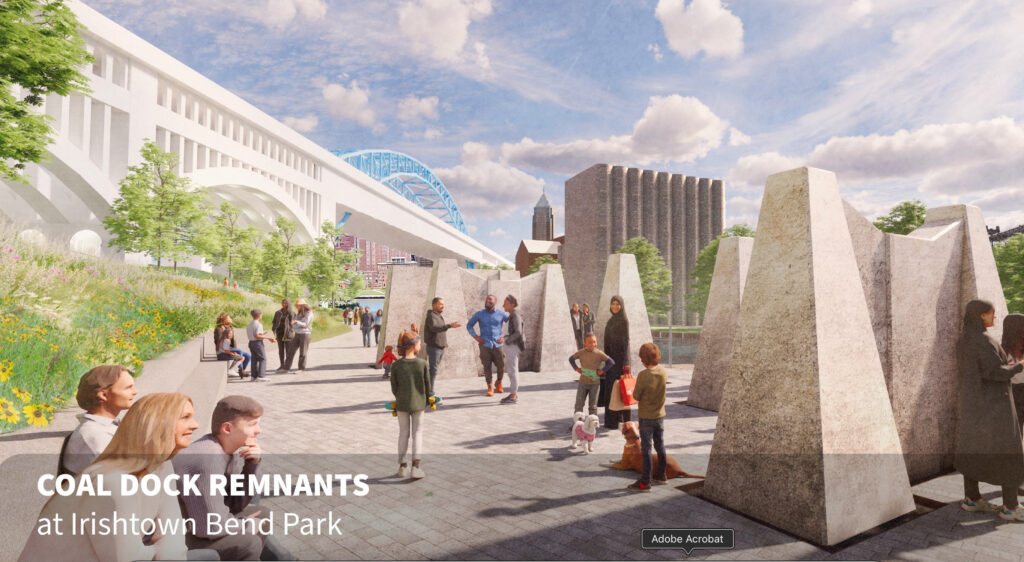
In 1912, the Erie Railroad replaced timber docks with mechanized steel and reinforced concrete, hiring Cleveland’s Wellman Engineering to design a new loading system. These changes created what you can still see today: a string of triangular concrete pads—four to six feet thick, weighing up to 200 tons, running almost 400 feet along the waterline. They once held conveyors, hoppers, and machinery capable of moving thousands of tons a day.
Distinct from the lakefront ore docks, the Irishtown Bend coal docks were built specifically for river freight. The surviving concrete foundations are the remains of the final, fully mechanized dock, still operating into the late 1930s and early 1940s, long after earlier wooden platforms had decayed or been abandoned. For the men who worked them, the shift from shovels to conveyors changed the volume, not the hardship. By noon, they were still covered in soot
From Shovel to Conveyor
For John Connors in the 1880s, a coal dock meant muscle and handwork. For Michael Sammon in the 1910s, it meant machinery shrieking overhead. Both men belonged to the same story – one laying the foundations of Cleveland’s industry, the other tending the engines that carried it forward.
And both lived with the reality that their own homes shook with the weight of the work.
“The train ran right by the house,” Jim said. “My great grandma opened her window for air, and soot came in.” Progress promised wages, but it also exacted a price—lungs, hearing, years with family.

Stand at the river’s edge today and you close your eyes, you can almost hear it: steam hissing, coal clattering against steel, the deep rumble that once shook the hillside homes. For the families of Irishtown Bend, that sound shaped daily life.
Children fell asleep to it. Mothers folded laundry to its rhythm. Fathers like John and Michael measured their days by its rise and fall. It was the sound of survival. It was also the sound of loss.
When the River Fell Silent
By the 1930s, the riverfront quieted. Operations moved downstream. The hillside, already weakened from decades of excavation, began to slide. Streets cracked, porches tilted, and houses disappeared.
Fifty years later, archaeologists returned to find the earth still holding its memory: ash pits, wells, broken dishes, tools, and those massive concrete foundations still gripping the riverbank. The machinery had rusted away, but the pads remained, the bones of labor that outlasted the men who built them.
“They’re not just slabs,” Jim said. “They’re proof our people were here.”
Irishtown Bend Park
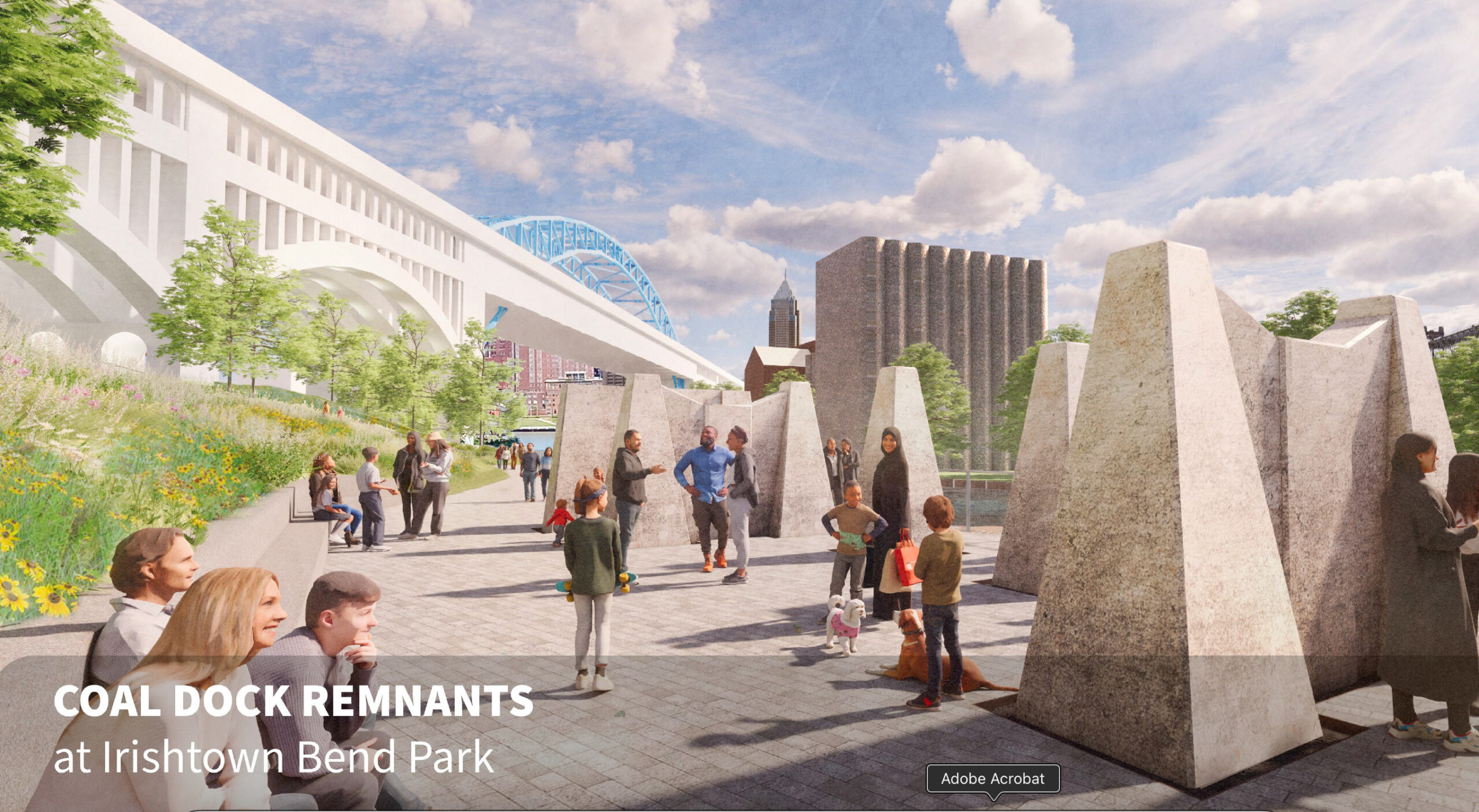
Now those bones are becoming the heart of the new Irishtown Bend Park, a 23-acre greenway reconnecting Ohio City to the Cuyahoga. The surviving dock foundations, each weighing more than a hundred tons, will be stabilized, lit, and preserved in the site’s Irish Heritage sector.
Visitors will walk among them, seeing how coal moved from freighter to bin to conveyor to railcar, and how the work evolved, from Connors’ shovel to Sammon’s machine. Interpretive markers will tell the story of the families who gave Cleveland its industrial soul.
“They’re turning the docks into art,” Jim said. “But for me, it’s more than that. When I see those pieces, I see my family. I see why Anne died. I see why Michael kept working.”
It is a kind of justice that what once suffocated this neighborhood will soon help it breathe again. Wetlands, walkways, and open air will return to the slope that once rattled with hoists. The concrete will stay, rough, unpolished, and honest, serving as an open-air monument to Cleveland’s first industrial immigrants.
Jim sometimes visits the site, matching old photos to the ridges that remain. “Every time I look out over that bend,” he said, “I think about Michael – barely forty, sitting on that roof, realizing he couldn’t save her, couldn’t raise his kids. And now I get to help make sure people know he was here.”
References
- National Park Service. (1990). National Register of Historic Places: Irishtown Bend Archaeological District (Cleveland, Ohio).
- Cleveland Historical. (n.d.). Irishtown Bend. Cleveland State University Department of History.
- Coal Dock Slides. (2025). Plural Studio of San Franciso. Coal Dock Slides
- Sammon, J. (2025, Nov). Personal emails and interview with Vaiva Neary.
- Census Records 1900, 1910, 1920
- Lynch, M. (2025). Historical background on the coal docks at Irishtown Bend [Unpublished manuscript].