The Irish War for Independence, launched by the Easter Uprising in 1916, resulted in The Treaty, signed December 6, 1921 and forced upon the Irish people at the threat of scorched earth by Secretary of War and Secretary of The Colonies, Winston Churchill. The Treaty segregated six of Ireland’s 32 counties; a gerrymandered garrison created to appease the Orange Order who threatened armed uprising if they were included in the newly created Irish Free State.
The artificially engineered carve out, born out of the threat of the Orange man’s gun, created a district with an artificial loyalist majority. The carve out was to be a temporary solution to appease the loyalists with a Boundary Commission to meet in 1925 to address the boundaries of this pretend statelet. Of course, like so many Brit colonial “promises,” the 1925 Boundary Commission was a sham.
This year, 2025 marks the centenary of this Brit appeasement to loyalist thuggery and the resulting pain, misery and suffering of so many thru the disgraceful efforts by Westminster and Stormont to maintain this fallacious franken state and enshrine loyalist privilege. Sinn Fein Leader Mary Lou McDonald recently observed this sad anniversary by sharing:
“Today we mark one hundred years since the collapse of the Irish Boundary Commission. It was a moment that revealed not just a political failure, but a deep betrayal of the Irish people. The leaked details of the report dashed nationalist hopes that large areas of the North would be transferred to the Free State and that Irish Unity would be expedited. Instead, the minimal adjustments proposed exposed the Commission as a piece of British government duplicity. The leak of the details of the Report on 7th November 1925 exposed a deal that abandoned nationalists in the Six Counties and caused division on this island for generations. A century later, Ireland has changed beyond recognition. Partition has been exposed as a failure – socially, economically and politically. The conversation about Irish unity is now open, confident and growing. Across every county, people are engaging in how we can build a new and united Ireland based on fairness, equality and opportunity for all. The hopes of our generation for the reunification of Ireland were reflected in the Presidential Election. The prospect of Irish Unity was recognised as an immense opportunity for our future. We must learn from history. The future of this island must be decided by the people, in an open, democratic process – through dialogue, planning, and referendums North and South by the end of this decade. One hundred years after the Boundary Commission tried to copper fasten division, we are looking now to reconciliation, national renewal and Irish unity. Together, we can build an Ireland that finally fulfils the promise of equality and freedom for all our people.”
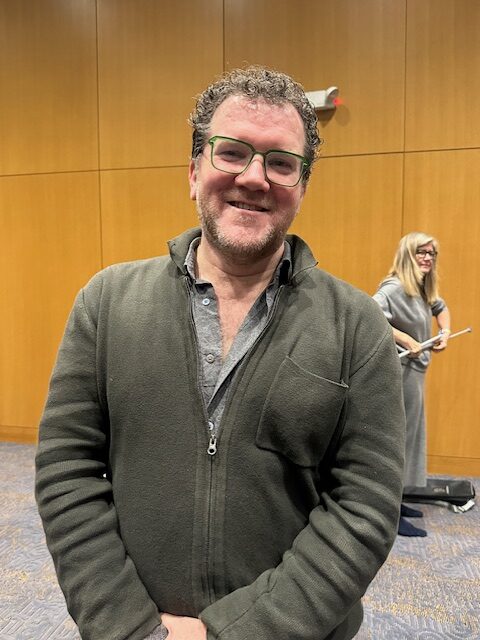
Pádraig Ó Tuama
In these fractious, crazy times we find ourselves, I sometimes turn to the poets to help process and attempt to find harmony with the world we live in. And who better than Irish Poets? The Island of Saints and Scholars has produced more world class poets per square bog field than anywhere else in the world.
One of Eire’s current contributions to the universe of great poetry is Padraig O’Tuama. O’Tuama spoke last month at Case Western Reserve University as part of the Baker Nord Center Humanities series, including some reading of his work. He lives in Belfast and has worked for many years on conflict resolution in addition to being a poet and a theologian. Check out his work.
I share a small slice from his book “In The Shelter: finding a home in the World”:
I used to need to know the end of every story but these days I only need the start to get me going. God is the crack where the story begins. We are the crack where the story gets interesting. God is the plot, and we are the writers, the story of winners and the story of fighters, the story of love, and the story of rupture, the story of stories, the story without structure.”
Connolly Takes Oath
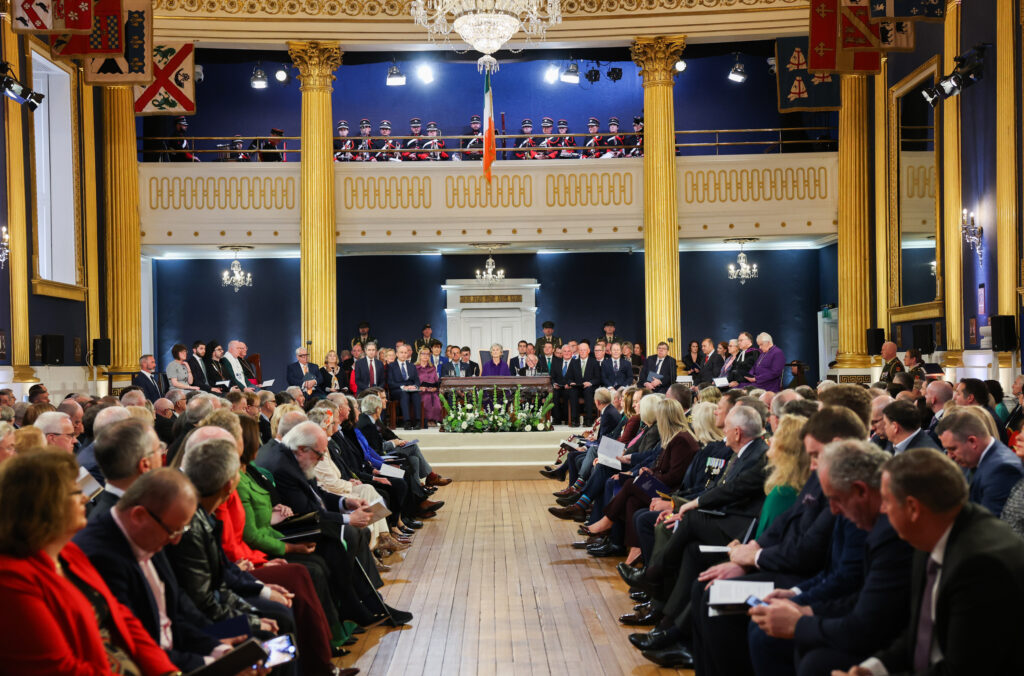
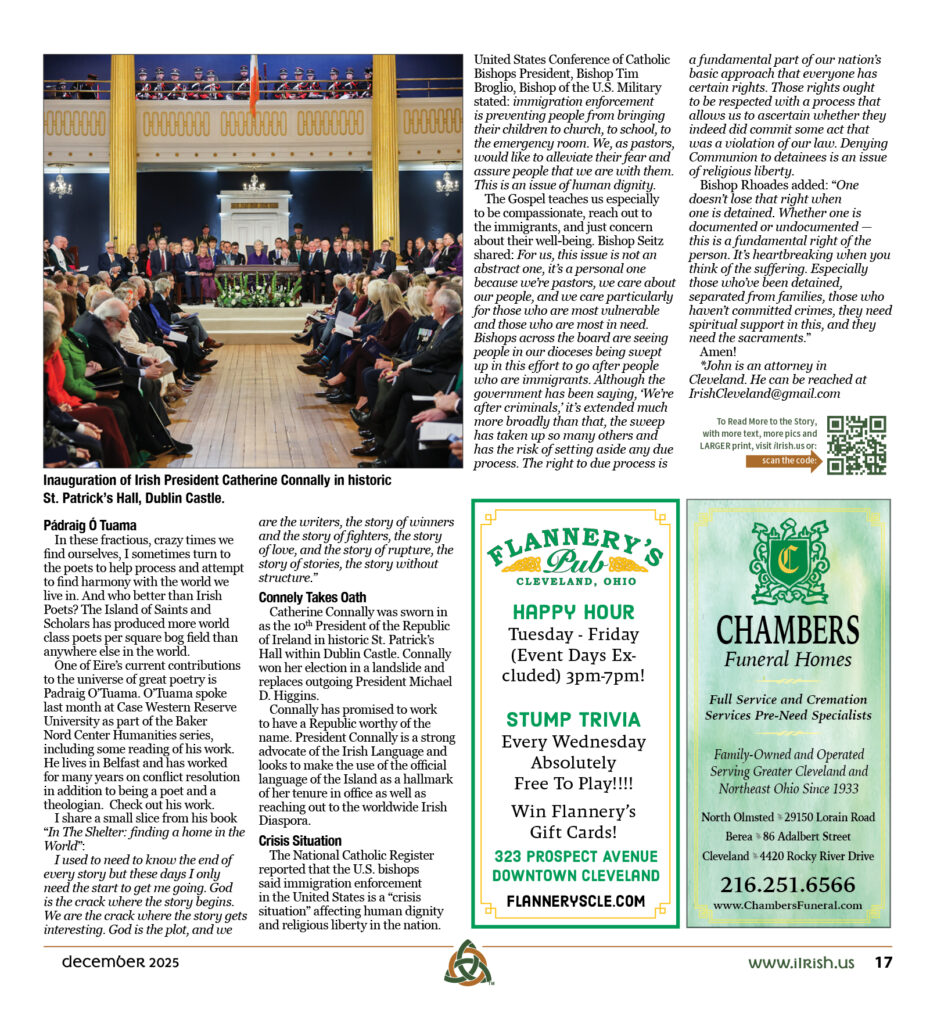
Catherine Connolly was sworn in as the 10th President of the Republic of Ireland in historic St. Patrick’s Hall within Dublin Castle. Connolly won her election in a landslide and replaces outgoing President Michael D. Higgins.
Connolly has promised to work to have a Republic worthy of the name. President Connolly is a strong advocate of the Irish Language and looks to make the use of the official language of the Island as a hallmark of her tenure in office as well as reaching out to the worldwide Irish Diaspora.
Crisis Situation
The National Catholic Register reported that the U.S. bishops said immigration enforcement in the United States is a “crisis situation” affecting human dignity and religious liberty in the nation. United States Conference of Catholic Bishops President, Bishop Tim Broglio, Bishop of the U.S. Military stated: immigration enforcement ispreventing people from bringing their children to church, to school, to the emergency room.We, as pastors, would like to alleviate their fear and assure people that we are with them.This is an issue of human dignity.
The Gospel teaches us especially to be compassionate, reach out to the immigrants, and just concern about their well-being. Bishop Seitz shared: For us, this issue is not an abstract one, it’s a personal one because we’re pastors, we care about our people, and we care particularly for those who are most vulnerable and those who are most in need.Bishops across the boardare seeingpeople in our dioceses being swept up in this effort to go after people who are immigrants. Although the government has been saying, ‘We’re after criminals,’ it’s extended much more broadly than that, the sweep has taken up so many others and has the risk of setting aside any due process. The right to due process is a fundamental part of our nation’s basic approach that everyone has certain rights. Those rights ought to be respected with a process that allows us to ascertain whether they indeed did commit some act that was a violation of our law.Denying Communion to detainees is an issue of religious liberty.
Bishop Rhoades added: “One doesn’t lose that right when one is detained. Whether one is documented or undocumented — this is a fundamental right of the person.It’s heartbreaking when you think of the suffering. Especially those who’ve been detained, separated from families, those who haven’t committed crimes,they need spiritual support in this, and they need the sacraments.”