




By Greg McInerney
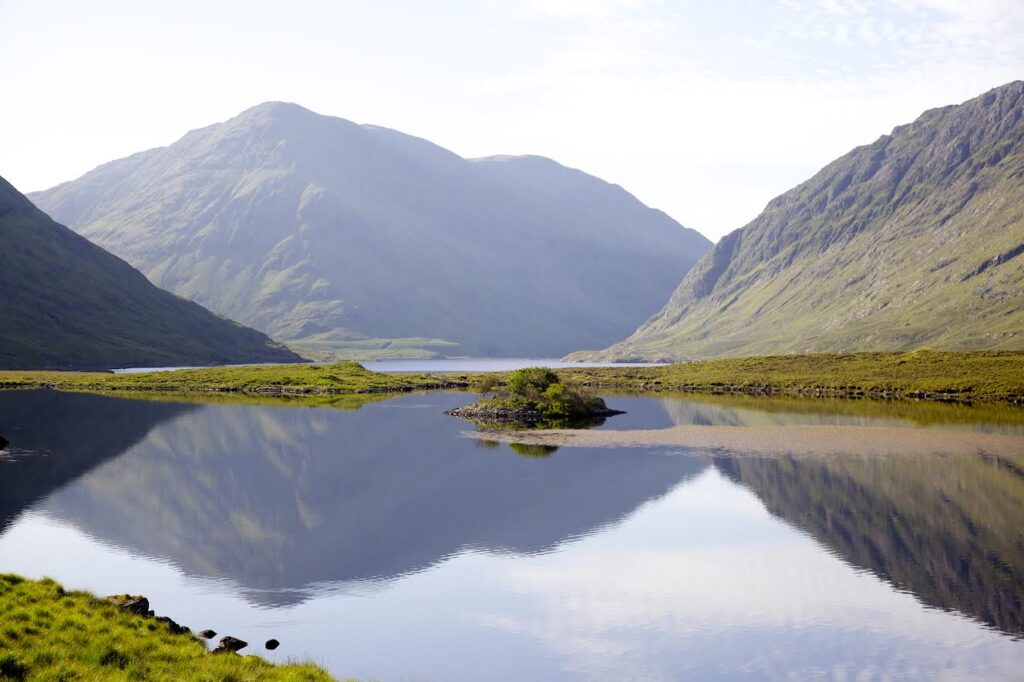
There’s a quiet magic that lingers in the Irish boglands. Mist hangs low over the turf in the early light, and beneath those layers of dark soil, the past sleeps — oak, yew, and pine trees buried for thousands of years, preserved in silence and secrecy. It’s here, in these ancient wetlands, that my craft begins.
I never set out to be a sculptor. For most of my life, I was a teacher — a student and storyteller of history and geography. My classroom overlooked the Bog of Allen in County Kildare, one of Ireland’s great natural archives. I used to tell my students that the bog isn’t dead land, but living memory — a keeper of stories. I suppose, in a way, I’ve been trying to release those stories ever since.
When I left teaching, I returned to a more tactile form of learning — wood, grain, texture, patience. I began to work with bog oak, that jet-black wood born of Ireland’s vanished forests and slow centuries underground. What began as curiosity grew into fascination, and eventually, obsession. Bog oak isn’t easy to work with — it’s dense, unpredictable, and often fractured — but it’s also incredibly rewarding. Each piece has survived millennia of peat, pressure, and time. You don’t so much carve it as negotiate with it.

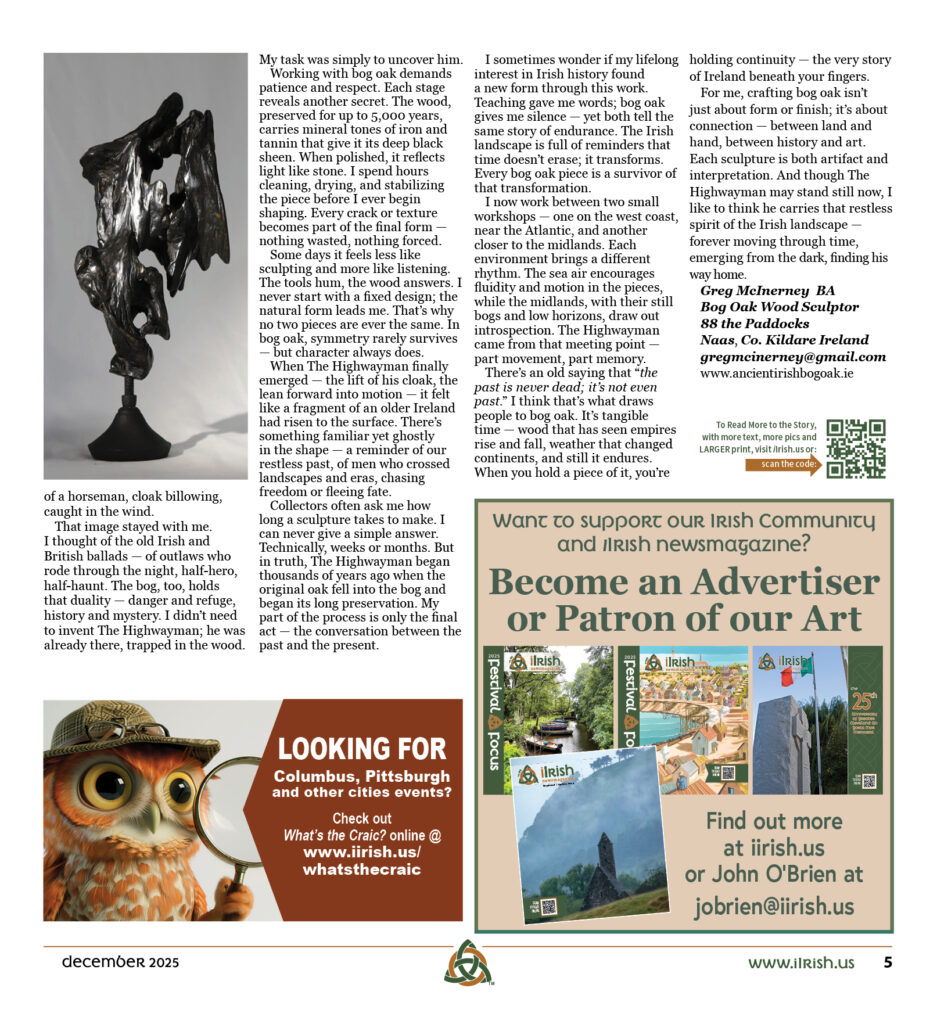
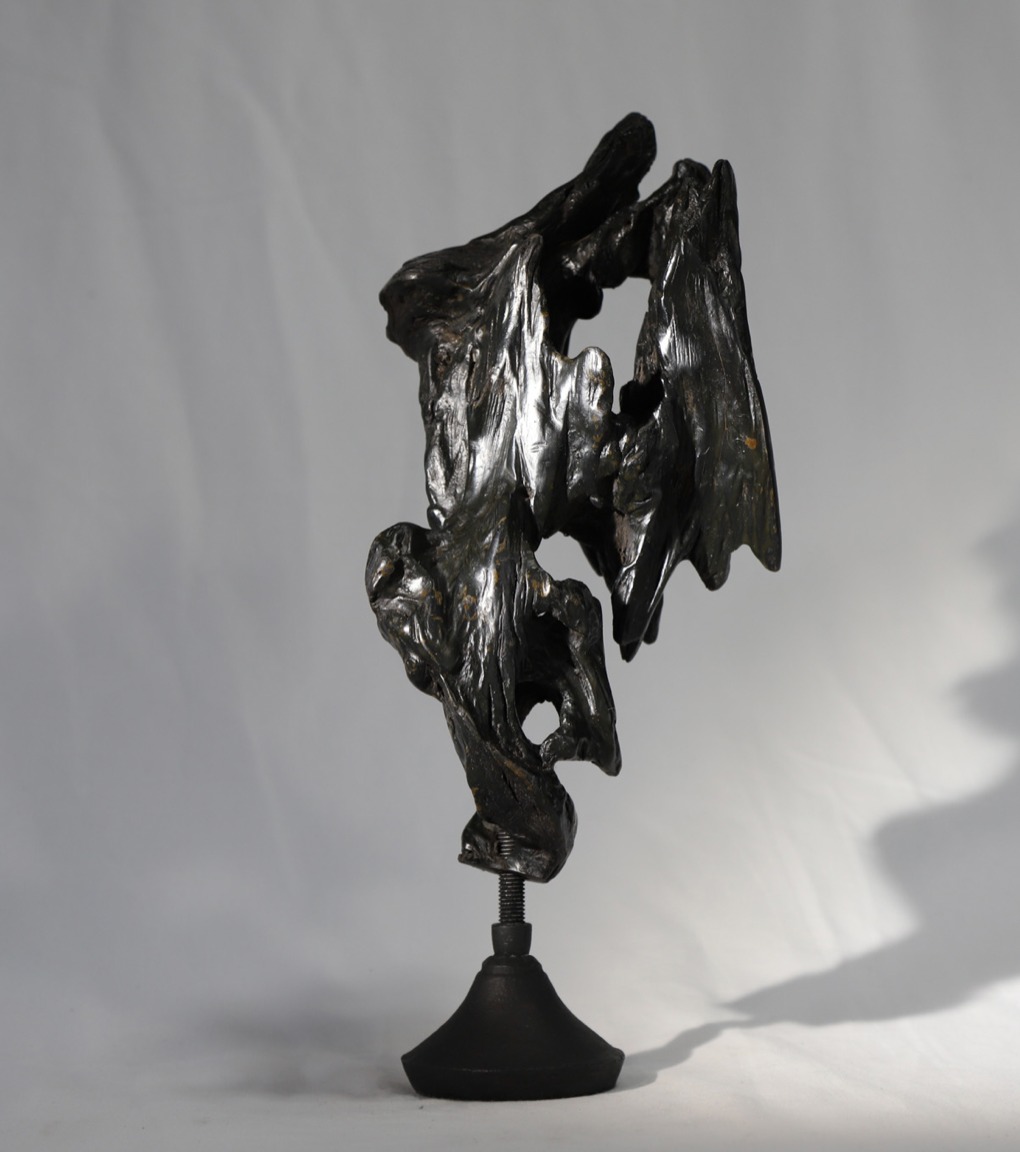
The sculpture you see here — The Highwayman — began as a twisted, half-buried root from the east of Ireland. When I lifted it from the bog, its form was already halfway between ruin and revelation. There was movement in it — a kind of reckless energy — and in my mind I saw the outline of a horseman, cloak billowing, caught in the wind.
That image stayed with me. I thought of the old Irish and British ballads — of outlaws who rode through the night, half-hero, half-haunt. The bog, too, holds that duality — danger and refuge, history and mystery. I didn’t need to invent The Highwayman; he was already there, trapped in the wood. My task was simply to uncover him.
Working with bog oak demands patience and respect. Each stage reveals another secret. The wood, preserved for up to 5,000 years, carries mineral tones of iron and tannin that give it its deep black sheen. When polished, it reflects light like stone. I spend hours cleaning, drying, and stabilizing the piece before I ever begin shaping. Every crack or texture becomes part of the final form — nothing wasted, nothing forced.
Some days it feels less like sculpting and more like listening. The tools hum, the wood answers. I never start with a fixed design; the natural form leads me. That’s why no two pieces are ever the same. In bog oak, symmetry rarely survives — but character always does.
When The Highwayman finally emerged — the lift of his cloak, the lean forward into motion — it felt like a fragment of an older Ireland had risen to the surface. There’s something familiar yet ghostly in the shape — a reminder of our restless past, of men who crossed landscapes and eras, chasing freedom or fleeing fate.
Collectors often ask me how long a sculpture takes to make. I can never give a simple answer. Technically, weeks or months. But in truth, The Highwayman began thousands of years ago when the original oak fell into the bog and began its long preservation. My part of the process is only the final act — the conversation between the past and the present.
I sometimes wonder if my lifelong interest in Irish history found a new form through this work. Teaching gave me words; bog oak gives me silence — yet both tell the same story of endurance. The Irish landscape is full of reminders that time doesn’t erase; it transforms. Every bog oak piece is a survivor of that transformation.
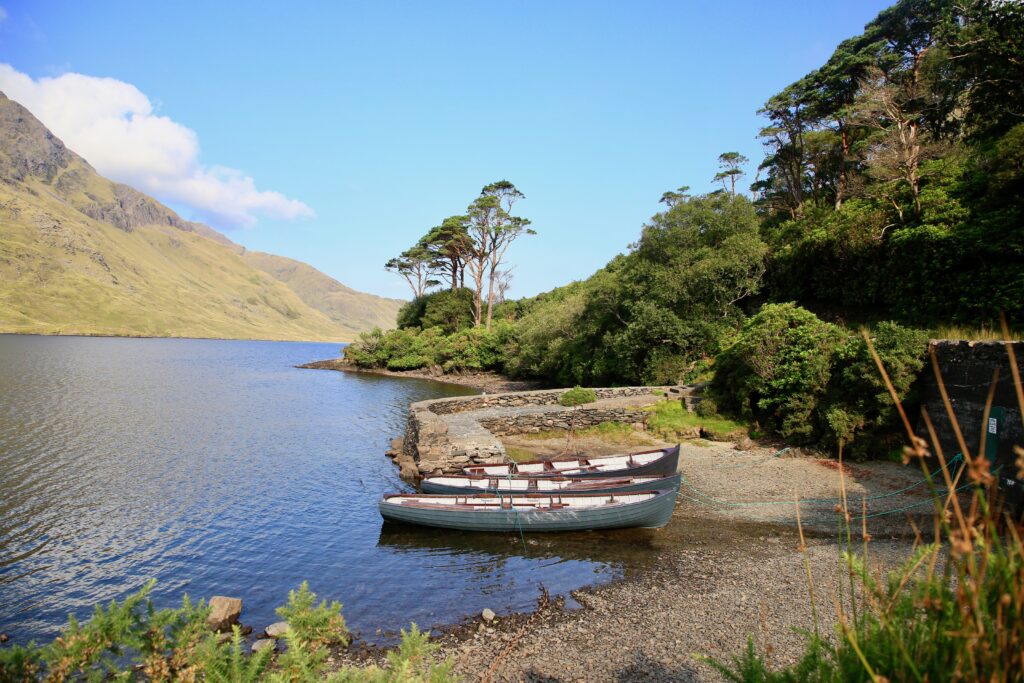
I now work between two small workshops — one on the west coast, near the Atlantic, and another closer to the midlands. Each environment brings a different rhythm. The sea air encourages fluidity and motion in the pieces, while the midlands, with their still bogs and low horizons, draw out introspection. The Highwayman came from that meeting point — part movement, part memory.
There’s an old saying that “the past is never dead; it’s not even past.” I think that’s what draws people to bog oak. It’s tangible time — wood that has seen empires rise and fall, weather that changed continents, and still it endures. When you hold a piece of it, you’re holding continuity — the very story of Ireland beneath your fingers.
For me, crafting bog oak isn’t just about form or finish; it’s about connection — between land and hand, between history and art. Each sculpture is both artifact and interpretation. And though The Highwayman may stand still now, I like to think he carries that restless spirit of the Irish landscape — forever moving through time, emerging from the dark, finding his way home.
Greg McInerney BA
Bog Oak Wood Sculptor
88 the Paddocks
Naas, Co. Kildare Ireland
gregmcinerney@gmail.com
www.ancientirishbogoak.ie