

Frederick Douglass and Daniel O’Connell:
Agitate Agitate Agitate!
On September 29,1845, twenty-seven year old Frederick Douglass met with The Liberator, seventy year old Daniel O’Connell in the city of Dublin. Douglass was born into slavery, but had emancipated himself seven years earlier. Under U.S. law at the time he was considered a fugitive slave.
In August of 1845, Douglass left America before he could be apprehended and returned to a life of slavery. He had just published “The Narrative of the Life of Frederick Douglass”, and travelled first to England and then to Dublin to meet with a Quaker publisher and abolitionist who had offered to publish an Irish edition of the book.
Frederick Douglass
Frederick Douglass gave 1818 as the approximate year of his birth. He said that slaves knew as much about their date of birth as horses did. When he was eight years of age, his owner, Sophie Auld was teaching Frederick how to read and write, until her husband put a stop to it. He felt that a literate man was unfit for slavery.
A couple of years later, young Frederick was sent to work on the docks of Baltimore, learning how to caulk ships. It was there in that urban environment that Frederick saw an opportunity for a life as a free man and began to think about escape.
Almost seven years passed. Douglass and four other slaves their escape plans are discovered before they can be enacted. Frederick used his reading and writing abilities to forge passses that they had hoped to use in escaping Maryland.
One year later Frederick met a free black woman, Anna Murray, in Baltimore, she later became his wife. With her help, he made his escape to the free state of New York.
It was when he reached New York that Frederick changed his name from Frederick Washington Bailey to Frederick Douglass. There he began to attend anti-slavery meetings and met the editor of The Liberator, William Lloyd Garrison.
Garrison persuaded Douglass to use his command of the English language to speak publicly against slavery. Frederick gives his first speech in 1841, at an anti-slavery convention in Massachusetts.
He published his life story and made his status of a fugitive slave public knowledge. Douglass and his now wife, Anna moved to England, where he continues to lecture against slavery.
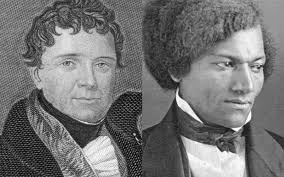
Daniel O’Connell, The Liberator
Daniel O’Connell was born August 6, 1775, in Cahersiveen in Co. Kerry to a wealthy Roman Catholic family. He grew up in Derrynane House and was raised by his uncle, Maurice “Hunting Cap” O’Connell, a landowner, snuggler and justice of the peace.
In 1791, Daniel and his older brother Maurice were sent to France to further their studies. That was a time of social and political unrest in France and the talk of revolution was all about. The brothers were denounced as little aristocrats and labeled as young priests. They decided in 1793 to flee their Benedictine College at Douai and leave France.
They crossed the English Channel with two other brothers, John and Henry Sheares. The Sheares had shown Daniel and Maurice a blood soaked handkerchief. Blood they claimed that was from Louis XVI, who had recently been executed. That experience left Daniel with an aversion to violence and mob rule.
After finishing his studies in London, O’Connell was called to the Irish Bar. Four days later, the United Irishmen launched their unsuccessful rebellion. Daniel had little faith in the United Irishmen and sat out the rebellion in Kerry. In the following years he practiced private law and raised a family.
Politics was calling to him because of his desire to see change. He played a major part in the passage of the Reform Act of 1832 and in the Slavery Abolition Act in 1833, a cause that he campaigned for throughout his life.
O’Connell focused on parliamentry representation and peaceful protest to bring about the changes he felt were right, not only for the Irish people, but all people. He said:” No political change is worth the shedding of a single drop of human blood.” His critics argued that his ability to engage the masses was in itself an intimination of violence.
In 1823 he founded the Catholic Association, an organization designed to gain emancipation for the Irish majority. In 1828, he ran for public office on that platform and scored an overwhelming victory. Fearing yet another uprising, the British granted Catholic Emancipation.
Dublin
When Douglass arrived in Ireland, he had planned on staying in Dublin for a few days. He had recieved such a positive reception however, that he stayed for four months. During his stay he gave almost fifty lectures throughout the country to supportive crowds.
“I live a new life. The warm and generous co-operation extended to me by the friends of my despised race… and the entire absence of everything that looked like prejudice against me, on account of the color of my skin, contrasted so strongly with my long and bitter experience in the United States, that I look with wonder and amazement on the transition.”
Part of Frederick Douglass’ transition was based on Daniel O’Connell’s methods of representation and peaceful protest. Most importantly, Douglass adopted O’Connell’s belief in universal human rights and was an activist for any suffering at the hands of others throughout his remaining life.
Douglass returned to the United States a free man, a group of English and Irish women raised money and completed the legal process to purchase his freedom. He continued to experience prejudice and segragation even after the Civil War, but he continued to be a champion for human rights.
In 1887 he returned to Ireland and announced his support for Irish Nationalists and their struggle for independence. Wherever he was needed, Douglass could be relied on to support those that needed him, drawing on the words of Daniel O’Connell that he heard in Dublin, agitate, agitate, agitate!